On Opinion Dynamics in Heterogeneous Networks
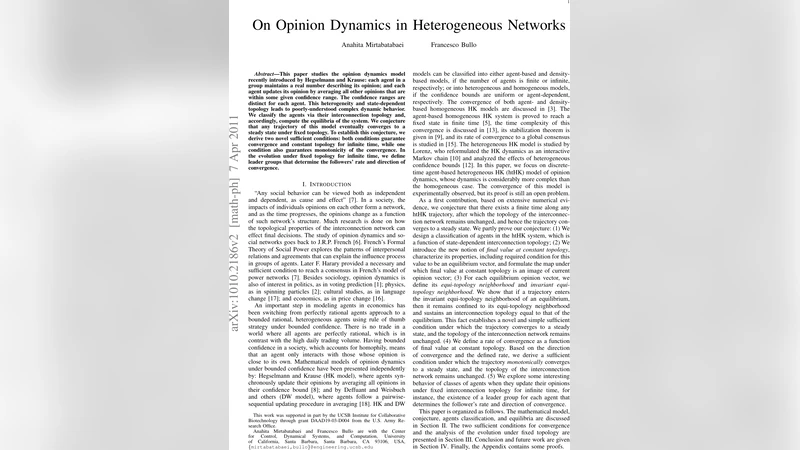
This paper studies the opinion dynamics model recently introduced by Hegselmann and Krause: each agent in a group maintains a real number describing its opinion; and each agent updates its opinion by averaging all other opinions that are within some given confidence range. The confidence ranges are distinct for each agent. This heterogeneity and state-dependent topology leads to poorly-understood complex dynamic behavior. We classify the agents via their interconnection topology and, accordingly, compute the equilibria of the system. We conjecture that any trajectory of this model eventually converges to a steady state under fixed topology. To establish this conjecture, we derive two novel sufficient conditions: both conditions guarantee convergence and constant topology for infinite time, while one condition also guarantees monotonicity of the convergence. In the evolution under fixed topology for infinite time, we define leader groups that determine the followers’ rate and direction of convergence.
💡 Research Summary
The paper investigates a heterogeneous extension of the Hegselmann‑Krause (HK) opinion dynamics model, where each agent i possesses its own confidence bound ε_i. At each discrete time step an agent updates its opinion by averaging the opinions of all agents j whose current opinions lie within ε_i of its own. Because the confidence intervals differ across agents, the interaction graph is directed, state‑dependent, and can change dramatically over time.
The authors first classify agents according to the structure of the interaction graph that emerges from the confidence bounds. Three classes are defined: (1) Leader groups – subsets of agents that are mutually connected and receive no influence from agents outside the group; (2) Follower groups – agents that are only influenced by a leader group and have no internal connections; (3) Isolated agents – agents that have no incoming edges at any time, thus keeping their initial opinion forever. This classification allows the authors to isolate periods during which the topology remains fixed.
For each class the equilibrium (steady‑state) opinions are derived analytically. Leaders converge to the average of their initial opinions, followers converge to a convex combination of the leaders’ equilibrium, and isolated agents remain at their initial values. Consequently, any equilibrium of the whole system is a combination of the leader‑group average and the unchanged opinions of isolated agents.
The central contribution is the proof of two sufficient conditions guaranteeing that, after a finite transient, the interaction topology becomes constant and the state trajectory converges to an equilibrium.
- Condition A requires that every confidence bound be larger than the maximal initial opinion spread. Under this assumption the graph becomes strongly connected in the first step, after which the dynamics reduce to a standard averaging process that is known to converge.
- Condition B assumes that the leaders’ confidence intervals overlap (so the leader subgraph is strongly connected) and that every follower’s confidence interval fully contains the leader interval. This condition not only fixes the topology for all future times but also ensures monotonic convergence of each follower’s opinion toward the leader average.
When the topology is fixed, the authors study convergence speed by examining the Laplacian matrix of the leader subgraph. The second smallest eigenvalue λ₂ (the algebraic connectivity) dictates the exponential rate at which followers approach the leader equilibrium; larger λ₂ yields faster convergence. The leader group therefore acts as a “driver” that determines both the direction and the rate of convergence for the entire network.
Numerical simulations illustrate the theoretical results. Scenarios satisfying Condition A or B display rapid topology fixation and monotone convergence, while violations lead to persistent topology changes, opinion oscillations, or the formation of multiple opinion clusters.
In the discussion, the authors argue that the heterogeneous HK model captures realistic features of social influence, robotic swarms, and distributed sensor networks where agents have different sensing ranges or trust levels. They suggest future work on time‑varying confidence bounds ε_i(t), the impact of external information sources, and extensions to multi‑dimensional opinion spaces. The paper thus provides both a rigorous mathematical framework for heterogeneous opinion dynamics and practical insights for designing stable consensus protocols in non‑uniform networks.
Comments & Academic Discussion
Loading comments...
Leave a Comment