Compact Binaries in Star Clusters I - Black Hole Binaries Inside Globular Clusters
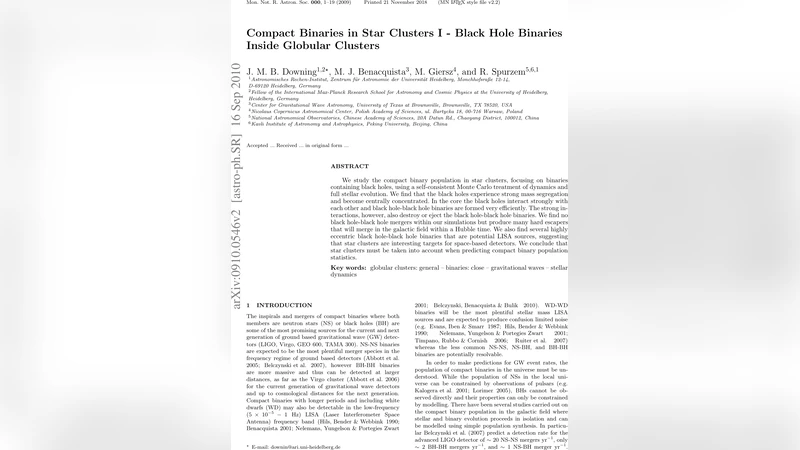
We study the compact binary population in star clusters, focusing on binaries containing black holes, using a self-consistent Monte Carlo treatment of dynamics and full stellar evolution. We find that the black holes experience strong mass segregation and become centrally concentrated. In the core the black holes interact strongly with each other and black hole-black hole binaries are formed very efficiently. The strong interactions, however, also destroy or eject the black hole-black hole binaries. We find no black hole-black hole mergers within our simulations but produce many hard escapers that will merge in the galactic field within a Hubble time. We also find several highly eccentric black hole-black hole binaries that are potential LISA sources, suggesting that star clusters are interesting targets for space-based detectors. We conclude that star clusters must be taken into account when predicting compact binary population statistics.
💡 Research Summary
This paper presents a comprehensive study of black‑hole binary (BHB) formation and evolution within globular clusters, using a self‑consistent Monte‑Carlo framework that couples dynamical interactions with full stellar‑evolution modeling. The authors initialize clusters with realistic masses, radii, binary fractions, metallicities, and an initial mass function that matches observations. By integrating up‑to‑date stellar evolution tracks, they follow the birth of black holes from massive stars, their subsequent mass segregation, and the dynamical processes that dominate the cluster core.
The simulations reveal that massive black holes rapidly sink to the cluster centre due to mass segregation, creating a dense black‑hole subsystem within a few hundred Myr. In this core, three‑body encounters are frequent, leading to efficient formation of black‑hole–black‑hole binaries through exchange interactions. Once formed, these binaries harden via repeated close encounters, increasing their binding energy and reducing their orbital separation. However, the same dynamical environment also drives binary disruption and ejection. Recoil velocities imparted during three‑body interactions often exceed the cluster escape speed, producing a population of “hard escapers” – tightly bound BHBs that are expelled from the cluster.
During the full simulation time (up to a Hubble time), no in‑cluster BHB mergers are observed. Nevertheless, the escaped hard binaries are expected to merge in the galactic field within a Hubble time, contributing significantly to the overall merger rate observed by ground‑based detectors such as LIGO/Virgo. Moreover, a subset of the binaries retains very high eccentricities (e > 0.9). These highly eccentric systems emit gravitational‑wave power at frequencies that fall within the planned LISA band (10⁻⁴–10⁻¹ Hz), making globular clusters promising sources for space‑based detectors.
The authors conclude that globular clusters play a dual role: they are efficient factories for creating black‑hole binaries, yet they also act as a sink that destroys or ejects many of these systems. Ignoring the contribution of clusters when estimating the cosmic BHB merger rate leads to a systematic underestimate, especially for mergers that occur after the binaries have been expelled into the galactic field. The presence of eccentric BHBs also implies that future LISA observations could directly probe the dynamical processes inside dense stellar systems.
Finally, the paper calls for higher‑resolution N‑body simulations and cross‑validation with observational data (e.g., Gaia proper motions, HST photometry) to refine predictions of merger rates, eccentricity distributions, and the relative importance of cluster‑origin versus field‑origin black‑hole binaries. This work underscores the necessity of incorporating star‑cluster dynamics into any comprehensive model of compact‑binary populations and gravitational‑wave event forecasts.
Comments & Academic Discussion
Loading comments...
Leave a Comment