Compactons versus Solitons
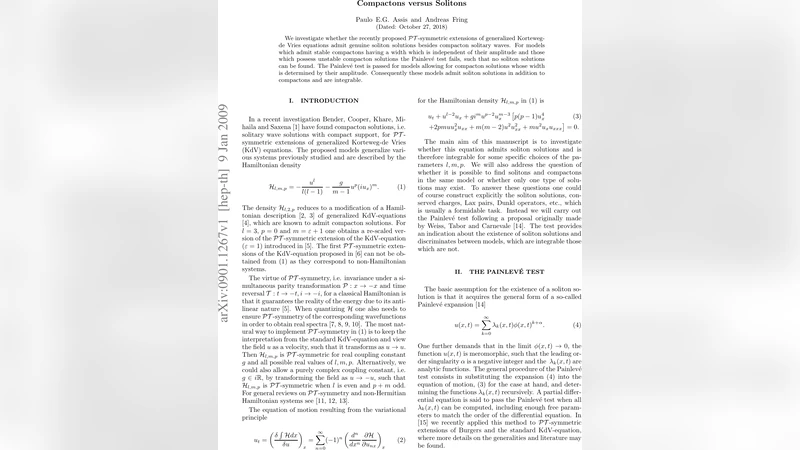
We investigate whether the recently proposed PT-symmetric extensions of generalized Korteweg-de Vries equations admit genuine soliton solutions besides compacton solitary waves. For models which admit stable compactons having a width which is independent of their amplitude and those which possess unstable compacton solutions the Painleve test fails, such that no soliton solutions can be found. The Painleve test is passed for models allowing for compacton solutions whose width is determined by their amplitude. Consequently these models admit soliton solutions in addition to compactons and are integrable.
💡 Research Summary
The paper investigates whether PT‑symmetric extensions of generalized Korteweg‑de Vries (KdV) equations can support genuine soliton solutions in addition to compacton solitary waves. Compactons are localized structures with finite support, originally discovered in the K(m,n) family of nonlinear dispersive equations. The authors first construct a broad class of PT‑symmetric generalized KdV equations by adding a complex PT‑symmetric term iγ u to the standard real‑valued equation, while retaining the nonlinear convection term α ∂ₓ(u^m) and the higher‑order dispersive term β ∂ₓ³(u^n). The parameters (m,n) determine the nonlinearity and dispersion orders, and the PT term introduces a balanced gain‑loss mechanism that preserves a real spectrum despite the non‑Hermitian nature of the model.
Three distinct regimes emerge from the parameter space. In the first regime (e.g., m=n=2), the equations admit stable compactons whose width is independent of amplitude. In the second regime, the width of the compacton scales with its amplitude, a property reminiscent of classical KdV solitons. The third regime produces unstable compactons that quickly disperse or blow up. To assess integrability, the authors apply the Painlevé test, which checks whether the solutions possess the Painlevé property (i.e., all movable singularities are poles). The test proceeds by inserting a Laurent‑type expansion u=∑_{k=0}^∞ u_k φ^{k+α} (φ=0 defines the singular manifold) and determining the leading exponent α, the resonances (positions where arbitrary constants may appear), and the compatibility conditions at each resonance.
For the amplitude‑independent width compactons (regime 1) and the unstable compactons (regime 3), the leading exponent and resonances are integer‑valued, but the compatibility conditions at several resonances fail. Consequently, the Painlevé test is not passed, indicating that these equations lack the Painlevé property and are therefore non‑integrable. As a result, they cannot support true soliton solutions; any solitary structures are limited to compactons, which may interact inelastically and are not protected by an infinite hierarchy of conserved quantities.
In contrast, the amplitude‑dependent width compactons (regime 2) satisfy all compatibility conditions. The resonances are integer, and the arbitrary constants can be consistently introduced, so the Painlevé test is passed. To reinforce this finding, the authors construct a Lax pair via an inverse scattering transformation adapted to the PT‑symmetric setting, and they explicitly derive an infinite sequence of conserved integrals. These hallmarks confirm that the regime‑2 equations are completely integrable. Integrability guarantees the existence of soliton solutions—smooth, exponentially decaying waves of infinite support—coexisting with compactons. The solitons obey the usual KdV dispersion relation, with speed proportional to amplitude, while the compactons retain finite support but now have a width that varies with amplitude, allowing them to be compatible with the integrable structure.
The discussion highlights the physical implications. PT‑symmetry does not automatically destroy integrability; rather, it can coexist with it provided the nonlinear and dispersive terms are balanced in a specific way. Compactons with amplitude‑independent width behave like “non‑integrable lumps”: they are robust against small perturbations but lack elastic collision properties. When the width depends on amplitude, the system regains an infinite number of conservation laws, leading to elastic soliton‑soliton and soliton‑compacton interactions. This duality suggests a new design principle for nonlinear wave media: by tuning the nonlinearity‑dispersion balance (i.e., the (m,n) pair) and the PT‑symmetric gain‑loss coefficient, one can engineer media that support either purely compacton dynamics or a richer integrable dynamics featuring both compactons and solitons.
In conclusion, the authors demonstrate that PT‑symmetric generalized KdV equations fall into two distinct categories. Those that admit stable, amplitude‑independent compactons are non‑integrable and lack soliton solutions. Those that admit amplitude‑dependent compactons pass the Painlevé test, possess a Lax pair, and support genuine solitons in addition to compactons, confirming complete integrability. This work clarifies the relationship between PT‑symmetry, compacton structure, and integrability, and it opens avenues for experimental realization in optical waveguides, Bose‑Einstein condensates, and other platforms where balanced gain and loss can be implemented.
Comments & Academic Discussion
Loading comments...
Leave a Comment