We investigate a tropical analogue of the Hessian group $G_{216}$, the group of linear automorphisms acting on the Hesse pencil. Through the procedure of ultradiscretization, the group law on the Hesse pencil reduces to that on the tropical Hesse pencil. We then show that the dihedral group $\mathcal{D}_3$ of degree three is the group of linear automorphisms acting on the tropical Hesse pencil.
Deep Dive into A tropical analogue of the Hessian group.
We investigate a tropical analogue of the Hessian group $G_{216}$, the group of linear automorphisms acting on the Hesse pencil. Through the procedure of ultradiscretization, the group law on the Hesse pencil reduces to that on the tropical Hesse pencil. We then show that the dihedral group $\mathcal{D}_3$ of degree three is the group of linear automorphisms acting on the tropical Hesse pencil.
The Hessian group G 216 ≃ Γ ⋊ SL(2, F 3 ) is a subgroup of P GL(3, C), the group of linear transformations on the projective plane P 2 (C), where Γ = (Z/3Z) 2 and SL(2, F 3 ) is the special linear group over the finite field F 3 of characteristic three. The Hessian group is generated by the following four linear transformations
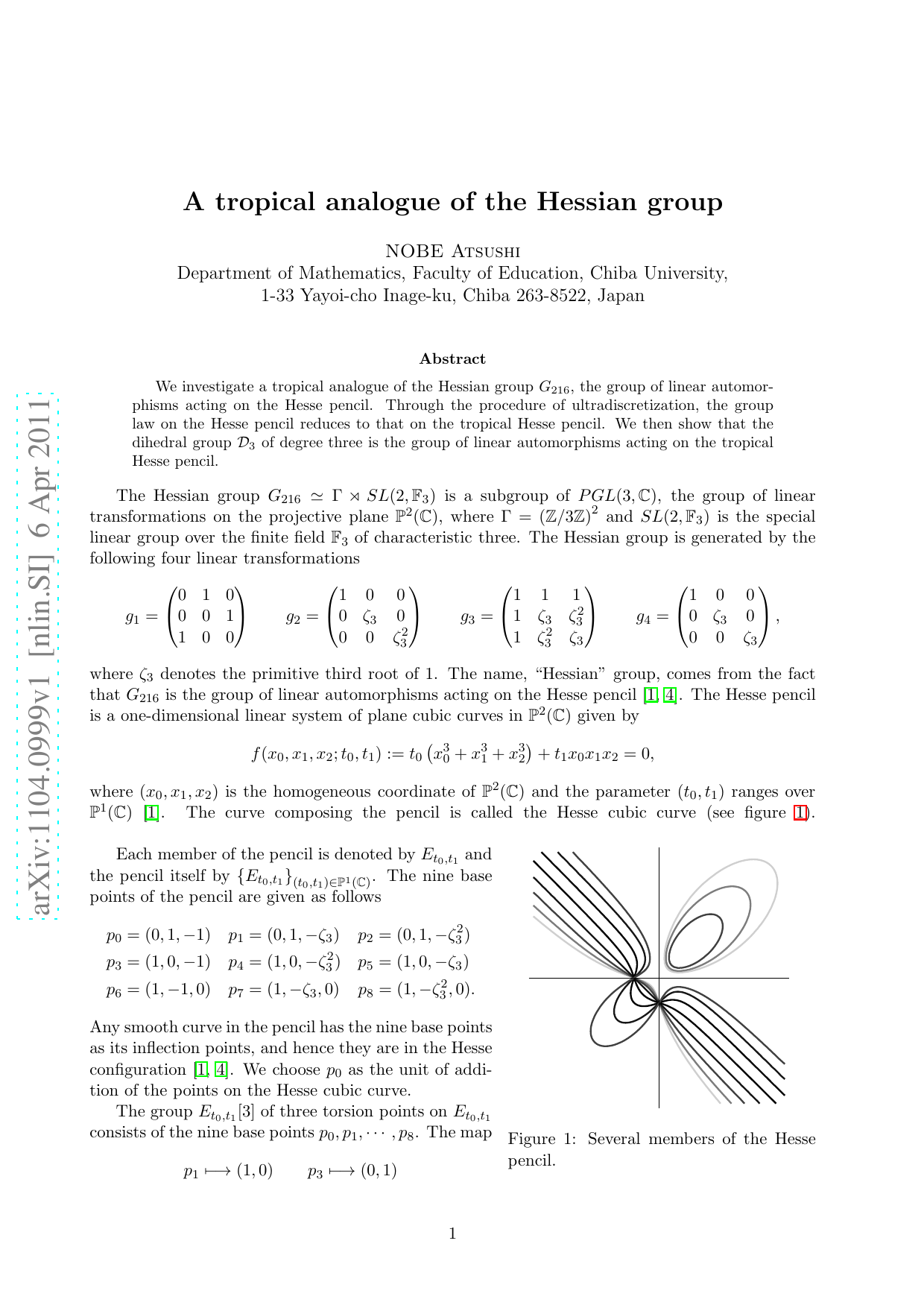
where ζ 3 denotes the primitive third root of 1. The name, “Hessian” group, comes from the fact that G 216 is the group of linear automorphisms acting on the Hesse pencil [1,4]. The Hesse pencil is a one-dimensional linear system of plane cubic curves in P 2 (C) given by f (x 0 , x 1 , x 2 ; t 0 , t 1 ) := t 0 x 3 0 + x 3 1 + x 3 2 + t 1 x 0 x 1 x 2 = 0, where (x 0 , x 1 , x 2 ) is the homogeneous coordinate of P 2 (C) and the parameter (t 0 , t 1 ) ranges over P 1 (C) [1]. The curve composing the pencil is called the Hesse cubic curve (see figure 1).
Figure 1: Several members of the Hesse pencil.
Each member of the pencil is denoted by E t 0 ,t 1 and the pencil itself by {E t 0 ,t 1 } (t 0 ,t 1 )∈P 1 (C) . The nine base points of the pencil are given as follows
Any smooth curve in the pencil has the nine base points as its inflection points, and hence they are in the Hesse configuration [1,4]. We choose p 0 as the unit of addition of the points on the Hesse cubic curve.
The group E t 0 ,t 1 [3] of three torsion points on E t 0 ,t 1 consists of the nine base points p 0 , p 1 , • • • , p 8 . The map
induces the group isomorphism E t 0 ,t 1 [3] ≃ Γ, which is the normal subgroup of G 216 generated by the elements g 1 and g 2 . Therefore, the action of Γ fixes the parameter (t 0 , t 1 ) of the Hesse pencil. Let α : G 216 → P GL(2, C) be a map given by
where g ∈ G 216 and g : (
). Then we have Ker(α) ⊃ Γ = g 1 , g 2 . Actually, Γ is a subgroup of Ker(α) of index two.
On the other hand, α(g 3 ) and α(g 4 ) act effectively on P GL(2, C):
Thus g 3 and g 4 induce the action on the Hesse pencil independent of its additive group structure. We can easily check the following relation
It follows that we have
where T is the tetrahedral group. Thus the group α(G 216 ) acts on P GL(2, C) as the permutations among the following 12 elements
.
The Hesse pencil contains four singular members with multiplicity three corresponding to the following (t 0 , t 1 ) [1] (t 0 , t 1 ) = (0, 1), (1, -3), (1, -3ζ 2
3 ), (1, -3ζ 3 ). Denote these points by s i (i = 1, 2, 3, 4) in order. These s i ’s are permuted by α(G 216 ) as follows
α(g 4 ) :
Thus s i ’s can be corresponded to the vertices of the tetrahedron on which T ≃ α(G 216 ) acts. Moreover, let
Then we have
Therefore, we obtain
where T is the binary tetrahedral group. Since T is isomorphic to SL(2, F 3 ), we obtain the semidirect product decomposition G 216 ≃ Γ ⋊ SL(2, F 3 ). The level-three theta functions θ 0 (z, τ ), θ 1 (z, τ ), and θ 2 (z, τ ) are defined by using the theta function ϑ (a,b) (z, τ ) with characteristics:
where z ∈ C and τ ∈ H := {τ ∈ C | Im τ > 0}. Fixing τ ∈ H, we abbreviate θ k (z, τ ) and θ k (0, τ ) as θ k (z) and θ k for k = 0, 1, 2, respectively. We can easily see that the following holds
This induces an isomorphism from the complex torus C/L τ to the Hesse cubic curve E θ ′ 2 ,6θ ′ 0 . It also induces the additive group structure on E θ ′ 2 ,6θ ′ 0 from C/L τ through the addition formulae for the level-three theta functions [2]; let (x 0 , x 1 , x 2 ) and (
of the points is given as follows
The relation (3) implies that the unit of addition on
By using (4), we see that the actions of g 1 and g 2 on E θ ′ 2 ,6θ ′ 0 can be realized as the additions with p 6 and p 1 , respectively
Take the following representatives z 0k , z k1 , z k2 of the zeros of
Then these nine zeros are mapped into the nine inflection points on .
Let us tropicalize the Hesse pencil. For the defining polynomial f (x 0 , x 1 , x 2 ; t 0 , t 1 ) of the Hesse cubic curve, we apply the procedure of tropicalization. Replacing + and × with max and + respectively, the polynomial f (x 0 , x 1 , x 2 ; t 0 , t 1 ) reduces to f (x 0 , x1 , x2 ; t0 , t1 ) = max t0 + 3x 0 , t0 + 3x 1 , t0 + 3x 2 , t1 + x0 + x1 + x2 .
In order to distinguish tropical variables form original ones, we ornament them with˜.
The curves drawn with solid lines are the regular members and the one with broken line is the singular member of the tropical Hesse pencil.
Let (t 0 , t 1 ) be a point in P 1,trop , the tropical projective line. Then f can be regarded as a function f : P 2,trop → T, where P 2,trop is the tropical projective plane and T := R∪{-∞} is the tropical semi-field. The tropical Hesse curve is the set of points such that the function f is not differentiable. We denote the tropical Hesse curve by C t0 , t1 . Upon introduction of the inhomogeneous coordinate (X := x1 -x0 , Y := x2 -x0 ) ∈ P 2,trop and K := t1 -t0 ∈ P 1,trop the tropical Hesse curve is denoted by C K and is given by the tropical polynomial
Figure 2 shows the tropical Hesse curves. The onedime
…(Full text truncated)…
This content is AI-processed based on ArXiv data.