Video Encryption: A Survey
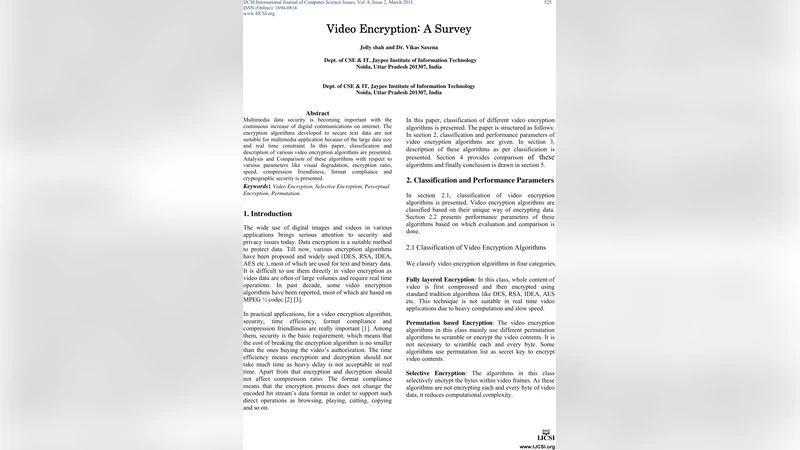
Multimedia data security is becoming important with the continuous increase of digital communications on internet. The encryption algorithms developed to secure text data are not suitable for multimedia application because of the large data size and real time constraint. In this paper, classification and description of various video encryption algorithms are presented. Analysis and Comparison of these algorithms with respect to various parameters like visual degradation, encryption ratio, speed, compression friendliness, format compliance and cryptographic security is presented.
💡 Research Summary
The paper addresses the growing need for protecting multimedia content, especially video, in the era of pervasive digital communication. Traditional cryptographic schemes designed for text—such as block ciphers (AES, DES) and stream ciphers (RC4)—are ill‑suited for video because of the massive data volume and the real‑time constraints of streaming services. To fill this gap, the authors present a comprehensive taxonomy of video encryption techniques and evaluate them against six key performance dimensions: visual degradation, encryption ratio, computational speed, compression friendliness, format compliance, and cryptographic security.
The taxonomy divides existing methods into four principal families. The first family, “full‑frame encryption,” applies conventional ciphers to the entire bitstream. While this approach offers the strongest theoretical security, it incurs prohibitive processing overhead and destroys compression efficiency, making it impractical for live transmission. The second family, “selective encryption,” targets only critical components of standard codecs (e.g., I‑frames, header fields, DCT coefficients). By encrypting a small fraction (typically 5‑30 % of the data), selective schemes dramatically reduce computational load and preserve compression ratios, yet they expose the unencrypted portions to potential information leakage. The third family, “permutation‑oriented (chaos‑based) encryption,” rearranges macro‑blocks, shuffles color channels, or applies chaotic maps to generate visually scrambled frames. These methods are lightweight and fast, but their security hinges on the secrecy of the permutation pattern; once the pattern is discovered, the protection collapses. The fourth family, “hybrid approaches,” combines elements of the previous three—e.g., encrypting headers with a strong block cipher while scrambling the remaining payload with a permutation algorithm—to balance security, speed, and compatibility.
For each algorithmic class, the authors conduct a systematic comparison across the six evaluation criteria. Visual degradation ranges from negligible (selective encryption that leaves most pixels untouched) to severe (permutation‑based schemes that render the video unrecognizable). Encryption ratio distinguishes full‑bitstream methods (≈100 %) from selective and hybrid techniques (often <30 %). Speed analysis shows that permutation and selective methods can meet real‑time requirements (≥30 fps) on modest hardware, whereas full‑frame encryption typically demands high‑end processors or dedicated ASICs. Compression friendliness is a decisive factor: selective encryption integrates seamlessly with existing codecs, preserving entropy coding efficiency, while full‑frame encryption either disables compression or causes a steep bitrate increase. Format compliance assesses whether the encrypted stream remains decodable by standard players; selective and many hybrid schemes retain compliance, whereas full‑frame encryption often breaks it. Finally, cryptographic security evaluates key space, resistance to known‑plaintext attacks, and provable security properties. Conventional ciphers provide well‑established security guarantees, but permutation‑based methods lack rigorous proofs and are vulnerable to statistical attacks; selective encryption inherits the security of the underlying cipher for the protected portions but may be compromised by side‑channel leakage from the unencrypted sections.
The paper then maps these technical findings to practical use‑cases. High‑security domains such as military communications or premium pay‑per‑view services benefit from full‑frame encryption despite its overhead, especially when hardware acceleration is available. Mobile streaming, video conferencing, and low‑bandwidth IoT video feeds favor selective or hybrid schemes that preserve bandwidth and meet latency constraints. Broadcast environments, which must adhere to established standards (e.g., MPEG‑2, H.264), are best served by selective encryption that maintains format compliance.
In the concluding sections, the authors acknowledge current limitations and outline future research directions. They highlight the need for post‑quantum video encryption algorithms, robust key‑management protocols for dynamic streaming sessions, and defenses against emerging machine‑learning‑based attacks that can infer content from partially encrypted streams. Moreover, they call for standardized benchmark suites that evaluate video encryption holistically, incorporating perceptual quality metrics, network performance, and security analyses.
Overall, the survey provides a clear, structured overview of the video encryption landscape, elucidating the trade‑offs among security, efficiency, and compatibility, and offering actionable guidance for selecting appropriate encryption strategies across diverse application scenarios.
Comments & Academic Discussion
Loading comments...
Leave a Comment