Modelisation numerique des processus de transport des sediments et de levolution des fonds
We propose a new mixing length profile, based on an extension of von K'arm'an similarity hypothesis, as well as the associated mixing velocity profile. This profile was compared with other profiles and was tested on three academic and experimental cases. The validation of the model was made from a set of reference examples and concerns the erosion of a bottom of sand in a uniform flow, and the filling of an extraction pit resulting from the tests presented in the European project SANDPIT. – On propose un nouveau profil de longueur de m'elange lm (z), bas'e sur une extension de l’hypoth`ese de similitude de von K'arm'an, ainsi que le profil de vitesse de m'elange associ'e. Ce profil a 'et'e compar'e `a d’autres profils et test'e sur trois cas test acad'emiques et exp'erimentaux. La validation du mod`ele a 'et'e effectu'ee `a partir d’un ensemble d’exemples de r'ef'erences et concernent l’'erosion d’un fond de sable 'erodable dans un 'ecoulement uniforme en canal, et le remplissage d’une fosse d’extraction issus des essais pr'esent'es dans le projet Europ'een SANDPIT.
💡 Research Summary
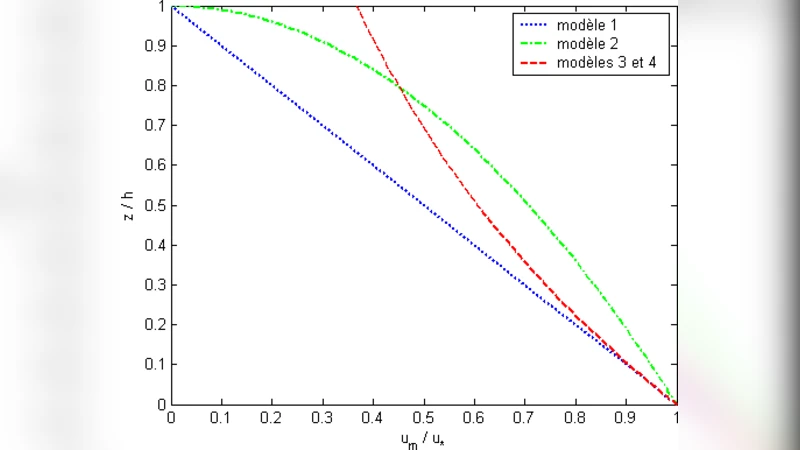
The paper introduces a novel turbulence mixing‑length (lₘ) and mixing‑velocity (uₘ) formulation derived from an extension of von Kármán’s similarity hypothesis. Traditional sediment‑transport models often assume a simple, usually linear or hyperbolic, profile for the mixing length and consequently predict a mixing velocity that does not decay exponentially with depth, contrary to experimental observations. By expressing the mixing length as a general function f(z) multiplied by the von Kármán constant (κ) and depth (z), the authors obtain a mixing velocity uₘ(z) that follows an exponential decay, leading to a turbulent viscosity νₜ(z)=lₘ(z)·uₘ(z) that can reproduce the logarithmic mean‑velocity profile observed in open‑channel flows.
Four existing turbulence‑viscosity models are reviewed: (1) linear lₘ, (2) hyperbolic lₘ, (3) exponential lₘ with logarithmic uₘ, and (4) a hybrid model that combines an exponential decay of uₘ with a modified lₘ incorporating bed roughness (z₀) and a calibration coefficient C₁. The new hybrid model (referred to as Model 4) is the focus of the study.
Numerical implementation relies on a two‑dimensional finite‑element (h‑s) scheme: the horizontal plane is discretised with standard Q4 elements, while the vertical direction uses a spectral expansion of Legendre polynomials, allowing accurate reconstruction of vertical profiles as the number of basis functions increases. Hydrodynamics are solved with an implicit Euler scheme, whereas sediment transport (erosion, deposition, and suspended‑load convection–diffusion) is treated with a Lax‑Wendroff‑Richtmeyer scheme. The model is calibrated and validated against three test cases:
-
Erosion of an initially clean alluvial bed under a uniform flow – The simulation imposes zero concentration at the inlet, a constant concentration Cₐ at the bed, and a zero flux condition at the free surface. Using Model 4 with C₁ = 0.7 yields concentration profiles that match the analytical solution of Hjelmfelt et al. (1970) and the experimental data of Van Rijn (1985) far better than the other models.
-
Diffusion of a concentration pulse in a bidimensional steady flow – An initial strip of concentration C = 1 is introduced at the inlet; the rest of the domain is initially clean. Sensitivity to the vertical turbulent diffusion coefficient εₛ is examined by comparing a constant εₛ, a parabolic εₛ (Model 1/2), and the exponential‑based Model 4. Model 4 reproduces the spreading of iso‑concentration contours and matches measured concentration profiles at several downstream stations (x = 0.5 m, 1 m, 2 m) more accurately than the other formulations.
-
Filling of an extraction pit (SANDPIT project) – Real field data from the European SANDPIT project are used to assess the model’s capability to predict deposition rates and pit‑filling dynamics. Model 4 again outperforms the alternatives, providing a close match to observed sediment accumulation over time.
Across all cases, the hybrid Model 4 demonstrates superior agreement with experimental and field data, confirming that an exponential decay of the mixing velocity, coupled with a properly calibrated mixing length, captures the essential physics of turbulent sediment transport. The study concludes that the proposed formulation offers a physically sound, yet computationally tractable, framework for engineers dealing with erosion, deposition, and suspended‑load transport in rivers, channels, and engineered basins.
Comments & Academic Discussion
Loading comments...
Leave a Comment