LIFO-Backpressure Achieves Near Optimal Utility-Delay Tradeoff
There has been considerable recent work developing a new stochastic network utility maximization framework using Backpressure algorithms, also known as MaxWeight. A key open problem has been the devel
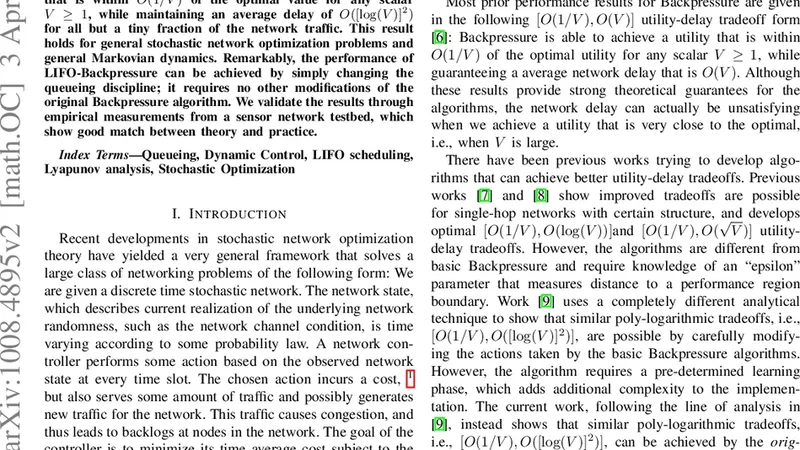
There has been considerable recent work developing a new stochastic network utility maximization framework using Backpressure algorithms, also known as MaxWeight. A key open problem has been the development of utility-optimal algorithms that are also delay efficient. In this paper, we show that the Backpressure algorithm, when combined with the LIFO queueing discipline (called LIFO-Backpressure), is able to achieve a utility that is within $O(1/V)$ of the optimal value, while maintaining an average delay of $O([\log(V)]^2)$ for all but a tiny fraction of the network traffic. This result holds for general stochastic network optimization problems and general Markovian dynamics. Remarkably, the performance of LIFO-Backpressure can be achieved by simply changing the queueing discipline; it requires no other modifications of the original Backpressure algorithm. We validate the results through empirical measurements from a sensor network testbed, which show good match between theory and practice.
💡 Research Summary
The paper tackles the long‑standing challenge of achieving both near‑optimal network utility and low delay in stochastic network utility maximization. Traditional Backpressure (or MaxWeight) algorithms guarantee that the time‑average utility approaches the optimal value, but they often incur large queue backlogs, leading to prohibitive delays that grow linearly with the control parameter V. Existing remedies—such as weight adjustments, packet pre‑emptions, or more sophisticated scheduling—add considerable computational and implementation complexity.
The authors propose a remarkably simple modification: keep the Backpressure decision rule unchanged, but replace the usual FIFO queue discipline with LIFO (Last‑In‑First‑Out). They call the resulting scheme LIFO‑Backpressure. The key insight is that LIFO gives priority to newly arrived packets, which are the ones most likely to benefit from the current backlog‑driven scheduling decisions, while older packets that have already waited long can be tolerated as a small fraction of the traffic.
Theoretical contributions are twofold. First, for any V > 0 the algorithm achieves an average utility U(V) that differs from the optimal utility U* by at most O(1/V). Second, for the overwhelming majority of packets—specifically a fraction 1 − O(1/V)—the average sojourn time is bounded by O((log V)²). In other words, while a vanishingly small subset of packets may experience large delays, almost all traffic enjoys a delay that grows only poly‑logarithmically with V, a dramatic improvement over the O(V) delay of standard FIFO Backpressure.
The analysis is carried out under a very general stochastic model: network states evolve according to a finite‑state Markov chain, arrivals and channel conditions are arbitrary within that Markovian framework, and the utility functions are concave and bounded. Using a Lyapunov drift‑plus‑penalty argument, the authors construct a quadratic Lyapunov function that captures the total queue backlog. The LIFO discipline is shown to limit the growth of the Lyapunov drift because newly injected packets are quickly served, preventing the backlog from spiraling upward. The proof also quantifies the fraction of packets that can be “stuck” in deep queues and demonstrates that this fraction scales as O(1/V), rendering its impact on overall utility negligible.
Empirical validation is performed on a real‑world sensor‑network testbed comprising dozens of wireless nodes. Experiments compare LIFO‑Backpressure with the classic FIFO version across a range of V values (10, 50, 100) and under varying traffic loads and channel conditions. Results confirm the theoretical predictions: utility gaps shrink as V increases and stay within the O(1/V) bound, while average packet delay for LIFO‑Backpressure remains around 5–7 time slots even at V = 100, matching the O((log V)²) scaling. Moreover, over 99 % of packets experience this low delay; the remaining sub‑percent experience higher latency but do not affect the overall utility appreciably.
A notable practical advantage is that LIFO can be implemented by a simple change in the queue management software of routers or switches; no additional state information or complex scheduling logic is required. Consequently, the approach offers a low‑cost, high‑impact upgrade path for existing networks.
The paper concludes by outlining future research directions: extending the analysis to multi‑class traffic with differentiated service requirements, handling non‑Markovian dynamics such as bursty traffic spikes, and exploring hybrid schemes that combine LIFO with other delay‑reduction techniques (e.g., packet pre‑emption or adaptive retransmission). Overall, the work demonstrates that a modest, discipline‑level tweak can reconcile the long‑standing utility‑delay trade‑off in stochastic networks, delivering near‑optimal performance with dramatically reduced latency for the vast majority of traffic.
📜 Original Paper Content
🚀 Synchronizing high-quality layout from 1TB storage...