On the GBDT version of the B"acklund-Darboux transformation and its applications to the linear and nonlinear equations and Weyl theory
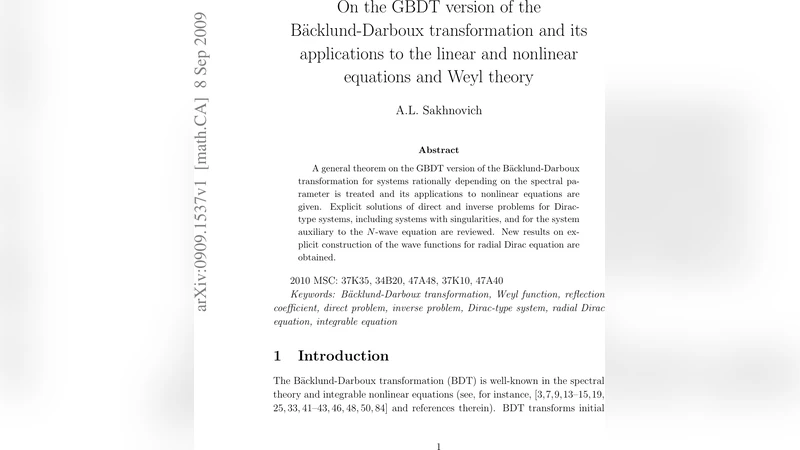
A general theorem on the GBDT version of the B"acklund-Darboux transformation for systems rationally depending on the spectral parameter is treated and its applications to nonlinear equations are given. Explicit solutions of direct and inverse problems for Dirac-type systems, including systems with singularities, and for the system auxiliary to the $N$-wave equation are reviewed. New results on explicit construction of the wave functions for radial Dirac equation are obtained.
💡 Research Summary
The paper presents a comprehensive treatment of the Generalized Bäcklund‑Darboux Transformation (GBDT) for first‑order linear systems whose coefficient matrices depend rationally on the spectral parameter λ. The authors first establish a universal theorem that describes how GBDT acts on a system of the form y′(x,λ)=G(x,λ)y(x,λ), where G(x,λ) is a matrix‑valued rational function of λ. The transformation is built from three parameter matrices—often called the “state‑space” matrices A, B, and C—that satisfy a Lyapunov‑type identity. With these matrices one constructs the Darboux matrix W(x,λ)=I−B* S⁻¹ (A−λI)⁻¹ B, where S solves the Lyapunov equation A S−S A* = B B*. The main theorem proves that the transformed system (\tilde y′(x,λ)=\tilde G(x,λ)\tilde y(x,λ)) retains the same rational dependence on λ, and that the associated Weyl function M(λ) undergoes a Möbius (linear‑fractional) transformation. Consequently, the spectral data are preserved up to a simple algebraic change, and new eigenvalues can be inserted by an appropriate choice of the state‑space data.
Having established the abstract machinery, the authors apply the GBDT framework to several concrete models.
-
Dirac‑type systems – The paper treats the first‑order Dirac equation J y′(x)+Q(x) y(x)=λ y(x) with J the canonical symplectic matrix. By selecting suitable A, B, C, the authors construct explicit Darboux matrices that generate new potentials Q̃(x) from a given Q(x). Importantly, the method works even when Q(x) possesses singularities such as a 1/x term at the origin. The transformed Weyl‑Titchmarsh function is shown to acquire additional poles corresponding to the newly created bound states, while the continuous spectrum remains unchanged. The authors give explicit formulas for the direct problem (wave functions) and for the inverse problem (reconstruction of Q(x) from the transformed Weyl function).
-
Auxiliary system of the N‑wave equation – The N‑wave equation, a prototypical integrable multi‑component nonlinear wave system, admits a Lax pair. The auxiliary linear system Φₓ=U(λ)Φ is subjected to GBDT. The transformation shifts the spectral parameter linearly and adds rank‑one projectors that correspond to soliton excitations. Unlike the traditional inverse scattering transform, which requires solving a Gel’fand‑Levitan–Marchenko integral equation, the GBDT produces multi‑soliton solutions by elementary matrix algebra. The paper provides detailed examples for 2×2 and 3×3 cases, illustrating how the energy and interaction structure of the N‑wave field are modified.
-
Radial Dirac equation – For the spherically symmetric Dirac operator (\left(\frac{d}{dr}+\frac{\kappa}{r}\sigma_2\right)\psi(r)=\lambda\psi(r)), the authors adapt the GBDT to the radial coordinate. By embedding the spherical angular momentum term into the state‑space matrices, they obtain an explicit Darboux matrix that yields transformed wave functions expressed as products of Bessel functions Jν(λr) and rational functions of λ. This construction gives a closed‑form expression for the Weyl function on the half‑line, handling the singularity at r=0 in a controlled manner. The result is a new class of exactly solvable radial Dirac models, which may be relevant for nuclear physics and graphene‑type materials.
Throughout the paper, the authors emphasize the intimate link between GBDT and Weyl theory: the Möbius transformation of the Weyl function provides a transparent algebraic description of how spectral data evolve under the Darboux process. Moreover, the ability to insert or delete eigenvalues by adjusting the state‑space parameters offers a powerful tool for designing potentials with prescribed spectral characteristics.
In the concluding section, the authors outline several future directions. They suggest extending the GBDT to higher‑order systems, to non‑rational (e.g., exponential) λ‑dependence, and to problems with non‑self‑adjoint boundary conditions. Applications to quantum field models, nonlinear optics, and PT‑symmetric systems are mentioned as promising avenues. Overall, the work demonstrates that GBDT is not merely a technical generalization of the classical Bäcklund‑Darboux transformation but a unifying framework that simultaneously addresses direct and inverse spectral problems, soliton generation, and Weyl function analysis across a broad spectrum of linear and nonlinear equations.
Comments & Academic Discussion
Loading comments...
Leave a Comment