Decentralized Online Learning Algorithms for Opportunistic Spectrum Access
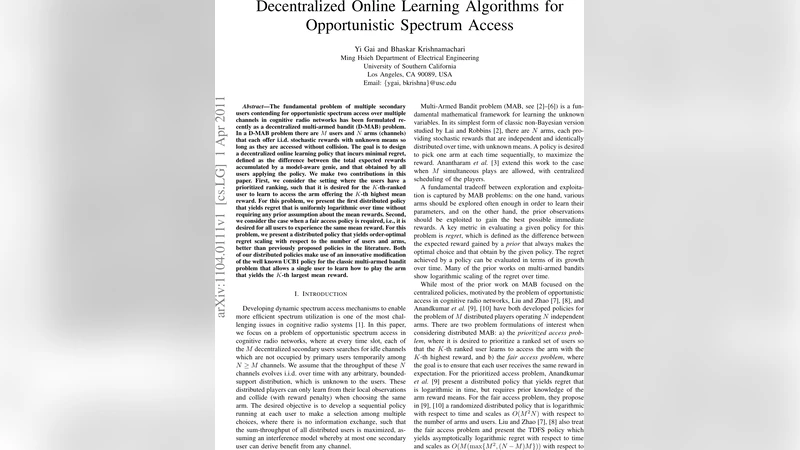
The fundamental problem of multiple secondary users contending for opportunistic spectrum access over multiple channels in cognitive radio networks has been formulated recently as a decentralized multi-armed bandit (D-MAB) problem. In a D-MAB problem there are $M$ users and $N$ arms (channels) that each offer i.i.d. stochastic rewards with unknown means so long as they are accessed without collision. The goal is to design a decentralized online learning policy that incurs minimal regret, defined as the difference between the total expected rewards accumulated by a model-aware genie, and that obtained by all users applying the policy. We make two contributions in this paper. First, we consider the setting where the users have a prioritized ranking, such that it is desired for the $K$-th-ranked user to learn to access the arm offering the $K$-th highest mean reward. For this problem, we present the first distributed policy that yields regret that is uniformly logarithmic over time without requiring any prior assumption about the mean rewards. Second, we consider the case when a fair access policy is required, i.e., it is desired for all users to experience the same mean reward. For this problem, we present a distributed policy that yields order-optimal regret scaling with respect to the number of users and arms, better than previously proposed policies in the literature. Both of our distributed policies make use of an innovative modification of the well known UCB1 policy for the classic multi-armed bandit problem that allows a single user to learn how to play the arm that yields the $K$-th largest mean reward.
💡 Research Summary
The paper addresses opportunistic spectrum access in cognitive radio networks where multiple secondary users (M) compete for N ≥ M channels whose instantaneous throughputs are i.i.d. random variables with unknown means θi. Users operate without any information exchange and experience a collision when more than one selects the same channel. Two collision models are considered: (M1) no user receives reward on a collision, and (M2) exactly one user (the one with the smallest index) receives the reward. The performance metric is regret, defined as the gap between the expected total reward of a genie that always picks the optimal set of channels and the reward obtained by the distributed policy.
The authors focus on two distinct objectives that have been studied in the decentralized multi‑armed bandit (D‑MAB) literature:
- Prioritized access – users are ranked, and the K‑th ranked user should learn to occupy the channel with the K‑th highest mean reward.
- Fair access – all users should obtain the same expected reward in the long run.
Existing work either requires prior knowledge of the arm means (for the prioritized case) or achieves regret that scales poorly with the number of users and channels (e.g., O(M²N) or O(M·max{M²,(N‑M)M}) for the fair case).
The core technical contribution is a novel generalization of the classic UCB1 algorithm, called SL(K) (Selective Learning of the K‑th largest expected reward). SL(K) maintains for each arm i an empirical mean (\hat θ_i) and a confidence term (c_i(t)=s\sqrt{2\ln t / n_i(t)}). At each time step it forms the set (O_K) of the K arms with the largest (\hat θ_i + c_i) values, then selects from (O_K) the arm with the smallest (\hat θ_i - c_i). The algorithm thus drives the selection toward the arm whose true mean is the K‑th largest. The authors prove that, for any sub‑optimal arm i (i.e., i ∉ AK where AK is the set of arms with the K‑th largest mean), the expected number of times it is selected after n rounds is bounded by (\frac{8\ln n}{\Delta_{K,i}^2}+1+\frac{2\pi^2}{3}), where (\Delta_{K,i}=|θ_K-θ_i|). Consequently, the regret of SL(K) grows only logarithmically in time and linearly in the number of arms.
Building on SL(K), two decentralized policies are proposed:
-
DLP (Decentralized Learning for Prioritized access) – user m runs SL(m) independently. Because each user targets a different rank, collisions are naturally avoided in the long run. The policy requires no prior knowledge of the means and achieves a total regret of O(M log n) for both collision models.
-
DLF (Decentralized Learning for Fair access) – the set of N arms is split into two groups: the K arms with the largest empirical means and the remaining N‑K arms. Each user alternates between running SL(K) on the first group and SL(N‑K+1) on the second group, ensuring that over a cycle every user experiences each rank exactly once. The authors prove that DLF’s regret scales as O(M(N‑M) log n). A matching lower‑bound of Ω(M(N‑M) log n) is also shown, establishing order‑optimality.
The regret analysis relies on Chernoff‑Hoeffding concentration bounds and careful counting of events where a sub‑optimal arm’s upper confidence bound exceeds that of a better arm. The proofs handle both collision models, showing that the additional loss due to collisions does not affect the asymptotic order.
Simulation results corroborate the theoretical findings. Across a range of N and M values, DLP and DLF consistently outperform prior algorithms such as TDFS and the randomized policies of Liu & Zhao. The cumulative reward curves approach the genie benchmark, and the regret curves exhibit the predicted logarithmic growth. Notably, DLF’s regret scaling with respect to N and M matches the derived O(M(N‑M)) term, confirming its superiority in dense channel settings.
Limitations are acknowledged: the i.i.d. assumption on channel rewards excludes temporally correlated or non‑stationary environments; perfect time synchronization is implicitly assumed for the slot‑based operation; and the computational burden of maintaining the set O_K grows with K, which may be significant when K≈N/2. Future work could extend the framework to non‑stationary reward processes, dynamic user arrivals/departures, and limited coordination messages to further reduce collisions.
In summary, the paper introduces a powerful selective‑learning primitive (SL(K)) and leverages it to design two fully decentralized policies that achieve logarithmic regret without prior knowledge (prioritized case) and order‑optimal regret O(M(N‑M) log n) for fair access. These results represent a substantial advance in the theory of decentralized multi‑armed bandits and have direct implications for practical spectrum sharing in cognitive radio networks.
Comments & Academic Discussion
Loading comments...
Leave a Comment