What Stops Social Epidemics?
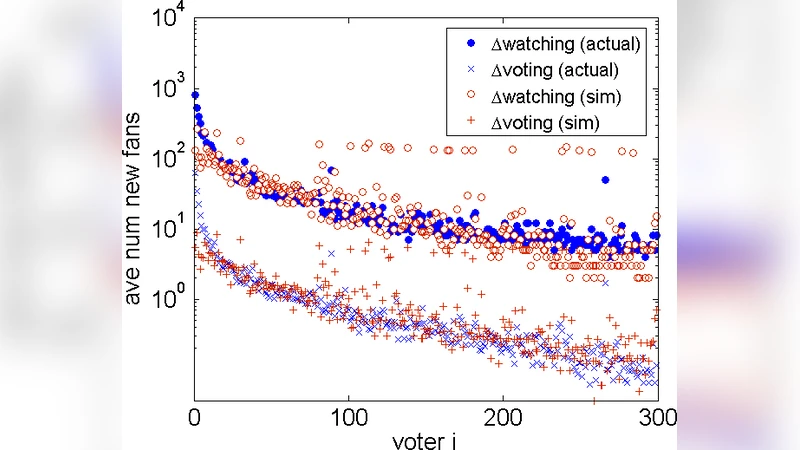
Theoretical progress in understanding the dynamics of spreading processes on graphs suggests the existence of an epidemic threshold below which no epidemics form and above which epidemics spread to a significant fraction of the graph. We have observed information cascades on the social media site Digg that spread fast enough for one initial spreader to infect hundreds of people, yet end up affecting only 0.1% of the entire network. We find that two effects, previously studied in isolation, combine cooperatively to drastically limit the final size of cascades on Digg. First, because of the highly clustered structure of the Digg network, most people who are aware of a story have been exposed to it via multiple friends. This structure lowers the epidemic threshold while moderately slowing the overall growth of cascades. In addition, we find that the mechanism for social contagion on Digg points to a fundamental difference between information spread and other contagion processes: despite multiple opportunities for infection within a social group, people are less likely to become spreaders of information with repeated exposure. The consequences of this mechanism become more pronounced for more clustered graphs. Ultimately, this effect severely curtails the size of social epidemics on Digg.
💡 Research Summary
The paper investigates why information cascades on the social news site Digg, despite sometimes spreading quickly enough for a single seed to reach hundreds of users, rarely affect more than a tiny fraction (≈0.1 %) of the entire user base. Using a dataset of 3,553 front‑page stories collected in June 2009, the authors reconstruct a directed “fan” network of 279,634 active users and 1.73 million follower links. The degree distribution follows a power‑law with exponent ≈2, and while the conventional clustering coefficient is modest (≈0.09), the authors show that in practice 63 % of exposed users receive the story from more than one friend, indicating strong local redundancy.
The authors define the “principal cascade” of each story as the set of voters reachable from the submitter via fan links. The size distribution of these cascades is log‑normal with a mean of about 156 voters; most cascades stay below 500 votes, and only one story (the Michael Jackson death news) reaches a size that could be called epidemic (≈5 % of active users). This empirical observation conflicts with standard epidemic theory, which predicts that once transmissibility exceeds a critical threshold, cascades should involve a sizable fraction of the network.
To resolve the puzzle, the paper examines two interacting effects. First, the highly clustered structure of the Digg graph creates many “multiple‑exposure” situations: a node often sees the same story from several friends. The authors generate a random graph with the same degree sequence (using the directed configuration model) to isolate the impact of clustering. Simulations of the Independent Cascade (IC) model—equivalent to an SIR epidemic with recovery after one transmission attempt—show that the random graph follows heterogeneous mean‑field (HMF) predictions closely, with an epidemic threshold λ_rand ≈ 0.0093. In contrast, the real Digg graph has a lower threshold λ_digg ≈ 0.0059, reflecting that dense clusters allow a story to take off locally. However, clusters also trap the contagion, limiting its spread beyond the community.
Second, the authors discover that repeated exposure does not increase a user’s probability of voting. In the classic IC model, each additional infected neighbor provides an independent infection chance, effectively making the overall infection probability 1 − (1 − λ)ⁿ for n infected neighbors. Empirical Digg data contradict this: users who have already seen the story once are not more likely to vote after seeing it again. To capture this behavior, the authors propose a modified cascade model where a node has a single infection attempt regardless of how many infected neighbors it has. Simulations of this “single‑exposure” model on the real Digg graph reproduce the observed cascade size distribution, whereas the standard IC model overestimates cascade sizes by an order of magnitude.
The interaction of the two effects is crucial. High clustering ensures many users experience multiple exposures, but the single‑exposure contagion rule nullifies the potential amplification that multiple contacts would otherwise provide. Consequently, cascades can ignite quickly within a cluster (lowered threshold) but quickly die out because the contagion cannot leverage redundant contacts to jump to other clusters.
The paper’s contributions are threefold: (1) empirical evidence that Digg cascades are far smaller than standard epidemic models predict; (2) identification of network clustering and a non‑cumulative contagion mechanism as the joint cause of this limitation; (3) a new cascade model that aligns theory with observed data. The findings have broader implications for viral marketing, misinformation spread, and the design of interventions in online platforms: in highly clustered social networks, simply increasing transmissibility may not yield large outbreaks if users exhibit “information fatigue” with repeated exposures. The work underscores the need to consider both structural properties and human behavioral response when modeling information diffusion.
Comments & Academic Discussion
Loading comments...
Leave a Comment