Towards an axiomatic system for Kolmogorov complexity
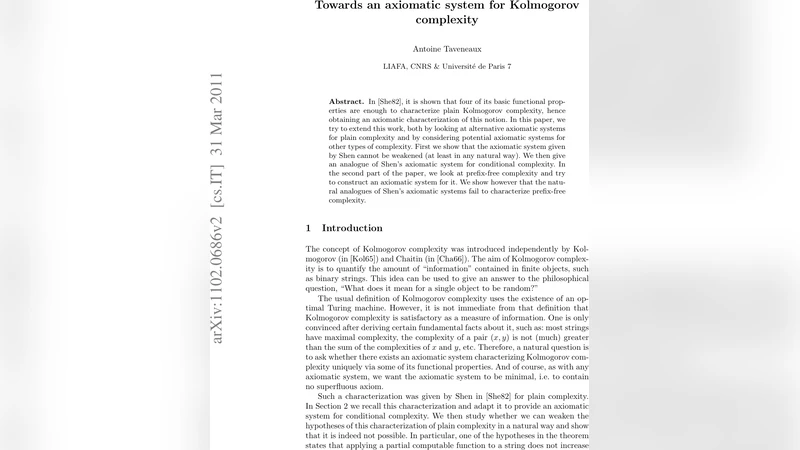
In [She82], it is shown that four basic functional properties are enough to characterize plain Kolmogorov complexity, hence obtaining an axiomatic characterization of this notion. In this paper, we try to extend this work, both by looking at alternative axiomatic systems for plain complexity and by considering potential axiomatic systems for other types of complexity. First we show that the axiomatic system given by Shen cannot be weakened (at least in any natural way). We then give an analogue of Shen’s axiomatic system for conditional complexity. In a the second part of the paper, we look at prefix-free complexity and try to construct an axiomatic system for it. We show however that the natural analogues of Shen’s axiomatic systems fails to characterize prefix-free complexity.
💡 Research Summary
The paper revisits the axiomatic characterization of Kolmogorov complexity originally established by Shen (1982). Shen showed that four elementary functional properties—(i) non‑negativity and integer‑valuedness, (ii) being a partial computable function, (iii) an information‑addition/subtraction law, and (iv) invariance up to an additive constant—are sufficient to uniquely determine plain Kolmogorov complexity K(x). The authors first ask whether any of these axioms can be weakened without losing the characterization. They explore two natural relaxations. The first replaces the additive‑constant bound in the information law with a sub‑linear (e.g., O(log n)) bound. By constructing a function that coincides with K except on carefully chosen intervals where it is shifted by a larger constant, they demonstrate that the relaxed axiom admits functions that differ from K by more than a constant, thereby breaking the uniqueness result. The second relaxation weakens the invariance axiom from a constant to a polynomial‑size difference. Again, a function is built that respects the other three axioms but deviates from K by a polynomial amount, showing that the constant‑additive invariance is essential. Consequently, each of Shen’s four axioms is shown to be independent and indispensable for plain complexity.
Having established the rigidity of Shen’s system, the paper proceeds to formulate an analogous axiomatic framework for conditional Kolmogorov complexity K(x | y). The authors simply add a conditioning parameter to each of the four axioms, yielding: (1) K(x | y) ≥ 0, (2) K(· | y) is a partial computable function for each fixed y, (3) K(x | y) ≤ K(x,z | y) + O(1), and (4) any two valid conditional description methods differ by at most a constant. They prove that these four conditions uniquely characterize K(x | y) and, as with the plain case, any weakening of an axiom leads to counterexamples analogous to those constructed for K. Thus the conditional version inherits the same level of axiomatic tightness.
The second part of the paper tackles prefix‑free (or self‑delimiting) complexity K⁺(x). Since prefix‑free codes impose an extra structural constraint, the authors attempt to translate Shen’s axioms into “prefix‑free analogues”: (i) non‑negativity, (ii) partial computability via a prefix‑free machine, (iii) a similar additive information law, and (iv) invariance up to an additive constant among all prefix‑free description methods. However, they exhibit a function h that satisfies all four proposed axioms yet differs from the true prefix‑free complexity by more than a constant—only by a logarithmic term. This counterexample shows that the naïve adaptation of Shen’s axioms fails to capture K⁺ uniquely. The failure suggests that prefix‑free complexity requires a stronger or qualitatively different invariance condition, perhaps involving precise multiplicative factors or tighter bounds on the additive term.
In summary, the paper confirms that Shen’s four‑axiom system is optimal for both plain and conditional Kolmogorov complexity: none of the axioms can be weakened without losing the characterization, and each axiom is independent. For prefix‑free complexity, however, the same straightforward translation does not work, indicating that a new set of axioms—potentially incorporating more delicate constraints on prefix‑free description methods—is needed. The work thus clarifies the limits of current axiomatic approaches and points to future research directions for establishing a robust axiomatic foundation for prefix‑free Kolmogorov complexity.
Comments & Academic Discussion
Loading comments...
Leave a Comment