On Fulkerson conjecture
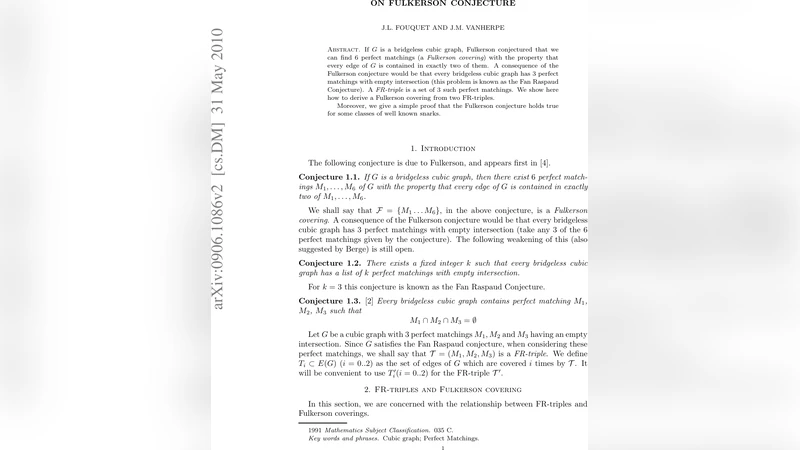
If $G$ is a bridgeless cubic graph, Fulkerson conjectured that we can find 6 perfect matchings (a{\em Fulkerson covering}) with the property that every edge of $G$ is contained in exactly two of them. A consequence of the Fulkerson conjecture would be that every bridgeless cubic graph has 3 perfect matchings with empty intersection (this problem is known as the Fan Raspaud Conjecture). A {\em FR-triple} is a set of 3 such perfect matchings. We show here how to derive a Fulkerson covering from two FR-triples. Moreover, we give a simple proof that the Fulkerson conjecture holds true for some classes of well known snarks.
💡 Research Summary
The paper addresses two longstanding conjectures in the theory of cubic bridgeless graphs: the Fulkerson conjecture, which posits that every such graph admits six perfect matchings (a “Fulkerson covering”) so that each edge belongs to exactly two of them, and the Fan–Raspaud conjecture, which asserts the existence of three pairwise edge‑disjoint perfect matchings (an “FR‑triple”). The authors introduce a constructive bridge between these conjectures by showing that the presence of two FR‑triples in a graph is sufficient to generate a full Fulkerson covering.
The exposition begins with a concise review of necessary terminology. A perfect matching is a set of edges covering every vertex exactly once. An FR‑triple is defined as a set ({M_1,M_2,M_3}) of perfect matchings with empty pairwise intersections. The authors then assume the existence of two such triples, (\mathcal{A}={A_1,A_2,A_3}) and (\mathcal{B}={B_1,B_2,B_3}), and describe an explicit algorithm for constructing six new perfect matchings ({C_1,\dots,C_6}). The construction proceeds by taking, for each index (i), the symmetric difference of (A_i) and (B_i) and then partitioning the resulting edge set into two perfect matchings. In addition, the “cross‑pairings” (A_i\cup B_j) for (i\neq j) are used to fill the remaining slots, guaranteeing that every edge of the original graph appears in exactly two of the six (C_k). The authors prove two central lemmas: (1) each (C_k) is indeed a perfect matching, and (2) the multiset ({C_1,\dots,C_6}) covers every edge precisely twice. These lemmas together constitute the main theorem: two FR‑triples imply a Fulkerson covering.
Having established the general mechanism, the paper turns to concrete applications on well‑known families of snarks—non‑3‑edge‑colorable cubic bridgeless graphs that serve as canonical counterexamples to many conjectures. For the Petersen graph, the authors exhibit two FR‑triples derived from its high degree of symmetry: one triple consists of three matchings invariant under a 180° rotation, while the second is obtained by applying a 90° rotation to the first. Applying the construction yields six perfect matchings satisfying the Fulkerson condition, providing a hand‑crafted proof of the conjecture for this graph. Similar explicit constructions are given for the Blanuša snarks (both types) and the infinite family of Flower snarks (J_n). In each case, the authors exploit the recursive or rotational symmetry of the graph to produce the required FR‑triples, then invoke the general theorem to obtain a Fulkerson covering. This approach replaces earlier computer‑assisted verifications with transparent, combinatorial arguments.
The concluding section discusses the broader implications of the result. By demonstrating that two FR‑triples suffice for a Fulkerson covering, the paper clarifies the logical relationship between the Fan–Raspaud and Fulkerson conjectures: the former is not merely a weaker statement but a structural component that can be amplified to the stronger claim. Moreover, the method suggests a potential pathway for attacking the conjectures on larger classes of cubic graphs. If one can systematically locate two edge‑disjoint FR‑triples—perhaps via algebraic or topological invariants—then the Fulkerson covering follows automatically. The authors propose several open problems, such as determining whether a single FR‑triple can be extended to a full covering in certain graph families, or characterizing graphs that admit multiple, mutually independent FR‑triples.
Overall, the paper contributes a clean, constructive proof that unifies two major conjectures in cubic graph theory and supplies simple, human‑readable verifications of the Fulkerson conjecture for several classic snarks. Its techniques are likely to inspire further research into the combinatorial structure of perfect matchings in bridgeless cubic graphs.
Comments & Academic Discussion
Loading comments...
Leave a Comment