Monads and extensive quantities
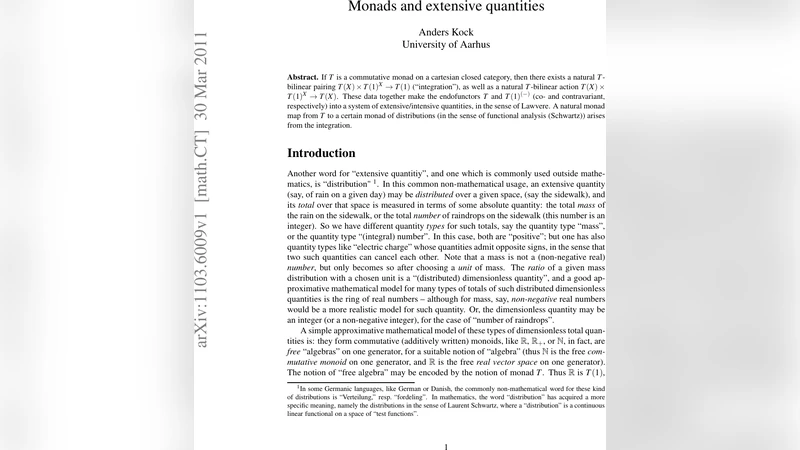
If T is a commutative monad on a cartesian closed category, then there exists a natural T-bilinear pairing from T(X) times the space of T(1)-valued functions on X (“integration”), as well as a natural T-bilinear action on T(X) by the space of these functions. These data together make the endofunctors T and “functions into T(1)” into a system of extensive/intensive quantities, in the sense of Lawvere. A natural monad map from T to a certain monad of distributions (in the sense of functional analysis (Schwartz)) arises from this integration.
💡 Research Summary
The paper “Monads and Extensive Quantities” develops a categorical framework that unifies the notion of extensive (covariant) quantities with intensive (contravariant) quantities, using the language of strong, commutative monads on a cartesian closed category E. The central object is a strong monad T: E → E, assumed to be commutative in the sense that the two monoidal structures ψ and ˜ψ induced by its tensorial strength coincide. The author shows that from this data one can construct a natural T‑bilinear “integration” pairing
R_{X,B}: T(X) × (X⇒B) → B
where B is any T‑algebra with structure map β: T(B)→B, and (X⇒B) denotes the internal hom (the space of B‑valued functions on X). In elementwise notation the pairing is written
∫_X φ(x) dP(x) := β(T(φ)(P)).
When B = T(1) (the “scalar” object of the monad) and β is the canonical algebra structure, this reduces to the usual total of a distribution. The pairing is T‑bilinear, i.e. linear in each argument with respect to the monad‑induced addition and scalar multiplication, and it satisfies the expected unit and associativity laws inherited from the strength of T.
The paper begins by recalling the three equivalent ways of encoding the strength of a strong endofunctor: the tensorial strength t′{X,Y}: T(X)×Y→T(X×Y), the cotensorial strength λ{X,Y}: T(X⇒Y)→X⇒T(Y), and the enriched strength st_{X,Y}: X⇒Y→T(X)⇒T(Y). Explicit elementwise descriptions are given, and a series of commutative diagrams (e.g., (6), (7), (8)) relate these structures. The author emphasizes that the tensorial strength is the primary tool; derived combinators such as t_{X,Y,Z}: X×T(Y)×Z→T(X×Y×Z) are built from it.
A key technical result (Theorem 2.1 in the author’s earlier work) states that the underlying functor of a strong monad carries two canonical monoidal structures ψ and ˜ψ, and that the unit η: Id⇒T is monoidal with respect to both. When ψ = ˜ψ (commutativity), the multiplication μ: T²⇒T becomes a monoidal natural transformation, making T a monoid monad. The paper shows how ψ_{X,Y} can be interpreted as the tensor product of two compactly supported distributions, aligning with Schwartz’s theory of distributions.
Having set up the integration pairing, the author introduces a natural transformation τ: T⇒S, where S is a “distribution monad” of Schwartz type (essentially the double‑dual construction S(X)=Hom(T(X⇒ℝ),ℝ) when ℝ is the scalar object). τ is required to be strong, meaning that the squares involving the tensorial strengths of T and S commute (equation (12)). Under this condition τ preserves the integration pairing and transports T‑bilinear structure to S‑bilinear structure. Consequently, T embeds into the classical distribution monad S, providing a categorical bridge between abstract monadic “extensive quantities” and concrete functional‑analytic distributions.
The paper then connects these constructions to Lawvere’s theory of extensive and intensive quantities. In Lawvere’s viewpoint, extensive quantities are covariant functors (here T) while intensive quantities are contravariant (here the internal hom X⇒T(1)). The integration pairing R and the action
T(X) × (X⇒T(1)) → T(X)
realize the interaction between the two sides: integrating a function against a distribution yields a scalar, while acting with a function on a distribution yields a new distribution (push‑forward or multiplication). This duality mirrors the classical relationship between measures and measurable functions.
Throughout the paper, concrete examples are mentioned: the free commutative monoid monad (modeling natural‑number valued quantities), the free real vector space monad (modeling real‑valued quantities), and more sophisticated settings such as the topos of convenient vector spaces or synthetic differential geometry, where the scalar object ℝ lives inside the ambient category. In these contexts the monad’s strength respects the underlying topology or smooth structure, ensuring that the integration pairing coincides with familiar integrals (e.g., Lebesgue or smooth integration).
In summary, the paper achieves three major contributions:
- Construction of a canonical T‑bilinear integration pairing for any commutative strong monad, together with a natural action of functions on distributions.
- Identification of a strong monad morphism τ from T into a Schwartz‑type distribution monad, thereby embedding the abstract monadic framework into classical distribution theory.
- Realization of Lawvere’s extensive/intensive quantity system within the monadic setting, providing a unified categorical semantics for quantities that are “distributed” over spaces and the functions that probe them.
These results not only clarify the categorical underpinnings of distribution theory but also suggest a pathway for extending analytical concepts (such as integration, expectation, and convolution) to any setting where a suitable commutative strong monad exists, including synthetic differential geometry, probabilistic programming semantics, and algebraic topology.
Comments & Academic Discussion
Loading comments...
Leave a Comment