On the second cohomology group of a simplicial group
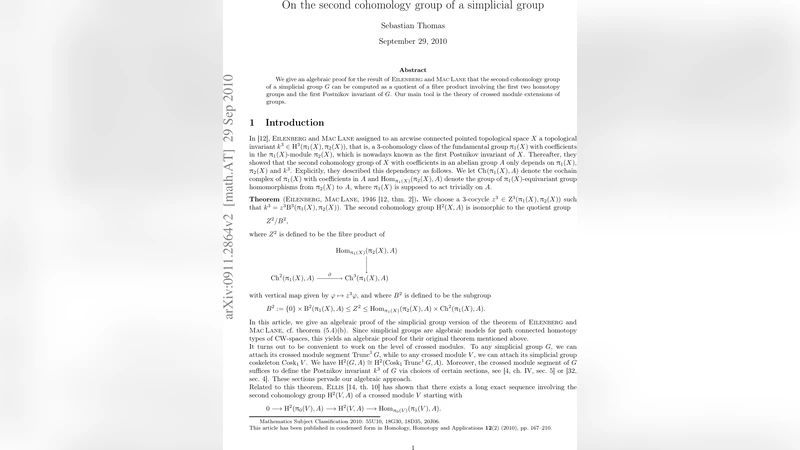
We give an algebraic proof for the result of Eilenberg and Mac Lane that the second cohomology group of a simplicial group G can be computed as a quotient of a fibre product involving the first two homotopy groups and the first Postnikov invariant of G. Our main tool is the theory of crossed module extensions of groups.
💡 Research Summary
The paper revisits a classical result of Eilenberg and Mac Lane stating that the second cohomology group of a simplicial group (G) can be expressed as a quotient of a fibre product built from the first two homotopy groups (\pi_{1}(G)), (\pi_{2}(G)) and the first Postnikov invariant (k\in H^{3}(\pi_{1},\pi_{2})). Rather than relying on the traditional topological argument involving classifying spaces and spectral sequences, the author provides a completely algebraic proof using the theory of crossed‑module extensions of groups.
The exposition begins with a concise review of simplicial groups, their homotopy groups, and the associated crossed‑module (\partial!:\pi_{2}\to\pi_{1}). This crossed‑module encapsulates the 2‑type of (G) and serves as the algebraic backbone for the subsequent analysis. The author then recalls the classification of crossed‑module extensions: given a (\pi_{1})‑module (\pi_{2}), central extensions \
Comments & Academic Discussion
Loading comments...
Leave a Comment