Repeated Matching Pennies with Limited Randomness
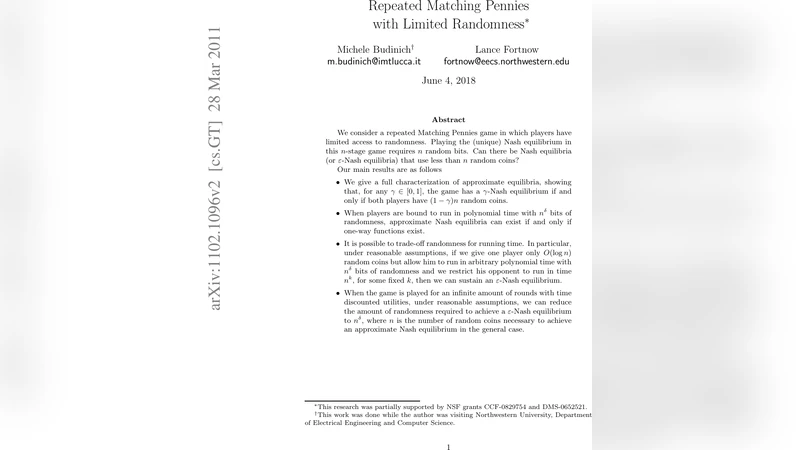
We consider a repeated Matching Pennies game in which players have limited access to randomness. Playing the (unique) Nash equilibrium in this n-stage game requires n random bits. Can there be Nash equilibria that use less than n random coins? Our main results are as follows: We give a full characterization of approximate equilibria, showing that, for any e in [0, 1], the game has a e-Nash equilibrium if and only if both players have (1 - e)n random coins. When players are bound to run in polynomial time, Nash equilibria can exist if and only if one-way functions exist. It is possible to trade-off randomness for running time. In particular, under reasonable assumptions, if we give one player only O(log n) random coins but allow him to run in arbitrary polynomial time and we restrict his opponent to run in time n^k, for some fixed k, then we can sustain an Nash equilibrium. When the game is played for an infinite amount of rounds with time discounted utilities, under reasonable assumptions, we can reduce the amount of randomness required to achieve a e-Nash equilibrium to n, where n is the number of random coins necessary to achieve an approximate Nash equilibrium in the general case.
💡 Research Summary
The paper investigates the role of limited randomness in the classic two‑player zero‑sum game of Matching Pennies when it is repeated for n stages. In the unrestricted setting the unique Nash equilibrium requires each player to flip an independent fair coin in every round, i.e., n random bits. The central question is whether approximate equilibria can be achieved with fewer random bits. The authors provide a complete characterization.
First, using an information‑theoretic argument (Lemma 3.1) they show that if a player has only n·(1‑γ) random bits, the opponent can adopt an exponential‑time “majority‑over‑consistent‑strategies’’ algorithm that guarantees an average payoff of at least γ. Consequently, any ε‑Nash equilibrium must give each player at least (1‑ε)·n random bits; otherwise the opponent can improve by more than ε. Corollary 3.2 extends this to both players simultaneously, proving that no Nash equilibrium exists when the total shortfall of randomness is positive.
Next, the paper introduces computational constraints. When strategies must be computed in polynomial time, the existence of ε‑Nash equilibria with only n^δ random bits (for any constant δ > 0) is shown to be equivalent to the existence of one‑way functions (OWFs). If OWFs exist, a short seed can be expanded by a polynomial‑time pseudorandom generator (PRNG) that is indistinguishable from uniform to any polynomial‑size circuit. Each player can therefore simulate the full‑random equilibrium using only n·(1‑ε) true bits, while the opponent cannot exploit the pseudorandomness beyond ε. Conversely, if OWFs do not exist, no polynomial‑time algorithm can generate sufficiently good pseudorandomness, and ε‑equilibria with sublinear randomness are impossible.
The authors then explore a trade‑off between randomness and running time. If one player is allowed arbitrary polynomial time (unbounded by a specific polynomial) but only O(log n) random bits, while the other player is restricted to time n^k for some fixed k, an ε‑Nash equilibrium still exists. The idea is that the limited‑randomness player can run a complexity‑theoretic PRNG whose seed is too short for the time‑bounded opponent to recover, preserving approximate equilibrium.
Finally, the analysis is extended to an infinitely repeated game with discounted utilities. By discounting future payoffs with factor δ ∈ (0,1), the authors show that for sufficiently large n the same equilibrium can be sustained with only n random bits, and if strategies are limited to polynomial‑size circuits the seed length can be reduced to n^ε for any ε > 0. This demonstrates that even in the long‑run, randomness requirements can be dramatically lowered under reasonable computational assumptions.
Overall, the paper tightly links three resources—randomness, computational time, and cryptographic hardness—to the existence of (approximate) Nash equilibria in repeated zero‑sum games. It provides both impossibility results (information‑theoretic lower bounds) and possibility results (cryptographic constructions), and it clarifies how randomness can be traded for computational effort or discounted future value. The work bridges game theory, complexity theory, and cryptography, offering a nuanced view of bounded rationality in strategic interactions.
Comments & Academic Discussion
Loading comments...
Leave a Comment