A new Jeans resolution criterion for (M)HD simulations of self-gravitating gas: Application to magnetic field amplification by gravity-driven turbulence
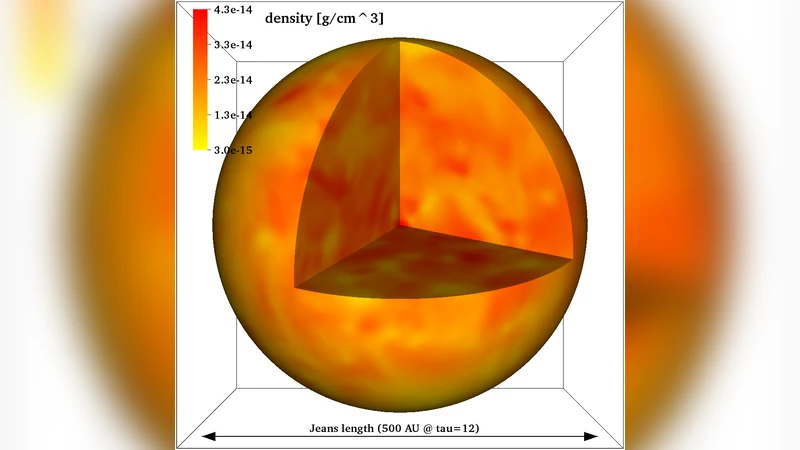
Cosmic structure formation is characterized by the complex interplay between gravity, turbulence, and magnetic fields. The processes by which gravitational energy is converted into turbulent and magnetic energies, however, remain poorly understood. Here, we show with high-resolution, adaptive-mesh simulations that MHD turbulence is efficiently driven by extracting energy from the gravitational potential during the collapse of a dense gas cloud. Compressible motions generated during the contraction are converted into solenoidal, turbulent motions, leading to a natural energy ratio of E_sol/E_tot of approximately 2/3. We find that the energy injection scale of gravity-driven turbulence is close to the local Jeans scale. If small seeds of the magnetic field are present, they are amplified exponentially fast via the small-scale dynamo process. The magnetic field grows most efficiently on the smallest scales, for which the stretching, twisting, and folding of field lines, and the turbulent vortices are sufficiently resolved. We find that this scale corresponds to about 30 grid cells in the simulations. We thus suggest a new minimum resolution criterion of 30 cells per Jeans length in (magneto)hydrodynamical simulations of self-gravitating gas, in order to resolve turbulence on the Jeans scale, and to capture minimum dynamo amplification of the magnetic field. Due to numerical diffusion, however, any existing simulation today can at best provide lower limits on the physical growth rates. We conclude that a small, initial magnetic field can grow to dynamically important strength on time scales significantly shorter than the free-fall time of the cloud.
💡 Research Summary
The authors investigate how gravitational collapse of a dense gas cloud can simultaneously drive turbulence and amplify magnetic fields through a small‑scale dynamo. Using the adaptive‑mesh refinement (AMR) code FLASH 2.5 with the HLL3R MHD solver, they set up an almost isothermal (γ≈1.1) Bonnor‑Ebert sphere of 1500 M⊙, radius 1.5 pc, temperature 300 K, and a weak random magnetic seed of 1 nG (β≈10¹⁰). An initial trans‑sonic turbulent velocity field (σ≈1.1 km s⁻¹) with a k⁻² power spectrum peaks at ~0.8 pc, roughly the initial Jeans length.
A suite of five simulations resolves the Jeans length λ_J with 8, 16, 32, 64, and 128 grid cells, respectively. The study focuses on three intertwined questions: (i) the scale at which magnetic energy grows during collapse, (ii) the effective kinetic energy injection scale of gravity‑driven turbulence, and (iii) the conversion of compressive motions into solenoidal (rotational) turbulence and the resulting solenoidal fraction.
Key findings:
-
Energy conversion – During collapse roughly two‑thirds of the released gravitational energy is transferred into solenoidal motions, i.e., E_sol/E_tot≈2/3. This ratio quickly saturates regardless of resolution, confirming earlier theoretical expectations that compressive inflow is efficiently turned into rotational turbulence.
-
Injection scale – The dominant turbulent driving scale coincides with the local Jeans length. Power‑spectral analysis shows that most kinetic energy is injected at k≈2π/λ_J, indicating that gravity itself acts as a large‑scale driver, without the need for external forcing.
-
Magnetic amplification – The weak seed field grows exponentially via the small‑scale dynamo. The growth rate is strongly resolution‑dependent because numerical viscosity and resistivity set the effective Reynolds (Re) and magnetic Reynolds (Rm) numbers. When λ_J is resolved with ≥30 cells, the dynamo becomes active, the magnetic energy spectrum peaks at the smallest resolved scales, and the growth rate converges. With ≤16 cells per λ_J, the dynamo is essentially quenched and the solenoidal kinetic energy is under‑estimated.
-
Resolution criterion – The authors propose a new minimum resolution of 30 grid cells per Jeans length for (M)HD simulations of self‑gravitating gas. This criterion ensures (a) accurate capture of the solenoidal turbulent component, (b) correct turbulent pressure on the Jeans scale, and (c) the onset of at least minimal dynamo amplification. It supersedes the classic Truelove criterion (4 cells) and the SPH guideline (≈2 particles per Jeans mass), which were designed only to avoid artificial fragmentation.
-
Implications for existing work – Most contemporary self‑gravitating MHD simulations employ ≤10 cells per Jeans length, implying that reported magnetic field strengths and turbulent pressures are lower limits. The new criterion suggests that many published results may have missed a substantial fraction of the dynamo‑driven magnetic energy.
-
Caveats – The study assumes ideal MHD, neglects ambipolar diffusion, Ohmic dissipation, and radiation feedback, which become important at very high densities. Consequently, the reported growth rates are upper limits for the physical system; real astrophysical clouds may experience reduced dynamo efficiency once non‑ideal effects set in.
In summary, the paper demonstrates that gravity‑driven turbulence naturally converts compressive inflow into solenoidal motions with a characteristic scale set by the Jeans length, and that this turbulence can power a rapid small‑scale dynamo provided the Jeans length is resolved with at least 30 cells. This finding establishes a concrete, physically motivated resolution benchmark for future simulations of star formation, galaxy formation, and primordial magnetic field evolution.
Comments & Academic Discussion
Loading comments...
Leave a Comment