On the extension of stringlike localised sectors in 2+1 dimensions
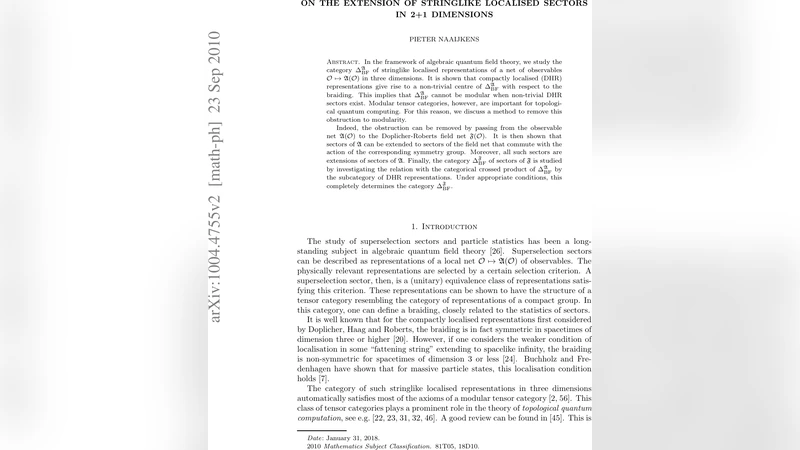
In the framework of algebraic quantum field theory, we study the category \Delta_BF^A of stringlike localised representations of a net of observables O \mapsto A(O) in three dimensions. It is shown that compactly localised (DHR) representations give rise to a non-trivial centre of \Delta_BF^A with respect to the braiding. This implies that \Delta_BF^A cannot be modular when non-trival DHR sectors exist. Modular tensor categories, however, are important for topological quantum computing. For this reason, we discuss a method to remove this obstruction to modularity. Indeed, the obstruction can be removed by passing from the observable net A(O) to the Doplicher-Roberts field net F(O). It is then shown that sectors of A can be extended to sectors of the field net that commute with the action of the corresponding symmetry group. Moreover, all such sectors are extensions of sectors of A. Finally, the category \Delta_BF^F of sectors of F is studied by investigating the relation with the categorical crossed product of \Delta_BF^A by the subcategory of DHR representations. Under appropriate conditions, this completely determines the category \Delta_BF^F.
💡 Research Summary
This paper investigates the category Δ_BF^A of string‑like localized representations (sectors) of a net of observables A(O) in three‑dimensional algebraic quantum field theory (AQFT). The authors first recall that in 2+1 dimensions, besides the usual Doplicher‑Haag‑Roberts (DHR) sectors, which are compactly (point) localized, one can consider sectors that are only localized along semi‑infinite spacelike strings; these are the so‑called Buchholz‑Fredenhagen (BF) sectors. The main observation is that whenever non‑trivial DHR sectors exist, they generate a non‑trivial centre Z(Δ_BF^A) with respect to the braiding. Concretely, DHR objects are transparent for the BF braiding, so they commute with every BF object and thus lie in the centre. Because a modular tensor category must have a trivial centre (the S‑matrix must be non‑degenerate), Δ_BF^A cannot be modular as soon as DHR sectors are present. This is a serious obstacle for applications to topological quantum computation, where modularity supplies the universal anyonic braiding needed for fault‑tolerant quantum gates.
To overcome this obstruction the authors employ the Doplicher‑Roberts reconstruction theorem. The DHR subcategory Δ_DHR^A is equivalent to the representation category Rep(G) of a compact gauge group G, and there exists a field net F(O) extending the observable net such that A(O)=F(O)^G (the G‑invariant subalgebra). The paper shows that every BF sector of the observable net can be lifted to a G‑invariant BF sector of the field net. Conversely, any G‑invariant BF sector of F arises uniquely from a BF sector of A. Hence the BF category of the field net, Δ_BF^F, can be described as a categorical crossed product of Δ_BF^A with the DHR subcategory:
\
Comments & Academic Discussion
Loading comments...
Leave a Comment