Hochschild cohomology for Lie algebroids
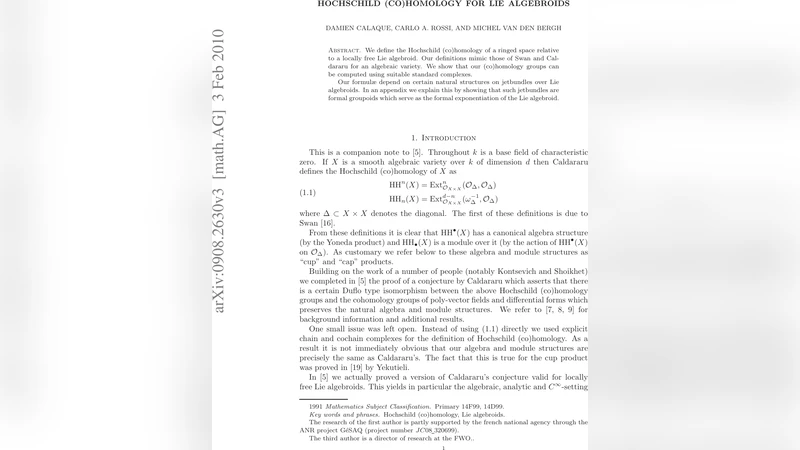
We define the Hochschild (co)homology of a ringed space relative to a locally free Lie algebroid. Our definitions mimic those of Swan and Caldararu for an algebraic variety. We show that our (co)homology groups can be computed using suitable standard complexes. Our formulae depend on certain natural structures on jetbundles over Lie algebroids. In an appendix we explain this by showing that such jetbundles are formal groupoids which serve as the formal exponentiation of the Lie algebroid.
💡 Research Summary
The paper introduces a systematic framework for defining Hochschild homology and cohomology on a ringed space relative to a locally free Lie algebroid (\mathcal{L}). Classical Hochschild (co)homology is usually formulated for the structure sheaf (\mathcal{O}_X) of a scheme or algebraic variety, relying on the tangent sheaf (T_X) as the source of differential operators. By replacing (T_X) with an arbitrary Lie algebroid (\mathcal{L}), the authors extend the theory to a much broader geometric setting that includes Poisson manifolds, foliations, and infinitesimal data of Lie groupoids.
The core construction begins with the (\mathcal{L})-jet bundle (\mathcal{J}^\infty_{\mathcal{L}}(\mathcal{O}_X)). This object generalizes the usual infinite jet bundle by encoding all higher‑order (\mathcal{L})-differential operators acting on (\mathcal{O}X). The jet bundle carries two compatible structures: a co‑algebra structure (coming from the formal Taylor expansion) and an (\mathcal{L})-connection that implements the Lie algebroid differential. The authors prove that (\mathcal{J}^\infty{\mathcal{L}}(\mathcal{O}_X)) is a formal groupoid, i.e., it is the formal exponentiation of the Lie algebroid. This observation is crucial because it guarantees that the algebraic operations on the jet bundle respect the Lie algebroid’s anchor map and bracket.
Using the jet bundle, the authors define the (\mathcal{L})-Hochschild complex (\mathcal{C}\bullet^{\mathcal{L}}(\mathcal{O}X)). The differential is built from the (\mathcal{L})-de Rham operator (\partial{\mathcal{L}}) and mimics the usual Hochschild boundary, but now each term involves (\mathcal{L})-derivations rather than ordinary derivations. The homology of this complex is denoted (HH\bullet^{\mathcal{L}}(\mathcal{O}X)), while its cohomological counterpart, obtained by dualizing, yields (HH^\bullet{\mathcal{L}}(\mathcal{O}_X)).
To make the theory computationally accessible, two standard complexes are presented:
-
Bar‑type complex – a straightforward tensor‑product construction where the (\mathcal{L})-differential acts on each factor. This complex is directly analogous to the classical bar resolution but with (\mathcal{L})-derivations replacing ordinary derivations.
-
Chevalley‑Eilenberg‑type complex – formed by tensoring the exterior algebra (\bigwedge^\bullet \mathcal{L}^\vee) with the jet bundle. The differential combines the Chevalley‑Eilenberg differential of the Lie algebroid with the jet‑bundle connection.
A key technical result is the existence of an explicit chain homotopy equivalence between these two complexes. Consequently, one may choose the more convenient model for a given calculation without altering the resulting (co)homology groups.
The paper includes several illustrative examples. When (\mathcal{L}=T_X), the construction recovers the classical Hochschild (co)homology, confirming that the new definition genuinely extends the old one. For a Poisson manifold ((X,\pi)), the associated Lie algebroid (\mathcal{L}_\pi) yields a “Poisson‑Hochschild” theory, linking the new invariants to Poisson cohomology. Similarly, the infinitesimal Lie algebroid of a Lie groupoid provides a bridge between groupoid representation theory and Hochschild invariants.
The appendix gives a detailed proof that (\mathcal{J}^\infty_{\mathcal{L}}(\mathcal{O}_X)) is a formal groupoid. The authors construct the groupoid multiplication, unit, and inverse maps explicitly in terms of the jet coordinates and verify the required associativity and compatibility conditions using the Lie algebroid axioms (anchor compatibility and Jacobi identity). This formal groupoid viewpoint explains why the jet bundle simultaneously carries a co‑algebra structure and an (\mathcal{L})-connection, and it justifies the use of the jet bundle as a “formal exponential” of the Lie algebroid.
In conclusion, the paper provides a robust, functorial definition of Hochschild (co)homology for any locally free Lie algebroid, supplies concrete computational tools via two standard complexes, and situates the construction within the broader context of formal geometry by interpreting jet bundles as formal groupoids. The results open several avenues for future work: extending the theory to non‑locally free algebroids, exploring connections with deformation quantization, and applying the invariants to problems in noncommutative geometry and representation theory of Lie groupoids.
Comments & Academic Discussion
Loading comments...
Leave a Comment