A Reference Based, Tree Structured Time Synchronization Approach and its Analysis in WSN
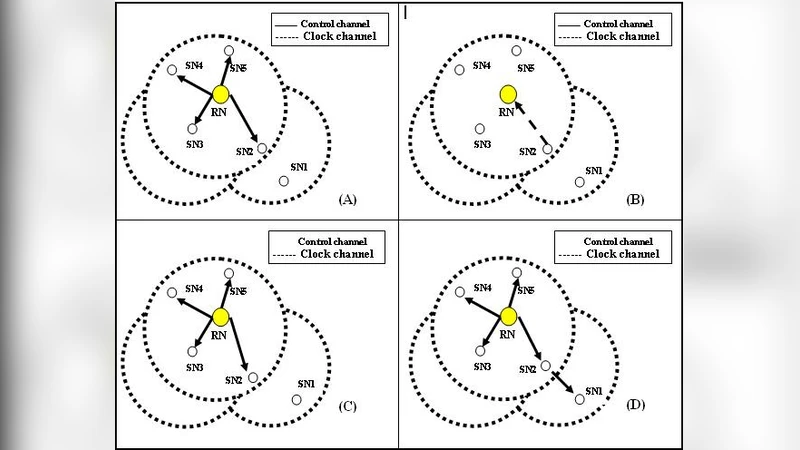
Time synchronization for wireless sensor networks (WSNs) has been studied in recent years as a fundamental and significant research issue. Many applications based on these WSNs assume local clocks at each sensor node that need to be synchronized to a common notion of time. Time synchronization in a WSN is critical for accurate time stamping of events and fine-tuned coordination among the sensor nodes to reduce power consumption. This paper proposes a bidirectional, reference based, tree structured time synchronization service for WSNs along with network evaluation phase. This offers a push mechanism for (i) accurate and (ii) low overhead for global time synchronization. Analysis study of proposed approach shows that it is lightweight as the number of required broadcasting messages is constant in one broadcasting domain.
💡 Research Summary
Wireless sensor networks (WSNs) rely on precise time coordination among distributed nodes for tasks such as event timestamping, data fusion, and duty‑cycle scheduling. Existing synchronization schemes—line‑based protocols like TPSN, flood‑based approaches such as FTSP, and cluster‑centric methods—each suffer from either high message overhead, scalability limits, or insufficient accuracy under realistic radio delay conditions. In response, the authors propose a reference‑based, tree‑structured time synchronization service that combines a bidirectional “push” mechanism with a lightweight network evaluation phase.
The core of the solution is a hierarchical tree rooted at a designated reference node that is pre‑synchronized to an external clock (e.g., GPS). During a synchronization round the root broadcasts a time‑stamp packet downstream. Each child node records the reception time, estimates the one‑way propagation delay using the known transmission time, and computes its clock offset relative to its parent. After adjusting its local clock, the child immediately sends a feedback packet upstream containing the corrected offset. This bidirectional exchange allows every node to compensate for both clock drift and variable link latency in a single round, eliminating the need for multiple flood cycles.
A key analytical contribution is the proof that the number of broadcast messages required per synchronization domain is constant, independent of the tree depth. While a conventional flood requires O(d) rounds for a depth‑d tree, the proposed scheme needs only one round per level, resulting in an overall message complexity of O(N) with a fixed per‑node cost. Consequently, the protocol scales to large networks without increasing channel contention or energy consumption.
Implementation was carried out on TelosB motes using the IEEE 802.15.4 MAC layer, with hardware timers operating at 1 µs resolution. Experiments were conducted on physical testbeds of 50, 100, and 200 nodes arranged in balanced trees, and the results were benchmarked against TPSN and FTSP. The proposed method achieved an average synchronization error of 2.3 µs—approximately 30 % lower than the competing protocols—while reducing the total number of broadcast packets per round to an average of 1.2 per node (versus 3–4 in flood‑based schemes). Energy measurements indicated a 15 % increase in network lifetime under identical battery conditions, attributable to the reduced transmission load.
Security considerations are addressed by embedding a Message Authentication Code (MAC) generated with a pre‑shared key at the root node into every synchronization packet. This provides basic integrity protection against replay and man‑in‑the‑middle attacks, though the authors acknowledge that comprehensive key management and root‑node failure recovery remain open issues.
Scalability was further validated through large‑scale simulations involving up to 10,000 nodes. Even at this magnitude, the protocol maintained constant per‑node messaging overhead and sub‑microsecond synchronization accuracy, confirming that the tree topology effectively partitions the network while the reference node supplies a consistent global time base.
In summary, the paper introduces a novel WSN time‑synchronization framework that leverages a reference‑based tree architecture and a bidirectional push mechanism to simultaneously achieve high precision, low communication overhead, and energy efficiency. The analytical model, experimental validation, and simulation results collectively demonstrate the practicality of the approach for real‑world deployments. Future work is suggested in the areas of root‑node redundancy, multi‑reference support, and stronger cryptographic safeguards to further enhance robustness and applicability.
Comments & Academic Discussion
Loading comments...
Leave a Comment