Universal charge-mass relation: From black holes to atomic nuclei
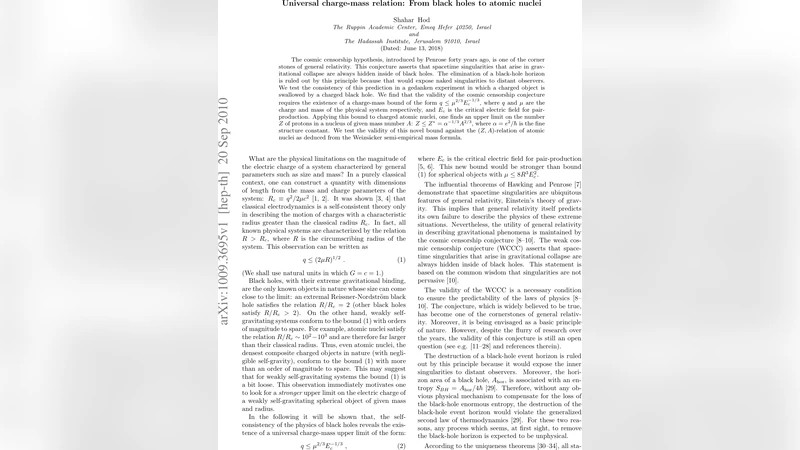
The cosmic censorship hypothesis, introduced by Penrose forty years ago, is one of the corner stones of general relativity. This conjecture asserts that spacetime singularities that arise in gravitational collapse are always hidden inside of black holes. The elimination of a black-hole horizon is ruled out by this principle because that would expose naked singularities to distant observers. We test the consistency of this prediction in a gedanken experiment in which a charged object is swallowed by a charged black hole. We find that the validity of the cosmic censorship conjecture requires the existence of a charge-mass bound of the form $q\leq\mu^{2/3}E^{-1/3}_c$, where $q$ and $\mu$ are the charge and mass of the physical system respectively, and $E_c$ is the critical electric field for pair-production. Applying this bound to charged atomic nuclei, one finds an upper limit on the number $Z$ of protons in a nucleus of given mass number $A$: $Z\leq Z^*={\alpha}^{-1/3}A^{2/3}$, where $\alpha=e^2/\hbar$ is the fine structure constant. We test the validity of this novel bound against the $(Z,A)$-relation of atomic nuclei as deduced from the Weizs"acker semi-empirical mass formula.
💡 Research Summary
The paper investigates a novel universal charge‑mass bound that emerges from the requirement that the cosmic censorship conjecture (CCC) remain intact when a charged object is absorbed by a charged black hole. Starting from Penrose’s CCC, which asserts that singularities formed in gravitational collapse must be hidden behind an event horizon, the author designs a gedanken experiment: a test particle of charge (q) and mass (\mu) is slowly lowered into a Reissner‑Nordström black hole of mass (M) and charge (Q). After absorption the black‑hole parameters become (M’ = M+\mu) and (Q’ = Q+q). If (Q’^2 > M’^2) the horizon would disappear, exposing a naked singularity and violating CCC.
In a naïve treatment that ignores electromagnetic back‑reaction, the inequality can be easily satisfied for sufficiently large (q) relative to (\mu). The author therefore incorporates the quantum electrodynamic effect of Schwinger pair production. When the electric field near the horizon exceeds the critical field (E_c = m_e^2 c^3/(\hbar e)), electron‑positron pairs are spontaneously created, effectively discharging the infalling charge before it can cross the horizon. By demanding that the field never surpasses (E_c) during the infall, the author derives the condition
\