Euler Characteristics of Categories and Homotopy Colimits
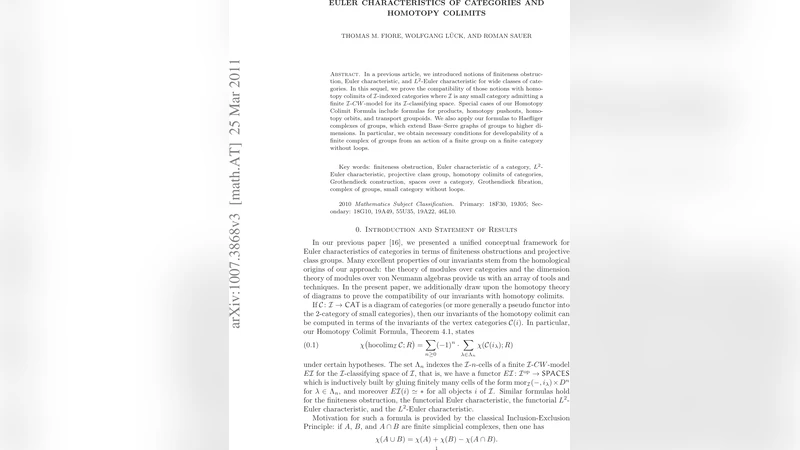
In a previous article, we introduced notions of finiteness obstruction, Euler characteristic, and L^2-Euler characteristic for wide classes of categories. In this sequel, we prove the compatibility of those notions with homotopy colimits of I-indexed categories where I is any small category admitting a finite I-CW-model for its I-classifying space. Special cases of our Homotopy Colimit Formula include formulas for products, homotopy pushouts, homotopy orbits, and transport groupoids. We also apply our formulas to Haefliger complexes of groups, which extend Bass–Serre graphs of groups to higher dimensions. In particular, we obtain necessary conditions for developability of a finite complex of groups from an action of a finite group on a finite category without loops.
💡 Research Summary
This paper continues a line of research that seeks to generalize classical invariants such as the Euler characteristic and the finiteness obstruction from spaces to categories. In the preceding article the authors introduced three categorical invariants: a finiteness obstruction, an Euler characteristic, and an L²‑Euler characteristic, each defined for a very broad class of small categories (including those that admit a finite CW‑model for their classifying space). The present work investigates how these invariants behave under homotopy colimits of diagrams of categories indexed by a small category I.
The central hypothesis is that the indexing category I possesses a finite I‑CW model for its I‑classifying space B I. This condition guarantees that B I is a finite CW‑complex, so that its cellular chain complex is finite and the usual alternating‑sum formula for the Euler characteristic is available. Under this hypothesis the authors prove a “Homotopy Colimit Formula” (Theorem 3.5) which expresses the Euler characteristic of the homotopy colimit hocolim_I F of a diagram F : I → Cat as an alternating sum over the cells of B I:
\