Magnetohydrodynamic Simulations of Gamma-Ray Burst Jets: Beyond the Progenitor Star
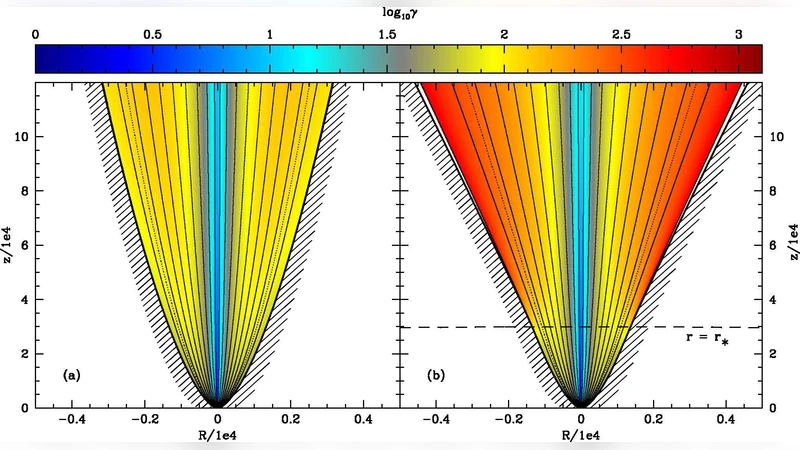
Achromatic breaks in afterglow light curves of gamma-ray bursts (GRBs) arise naturally if the product of the jet’s Lorentz factor \gamma and opening angle \Theta_j satisfies (\gamma \Theta_j) » 1 at the onset of the afterglow phase, i.e., soon after the conclusion of the prompt emission. Magnetohydrodynamic (MHD) simulations of collimated GRB jets generally give (\gamma \Theta_j) <~ 1, suggesting that MHD models may be inconsistent with jet breaks. We work within the collapsar paradigm and use axisymmetric relativistic MHD simulations to explore the effect of a finite stellar envelope on the structure of the jet. Our idealized models treat the jet-envelope interface as a collimating rigid wall, which opens up outside the star to mimic loss of collimation. We find that the onset of deconfinement causes a burst of acceleration accompanied by a slight increase in the opening angle. In our fiducial model with a stellar radius equal to 10^4.5 times that of the central compact object, the jet achieves an asymptotic Lorentz factor \gamma ~ 500 far outside the star and an asymptotic opening angle \Theta_j ~ 0.04 rad ~ 2 deg, giving (\gamma \Theta_j) ~ 20. These values are consistent with observations of typical long-duration GRBs, and explain the occurrence of jet breaks. We provide approximate analytic solutions that describe the numerical results well.
💡 Research Summary
This paper addresses a long‑standing tension between relativistic magnetohydrodynamic (MHD) models of gamma‑ray burst (GRB) jets and the observational requirement that the product of the jet’s Lorentz factor (γ) and its opening angle (Θ_j) be much larger than unity (γ Θ_j ≫ 1) at the onset of the afterglow, a condition inferred from the presence of achromatic jet breaks in afterglow light curves. Earlier axisymmetric relativistic MHD simulations, which typically assumed a continuously collimating environment, produced jets with γ Θ_j ≈ 1 or less, suggesting that pure MHD acceleration could not account for the observed jet breaks.
To resolve this discrepancy, the authors embed the jet within a collapsar‑type progenitor star and explicitly model the transition from a confined to an unconfined flow. The computational setup consists of a rigid, perfectly collimating wall that represents the stellar envelope up to a radius R_* = 10^4.5 R_0, where R_0 is the radius of the central compact object (a black hole or a neutron star). Inside this wall the jet is forced into a narrow channel, mimicking the strong pressure and magnetic confinement provided by the stellar material. At R = R_* the wall is removed, allowing the jet to expand freely into vacuum, thereby reproducing the physical process of “de‑confinement” that occurs when the jet punches through the stellar surface.
The simulations reveal two coupled effects at the de‑confinement radius. First, the sudden drop in external pressure releases the magnetic pressure stored in the jet’s toroidal field, converting a large fraction of the Poynting flux into kinetic energy. This “burst of acceleration” drives the Lorentz factor from modest values up to γ ≈ 500 well beyond the star. Second, the opening angle experiences a modest increase, settling at Θ_j ≈ 0.04 rad (≈ 2°). The combined result is γ Θ_j ≈ 20, comfortably satisfying the condition required for observable jet breaks.
To place the numerical findings on a firmer theoretical footing, the authors develop an analytic approximation based on energy conservation, magnetic flux freezing, and the balance between magnetic and kinetic pressures before and after de‑confinement. The derived scaling laws predict how γ and Θ_j depend on the stellar radius, the initial magnetization, and the jet’s power. These analytic expressions match the simulation data to within a few percent, confirming that the key physics is captured by the simple model.
The study therefore demonstrates that the inclusion of a finite stellar envelope and the associated de‑confinement transition resolves the apparent inconsistency between MHD jet acceleration and the observed afterglow jet breaks. It shows that MHD jets can naturally achieve γ Θ_j ≫ 1 when they emerge from the progenitor star, without invoking additional hydrodynamic or radiative processes. The authors suggest several avenues for future work: three‑dimensional, non‑axisymmetric simulations to explore kink instabilities, more realistic stellar density profiles, and the coupling of radiation transport to the dynamics in order to predict prompt‑emission spectra and polarization signatures. Overall, the paper provides a compelling, quantitatively backed argument that magnetically driven GRB jets, once allowed to expand beyond their confining star, can attain the high Lorentz factors and narrow opening angles required by observations, thereby reconciling theory with the phenomenology of jet breaks.
Comments & Academic Discussion
Loading comments...
Leave a Comment