Functorial topologies and finite-index subgroups of abelian groups
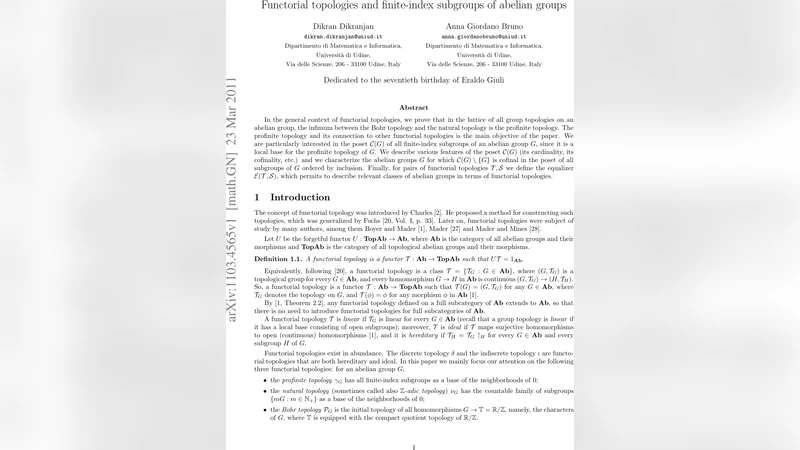
In the general context of functorial topologies, we prove that in the lattice of all group topologies on an abelian group, the infimum between the Bohr topology and the natural topology is the profinite topology. The profinite topology and its connection to other functorial topologies is the main objective of the paper. We are particularly interested in the poset C(G) of all finite-index subgroups of an abelian group G, since it is a local base for the profinite topology of G. We describe various features of the poset C(G) (its cardinality, its cofinality, etc.) and we characterize the abelian groups G for which C(G){G} is cofinal in the poset of all subgroups of G ordered by inclusion. Finally, for pairs of functorial topologies T, S we define the equalizer E(T,S), which permits to describe relevant classes of abelian groups in terms of functorial topologies.
💡 Research Summary
The paper investigates three fundamental functorial topologies on abelian groups— the profinite topology γ, the natural (or Z‑adic) topology ν, and the Bohr topology P— and studies how they interact within the lattice of all group topologies. A functorial topology is a functor T: Ab → TopAb that leaves the underlying group unchanged; continuity of every homomorphism is required. The authors first recall basic properties of these topologies: γ is generated by all finite‑index subgroups, ν by the chain {mG : m∈ℕ⁺}, and P is the initial topology making every character χ∈G* continuous. While γ and ν are linear (they have bases of open subgroups), only P is both ideal and hereditary; γ and ν are ideal but not hereditary.
The central result (Theorem 2.13) proves that for any abelian group G, \
Comments & Academic Discussion
Loading comments...
Leave a Comment