Elementary Magma Gradings on Rings
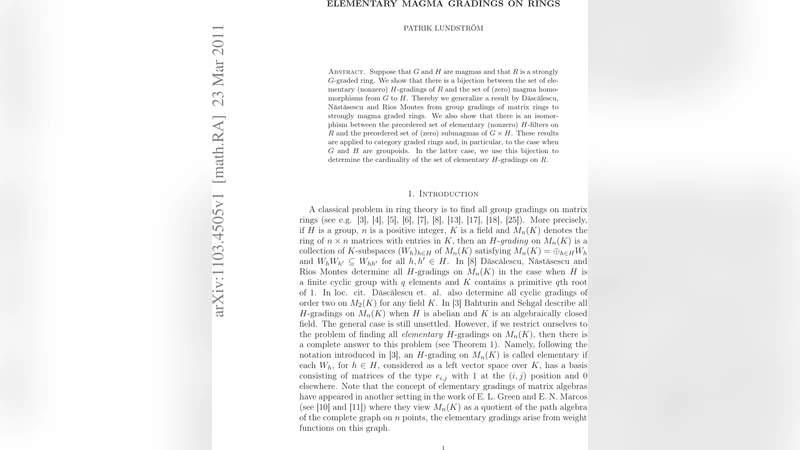
Suppose that $G$ and $H$ are magmas and that $R$ is a strongly $G$-graded ring. We show that there is a bijection between the set of elementary (nonzero) $H$-gradings of $R$ and the set of (zero) magma homomorphisms from $G$ to $H$. Thereby we generalize a result by D\u{a}sc\u{a}lescu, N\u{a}st\u{a}sescu and Rios Montes from group gradings of matrix rings to strongly magma graded rings. We also show that there is an isomorphism between the preordered set of elementary (nonzero) $H$-filters on $R$ and the preordered set of (zero) submagmas of $G \times H$. These results are applied to category graded rings and, in particular, to the case when $G$ and $H$ are groupoids. In the latter case, we use this bijection to determine the cardinality of the set of elementary $H$-gradings on $R$.
💡 Research Summary
The paper “Elementary Magma Gradings on Rings” extends the theory of graded rings from the classical setting of groups to the far more general framework of magmas—sets equipped only with a closed binary operation, without any associativity, identity or invertibility requirements. The authors work with a ring R that is strongly G‑graded, meaning that for every pair of elements g, h in the magma G the homogeneous components satisfy R_{gh}=R_gR_h. This strong condition guarantees that the multiplication in R mirrors the binary operation of G exactly, which is essential for the constructions that follow.
The first major result establishes a bijection between two seemingly different objects: (i) the set of elementary (non‑zero) H‑gradings of R, i.e. H‑gradings in which every homogeneous component is non‑zero, and (ii) the set of (possibly zero) magma homomorphisms f : G → H. Given a homomorphism f, one defines an H‑grading by collecting all G‑components that f sends to the same element of H: \
Comments & Academic Discussion
Loading comments...
Leave a Comment