Random Sequential Renormalization of Networks I: Application to Critical Trees
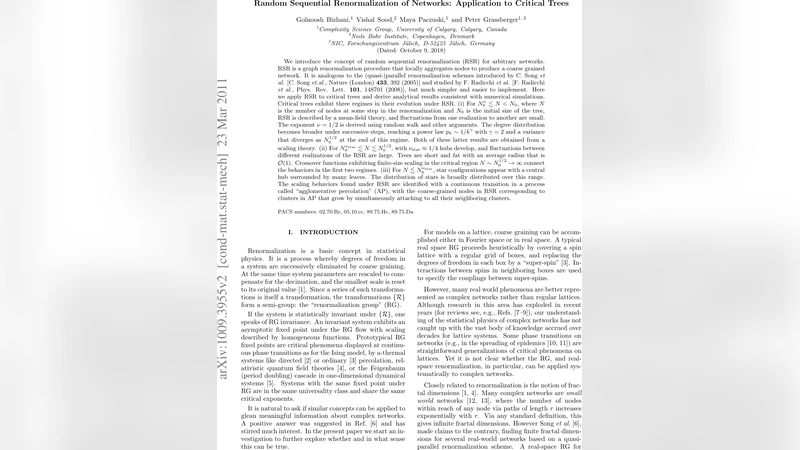
We introduce the concept of Random Sequential Renormalization (RSR) for arbitrary networks. RSR is a graph renormalization procedure that locally aggregates nodes to produce a coarse grained network. It is analogous to the (quasi-)parallel renormalization schemes introduced by C. Song {\it et al.} (Nature {\bf 433}, 392 (2005)) and studied more recently by F. Radicchi {\it et al.} (Phys. Rev. Lett. {\bf 101}, 148701 (2008)), but much simpler and easier to implement. In this first paper we apply RSR to critical trees and derive analytical results consistent with numerical simulations. Critical trees exhibit three regimes in their evolution under RSR: (i) An initial regime $N_0^{\nu}\lesssim N<N_0$, where $N$ is the number of nodes at some step in the renormalization and $N_0$ is the initial size. RSR in this regime is described by a mean field theory and fluctuations from one realization to another are small. The exponent $\nu=1/2$ is derived using random walk arguments. The degree distribution becomes broader under successive renormalization – reaching a power law, $p_k\sim 1/k^{\gamma}$ with $\gamma=2$ and a variance that diverges as $N_0^{1/2}$ at the end of this regime. Both of these results are derived based on a scaling theory. (ii) An intermediate regime for $N_0^{1/4}\lesssim N \lesssim N_0^{1/2}$, in which hubs develop, and fluctuations between different realizations of the RSR are large. Crossover functions exhibiting finite size scaling, in the critical region $N\sim N_0^{1/2} \to \infty$, connect the behaviors in the first two regimes. (iii) The last regime, for $1 \ll N\lesssim N_0^{1/4}$, is characterized by the appearance of star configurations with a central hub surrounded by many leaves. The distribution of sizes where stars first form is found numerically to be a power law up to a cutoff that scales as $N_0^{\nu_{star}}$ with $\nu_{star}\approx 1/4$.
💡 Research Summary
The paper introduces a novel graph‑renormalization scheme called Random Sequential Renormalization (RSR). Unlike earlier parallel coarse‑graining methods (Song et al., 2005; Radicchi et al., 2008), RSR proceeds step by step: at each iteration a node is chosen uniformly at random, together with all its immediate neighbors (radius ℓ = 1), and these vertices are merged into a single super‑node. This sequential, local operation is trivial to implement and, crucially, admits exact analytical treatment on tree‑like structures.
The authors apply RSR to critical trees—random trees tuned to the percolation threshold, which display scale‑free properties and a typical depth of order √N₀ (N₀ being the initial number of nodes). By tracking the number of remaining nodes N as the process evolves, three distinct regimes emerge.
-
Initial mean‑field regime (N₀^{ν} ≲ N < N₀, ν = ½).
Using a random‑walk argument the authors show that the characteristic scale at which mean‑field theory breaks down is N ≈ N₀^{½}. In this regime fluctuations between realizations are small, and the degree distribution broadens progressively. After many renormalization steps the distribution approaches a power law p_k ∝ k^{‑γ} with γ = 2. The variance of the degree distribution diverges as N₀^{½}, reflecting the emergence of increasingly heterogeneous nodes. Scaling theory yields p_k(N,N₀) = N^{‑β} f(k/N^{α}) with α = β = ½, consistent with numerical data. -
Intermediate, critical regime (N₀^{¼} ≲ N ≲ N₀^{½}).
Here large hubs begin to dominate. The stochastic nature of the sequential merging leads to large sample‑to‑sample fluctuations. The authors treat this region as a finite‑size critical window and introduce the scaling variable x = N/N₀^{½}. Observable quantities such as the average degree ⟨k⟩, its variance σ_k², and the maximal degree k_max obey crossover functions of x. Monte‑Carlo simulations confirm the predicted forms and reveal a sharp crossover near x ≈ 1, where the system transitions from a relatively homogeneous tree to a hub‑dominated structure. -
Final star‑formation regime (1 ≪ N ≲ N₀^{¼}).
The network collapses into star configurations: a single central hub surrounded by many leaves. The size s at which a star first appears follows a power‑law distribution P(s) ∝ s^{‑τ} with τ ≈ 2, truncated at s_max ∼ N₀^{ν_star}. Numerical measurements give ν_star ≈ ¼, indicating that the onset of star formation scales with the quarter power of the original system size.
The paper validates all analytical predictions with extensive simulations for N₀ ranging from 10³ to 10⁶. The agreement is quantitative: the exponent γ = 2, the variance scaling N₀^{½}, the crossover scaling functions, and the star‑formation exponent ν_star ≈ 0.25 all match the data.
Beyond the specific case of critical trees, the authors argue that RSR provides a versatile framework for studying coarse‑graining in arbitrary networks. Its simplicity makes it attractive for exploring how local aggregation rules generate macroscopic structural changes, and the sequential nature captures stochastic fluctuations that are washed out in parallel schemes. Future work is suggested on applying RSR to scale‑free graphs, small‑world networks, and to dynamical processes such as epidemic spreading or synchronization, where the interplay between renormalization and dynamics could reveal new universality classes.
In summary, Random Sequential Renormalization offers a transparent, analytically tractable, and computationally inexpensive method to probe the evolution of network topology under coarse‑graining. The three‑regime picture uncovered for critical trees—mean‑field broadening, hub‑driven criticality, and eventual star formation—provides deep insight into how local aggregation can drive a system from a fractal‑like state to a highly centralized one.
Comments & Academic Discussion
Loading comments...
Leave a Comment