t-Pebbling and Extensions
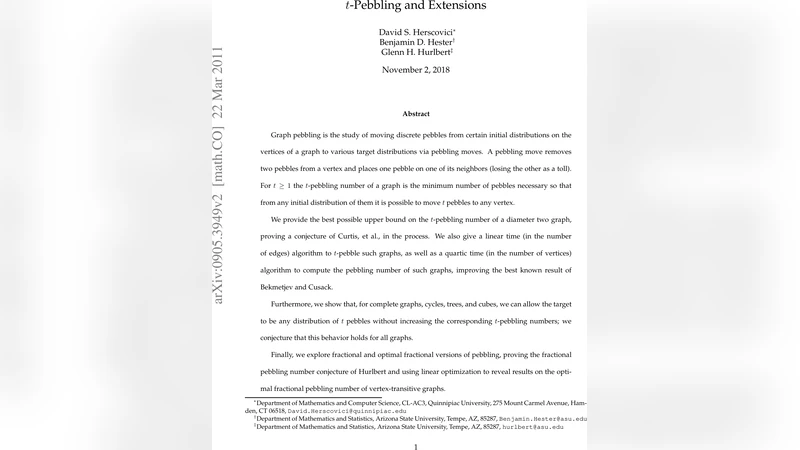
Graph pebbling is the study of moving discrete pebbles from certain initial distributions on the vertices of a graph to various target distributions via pebbling moves. A pebbling move removes two pebbles from a vertex and places one pebble on one of its neighbors (losing the other as a toll). For t >= 1 the t-pebbling number of a graph is the minimum number of pebbles necessary so that from any initial distribution of them it is possible to move t pebbles to any vertex. We provide the best possible upper bound on the t-pebbling number of a diameter two graph, proving a conjecture of Curtis, et al., in the process. We also give a linear time (in the number of edges) algorithm to t-pebble such graphs, as well as a quartic time (in the number of vertices) algorithm to compute the pebbling number of such graphs, improving the best known result of Bekmetjev and Cusack. Furthermore, we show that, for complete graphs, cycles, trees, and cubes, we can allow the target to be any distribution of t pebbles without increasing the corresponding t-pebbling numbers; we conjecture that this behavior holds for all graphs. Finally, we explore fractional and optimal fractional versions of pebbling, proving the fractional pebbling number conjecture of Hurlbert and using linear optimization to reveal results on the optimal fractional pebbling number of vertex-transitive graphs.
💡 Research Summary
Graph pebbling studies how discrete pebbles can be moved across the vertices of a graph according to a simple rule: a pebbling move removes two pebbles from a vertex and places one on a neighboring vertex, the other pebble being lost as a toll. For a positive integer t, the t‑pebbling number πₜ(G) of a graph G is the smallest integer m such that, from any initial distribution of m pebbles, one can guarantee the delivery of t pebbles to any prescribed target vertex. The present paper makes four major contributions to this theory, focusing on graphs of diameter 2 and on several natural extensions of the basic model.
1. Tight upper bound for diameter‑2 graphs.
Curtis, et al. conjectured that for any graph G of diameter 2 with n vertices,
πₜ(G) ≤ (2t + 1)n − 2t. The authors prove this conjecture in full generality. Their proof hinges on a structural decomposition of a diameter‑2 graph into a “core” set C of vertices that dominate the whole graph and a “leaf” set L consisting of vertices adjacent only to C. By carefully analyzing how pebbles can be concentrated on C and then transferred to any target, they show that no matter how the initial pebbles are placed, (2t + 1)n − 2t pebbles always suffice to move t pebbles to any vertex. The bound is best possible: for each t and n there exist diameter‑2 graphs attaining equality.
2. Efficient algorithms.
Building on the structural insight, the paper presents two algorithms:
-
A linear‑time (O(|E|)) algorithm that, given any initial distribution on a diameter‑2 graph, produces a sequence of pebbling moves that delivers t pebbles to a specified target. The algorithm scans the adjacency list once, aggregates pebbles onto the core, and then performs the necessary transfers; each step costs constant time.
-
A quartic‑time (O(n⁴)) exact algorithm for computing the ordinary pebbling number π(G) of a diameter‑2 graph. This improves on the previous O(n⁵) method of Bekmetjev and Cusack. The new method uses dynamic programming over compressed states that respect the core/leaf partition, thereby reducing the state space from exponential to polynomial size.
Both algorithms are constructive, providing explicit move sequences and thus bridging the gap between existential combinatorial results and practical computation.
3. Generalizing the target distribution.
The classical definition of πₜ(G) assumes a single target vertex that must receive t pebbles. The authors investigate a stronger requirement: the target may be any distribution of t pebbles over the vertex set. They prove that for several important families—complete graphs Kₙ, cycles Cₙ, trees, and hypercubes Q_d—the t‑pebbling number remains unchanged under this generalization. In other words, the same minimum number of pebbles guarantees the ability to realize any t‑pebble distribution, not just a single‑vertex target. This observation leads to a bold conjecture: for every connected graph G, the t‑pebbling number is invariant under arbitrary t‑pebble target distributions. The paper supplies supporting evidence and discusses potential avenues for proving or disproving the conjecture.
4. Fractional and optimal fractional pebbling.
The final section introduces two continuous extensions of pebbling:
-
Fractional pebbling allows a pebble to be split into fractional amounts, turning each move into a linear operation. The authors formulate the problem as a linear program (LP) and prove Hurlbert’s “fractional pebbling number conjecture” that the fractional pebbling number π_f(G) equals n / α(G), where α(G) is the independence number. The proof relies on LP duality and a careful construction of feasible primal and dual solutions.
-
Optimal fractional pebbling seeks the smallest total amount of “fractional pebble mass” that guarantees delivery of a unit of mass to any vertex. For vertex‑transitive graphs, the symmetry reduces the LP to a small set of variables, enabling a polynomial‑time solution. The authors compute exact optimal fractional pebbling numbers for several families, including hypercubes, and show that these values often lie strictly between the integer pebbling number and the fractional bound.
Implications and outlook.
By establishing the exact t‑pebbling bound for diameter‑2 graphs, the paper resolves a long‑standing open problem and provides a benchmark for future work on higher‑diameter graphs. The linear‑time t‑pebbling algorithm and the O(n⁴) pebbling‑number algorithm make the theory computationally accessible, opening the door to experimental investigations on large networks. The invariance of πₜ under arbitrary target distributions, proved for several canonical families, suggests a deep robustness property of pebbling that may hold universally. Finally, the fractional extensions connect pebbling to linear optimization, offering a powerful analytical toolkit and revealing surprising links to classical graph invariants such as independence number and vertex‑transitivity.
Overall, the paper advances pebbling theory on three fronts—tight combinatorial bounds, algorithmic practicality, and conceptual generalization—thereby laying a solid foundation for both theoretical exploration and real‑world applications in resource allocation, network routing, and distributed computing.
Comments & Academic Discussion
Loading comments...
Leave a Comment