Stationary distribution and cover time of random walks on random digraphs
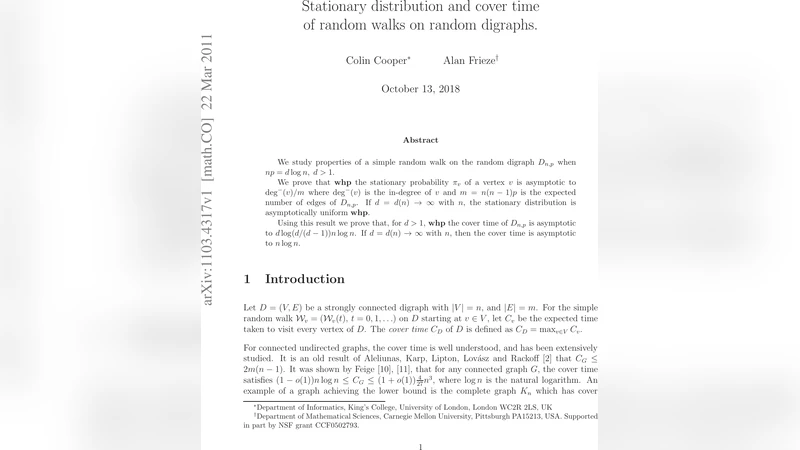
We study properties of a simple random walk on the random digraph D_{n,p} when np={d\log n},; d>1. We prove that whp the stationary probability pi_v of a vertex v is asymptotic to deg^-(v)/m where deg^-(v) is the in-degree of v and m=n(n-1)p is the expected number of edges of D_{n,p}. If d=d(n) tends to infinity with n, the stationary distribution is asymptotically uniform whp. Using this result we prove that, for d>1, whp the cover time of D_{n,p} is asymptotic to d\log (d/(d-1))n\log n. If d=d(n) tends to infinity with n, then the cover time is asymptotic to n\log n.
💡 Research Summary
The paper investigates the simple random walk on the random directed graph Dₙ,ₚ where the expected out‑degree and in‑degree are both np = d·log n with a constant d>1. The authors first establish that Dₙ,ₚ is strongly connected with high probability (whp) once the excess γ = np – log n tends to infinity, and that it fails to be strongly connected when γ→−∞. The main contributions are two theorems. Theorem 2 shows that for every vertex v the stationary probability πᵥ satisfies
πᵥ = (deg⁻(v) + ς⁎(v))/m with m = n(n−1)p,
where ς⁎(v)=max_{w∈N⁻(v)} deg⁻(w)/deg⁺(w). Lemma 14 proves that for almost all vertices ς⁎(v)=o(deg⁻(v)), and when d grows with n, ς⁎(v) is negligible for all vertices. Consequently, πᵥ≈deg⁻(v)/m, and if d→∞ then deg⁻(v)≈np for every vertex, yielding the uniform stationary distribution πᵥ≈1/n.
Armed with this precise description of the stationary distribution, the authors turn to the cover time C_{Dₙ,ₚ}, defined as the expected time for the walk to visit every vertex. The key technical tool is Lemma 3, a general result about random walks on any strongly connected digraph. It states that if the mixing time T satisfies a certain total‑variation bound (here T=O(log² n)) and the expected number of returns to a vertex within T steps, Rᵥ, is 1+o(1), then for t≥T the probability that vertex v has not been visited in steps T,…,t is
Pr(Aᵥ(t)) = (1+O(Tπᵥ))·exp(−t·πᵥ/Rᵥ) + lower‑order terms.
The proof of Lemma 3 is based on a coupling argument and a careful analysis of the walk’s return structure.
To apply Lemma 3 to Dₙ,ₚ, the paper establishes several structural properties of the random digraph. Using Chernoff bounds and moment calculations (Lemma 4), the degree sequence is shown to be tightly concentrated: the maximum degree is O(np) and the minimum degree is Θ(np) when d→∞. The authors construct two breadth‑first search trees – an out‑tree rooted at a source x and an in‑tree rooted at a target y – each of depth ℓ≈(2/3)·log_{np} n. They prove that almost all length‑(2ℓ+1) walks from x to y consist of a path from x to the boundary of the out‑tree, a single edge crossing to the boundary of the in‑tree, and then a path down the in‑tree to y. This yields the estimate
P^{(k)}(x,y) ≈ deg⁻(y)/m
for k=2ℓ+1, independent of x. Consequently the mixing time is O(log² n) and Rᵥ=1+o(1) for all vertices.
With these ingredients, the authors bound the cover time from above by choosing t large enough that the sum over v of Pr(Aᵥ(t)) is o(t). For the lower bound they identify a set V^{} of vertices with relatively small in‑degree, show that the expected number of vertices in V^{} still unvisited after time t is bounded away from zero, and then contract pairs of such vertices to a single vertex γ. Using the product form of the non‑visit probability (derived from Lemma 3) they show that the walk must take at least
t ≈ d·log(d/(d−1))·n·log n
steps before all vertices are visited, whp. When d→∞ the factor d·log(d/(d−1)) tends to 1, giving the classic n·log n cover time.
The analysis initially assumes 2≤d≤n^δ for a small constant δ (Assumption 1) to simplify degree‑concentration arguments; Section 6 removes this restriction, handling both d>n^δ and 1<d≤2 separately. Section 7 verifies that the conditions of Lemma 3 hold for Dₙ,ₚ, and Section 8 assembles all pieces to prove Theorem 1.
In summary, the paper provides a complete asymptotic description of both the stationary distribution and the cover time for random walks on the dense random digraph Dₙ,ₚ. It shows that the stationary distribution is essentially proportional to the in‑degree, becomes uniform when the average degree diverges, and that the cover time scales as d·log(d/(d−1))·n·log n, reducing to the well‑known n·log n when d grows. These results extend the classical theory for undirected random graphs to the directed setting and offer precise quantitative benchmarks for algorithms that rely on random walks in directed networks.
Comments & Academic Discussion
Loading comments...
Leave a Comment