X-ray spectral and timing investigations of XTE J1752-223
We report on X-ray monitoring observations of the transient black hole candidate (BHC) XTE J1752-223 with the Rossi X-ray Timing Explorer (RXTE). The source was discovered on 2009 October 23 and during its low/hard state, which lasted for at least 25 days, all timing and spectral properties were similar to those of Cyg X-1 during its canonical hard state. The combined PCA/HEXTE spectra were well fitted by an absorbed broken powerlaw with a high energy cutoff. When RXTE observations were resumed, after an observational gap due to solar constraint, the source was in the hard intermediate state. The evolution through the hardness intensity diagram and the timing properties observed in the power density spectrum suggest that the source crossed all the canonical BHCs states. We discuss the different states and present the results of our spectral and timing investigations.
💡 Research Summary
This paper presents a comprehensive X‑ray monitoring study of the transient black‑hole candidate XTE J1752‑223 using the Rossi X‑ray Timing Explorer (RXTE). The source was discovered on 23 October 2009, and the authors analyzed 206 RXTE observations spanning from 26 October 2009 to 3 July 2010, thereby covering the entire outburst. Data from the Proportional Counter Array (PCA, 2–60 keV) and the High‑Energy X‑ray Timing Experiment (HEXTE, 20–200 keV) were combined to obtain broad‑band spectra, while timing analysis was performed on PCA channels 0–35 (2–15 keV). Systematic uncertainties of 0.6 % (PCA) and 1 % (HEXTE) were added to account for calibration residuals. After 14 December 2009, HEXTE suffered from additional instrumental lines (≈63 keV, 53 keV, 40 keV); the authors modeled these by allowing the background normalization to vary and by inserting three Gaussian components at the line energies.
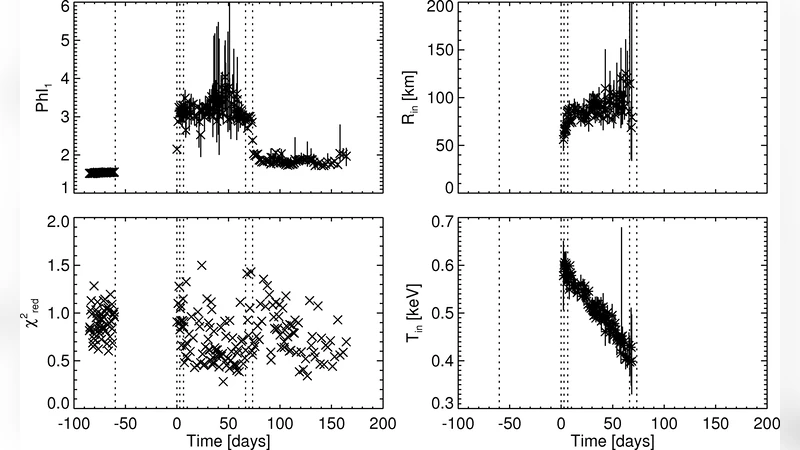
Spectral fitting employed an absorbed broken power‑law with a high‑energy cut‑off, supplemented by a Gaussian at 6.4 keV to model Fe‑K emission. From day 2 to day 68 a multicolour disc blackbody (diskbb) component was required, representing the soft thermal emission from the accretion disc. The absorption column was fixed at N_H = 0.72 × 10²² cm⁻². The broken power‑law parameters evolved systematically across the canonical black‑hole states: during the initial low/hard state (LHS) the photon indices were Γ₁ ≈ 1.53 (below the break at ≈10 keV) and Γ₂ ≈ 1.28 (above), the cut‑off energy was ≈145 keV, and the rms variability was ≈40 %. These values closely resemble those of Cyg X‑1 in its hard state.
A 60‑day observational gap caused by solar constraints was followed by a re‑appearance of the source in the hard‑intermediate state (HIMS). In HIMS the rms dropped from ~25 % to ~18 % and type‑C quasi‑periodic oscillations (QPOs) appeared at 2.2 Hz, 4.1 Hz and 5.5 Hz. The spectrum softened (Γ₁ ≈ 2.8, Γ₂ ≈ 2.0) and the high‑energy cut‑off became poorly constrained. The source then progressed to the soft‑intermediate state (SIMS), displaying type‑A/B QPOs and rms < 10 %. The disc component became dominant, with an inner disc temperature T_in ≈ 0.6 keV and an apparent inner radius R_in ≈ 60 km (assuming a distance of 3.5 kpc and an inclination of 70°). During the subsequent high/soft state (HSS) the disc temperature gradually decreased while the inner radius showed a modest increase, consistent with a receding disc as the source faded.
State classification was reinforced by a hardness‑intensity diagram (HID) and an rms‑intensity diagram (RID). The HID traced the classic q‑shaped track: starting in the upper‑right (hard) corner, moving counter‑clockwise through HIMS, SIMS, HSS, and finally returning to the lower‑left hard region. The RID placed all LHS observations near a line corresponding to 40 % rms, while HIMS and SIMS points moved rapidly toward lower rms values, confirming the timing‑spectral correlation.
After the main outburst, the source underwent a secondary hard‑intermediate transition at lower luminosity, followed by a final return to the low/hard state at even lower flux. Throughout the ≈300‑day outburst XTE J1752‑223 exhibited all canonical black‑hole transient states, with spectral and timing properties matching those of well‑studied systems such as GX 339‑4 and Cyg X‑1. The authors conclude that XTE J1752‑223 is a prototypical black‑hole transient, and its full state evolution provides a valuable benchmark for accretion‑state transition models. The work was supported by the EU FP7 “Black Hole Universe” grant.
Comments & Academic Discussion
Loading comments...
Leave a Comment