Commuting Groups and the Topos of Triads
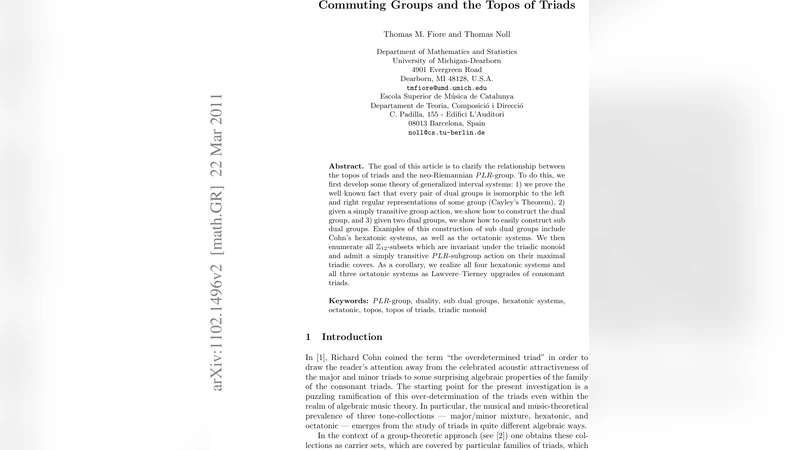
The goal of this article is to clarify the relationship between the topos of triads and the neo-Riemannian PLR-group. To do this, we first develop some theory of generalized interval systems: 1) we prove the well known fact that every pair of dual groups is isomorphic to the left and right regular representations of some group (Cayley’s Theorem), 2) given a simply transitive group action, we show how to construct the dual group, and 3) given two dual groups, we show how to easily construct sub dual groups. Examples of this construction of sub dual groups include Cohn’s hexatonic systems, as well as the octatonic systems. We then enumerate all Z_{12}-subsets which are invariant under the triadic monoid and admit a simply transitive PLR-subgroup action on their maximal triadic covers. As a corollary, we realize all four hexatonic systems and all three octatonic systems as Lawvere–Tierney upgrades of consonant triads.
💡 Research Summary
The paper “Commuting Groups and the Topos of Triads” establishes a rigorous bridge between the neo‑Riemannian PLR‑group, the T/I‑group, and the topos of triads built from a triadic monoid on the twelve‑tone pitch class set ℤ₁₂. The authors begin by recalling Lewin’s notion of dual groups: two subgroups G and H of the symmetric group Sym(S) are dual when each acts simply transitively on S and each is the centralizer of the other. They show that any pair of dual groups is isomorphic to the left and right regular representations of some abstract group G (a version of Cayley’s theorem).
Given a simply transitive action of a group G on a set S, they construct the dual group explicitly: the original action provides the left regular representation λ(G), while a second injection g ↦ (h·s₀ ↦ hg⁻¹·s₀) yields the right regular representation ρ(G). The choice of base point s₀ does not affect the resulting dual group. Applying this to the T/I‑group acting on the set of major and minor triads, the dual group ρ(T/I) is precisely the neo‑Riemannian PLR‑group, with the familiar operations P, L, and R corresponding to right multiplication by specific inversions (I₇, I₁₁, I₄).
The core technical contribution is Theorem 3.1, which provides a practical method for constructing “sub‑dual groups”. Starting from dual groups G and H, a subgroup G₀ ≤ G and a base point s₀ ∈ S define an orbit S₀ = G₀·s₀. The subgroup H₀ ⊂ H consists of those elements that send s₀ into S₀. The theorem proves that G₀ and H₀ act simply transitively on S₀ and remain dual after restriction to S₀. This reduces the verification of commutation to checking a single point, dramatically simplifying calculations.
Using this machinery, the authors reconstruct Cohn’s hexatonic systems. Taking G₀ = ⟨P, L⟩ ≅ S₃ and s₀ = E♭, the orbit S₀ consists of six triads {E♭, e♭, B, b, G, g}. The corresponding H₀ consists of those T/I transformations that map E♭ into this set; explicitly, it contains the transpositions T₀, T₄, T₈ and the inversions I₁, I₅, I₉. By conjugating with the remaining T/I elements (T₁, T₂, T₃) they obtain the other three hexatonic collections together with their dual sub‑groups, matching the results of Cohn and Clampitt.
A parallel construction yields the three octatonic systems. Here G₀ = ⟨P, R⟩ ≅ D₄ (order 8) and s₀ = C. The orbit S₀ contains eight triads {C, c, E♭, e♭, G♭, g♭, A, a}. The subgroup H₀ consists of the T/I elements that preserve this set (four transpositions and four inversions). Conjugating by T₁ and T₂ produces the remaining two octatonic collections and their dual sub‑groups.
The final part of the paper introduces the triadic monoid T, the set of eight affine maps ℤ₁₂ → ℤ₁₂ that preserve the C‑triad {0,4,7} as a set. T is generated by f(z)=3z+7 and g(z)=8z+4, and together with composition forms a monoid (not a group). The category Set^T of T‑actions is a topos, called the “topos of triads”. The authors enumerate all subsets of ℤ₁₂ that are closed under T and admit a simply transitive PLR‑subgroup action on their maximal triadic covers. They find exactly four such hexatonic subsets and three octatonic subsets. Moreover, each of these subsets can be obtained as a Lawvere–Tierney upgrade of the basic consonant triad, showing that the categorical structure of the topos captures the same musical phenomena described by the group‑theoretic constructions.
In conclusion, the paper demonstrates that the PLR‑group, the T/I‑group, and the triadic monoid are three facets of a unified algebraic‑categorical framework. The dual‑group construction explains why PLR is the natural “right” counterpart of T/I, while the sub‑dual‑group method systematically produces the familiar hexatonic and octatonic collections. The topos‑theoretic perspective then shows that these collections arise as internal subobjects (Lawvere–Tierney topologies) of the triadic topos, linking transformational music theory with modern categorical logic. This synthesis opens the way for further exploration of other pitch‑class structures, alternative monoids, and higher‑dimensional topoi in music theory.
Comments & Academic Discussion
Loading comments...
Leave a Comment