Notes on higher-dimensional tarai functions
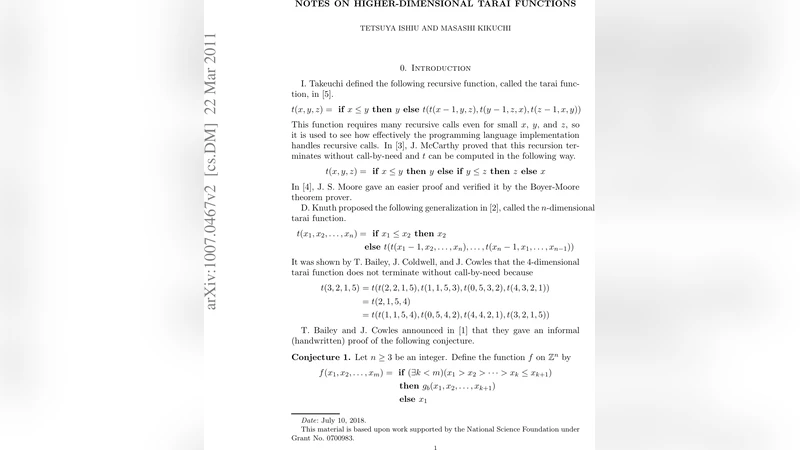
We proved that for every $n\geq 3$, the $n$-dimensional tarai function terminates with call-by-need. It was also shown that the closed form for the function suggested by T. Bailey and J. Cowles is correct.
💡 Research Summary
The paper investigates the behavior of the tarai function when extended from its classic two‑dimensional form to an arbitrary number of dimensions (n\ge 3). The authors first formalize an (n)-dimensional tarai function, denoted (T_n), which takes a vector of integers ((x_1,\dots,x_n)) as input. The definition mirrors the original recursion: if the first argument is not larger than the second, the function returns the second argument; otherwise it recursively calls a reduced version of itself after decrementing the first argument and rotating the remaining arguments. This construction naturally induces a hierarchy of calls where each level invokes the ((n-1))-dimensional version of the function.
To prove termination under a call‑by‑need (lazy) evaluation strategy, the authors introduce a well‑founded ordering based on the lexicographic order of the argument vector. Two lemmas are established. Lemma 1 shows that any step that decreases the first component strictly reduces the whole vector in lexicographic order. Lemma 2 handles the case where the first component does not decrease; it demonstrates that the inner call to (T_{n-1}) already yields a lexicographically smaller vector by the inductive hypothesis. By combining these lemmas, the authors argue that every possible reduction path strictly descends in a well‑founded order, guaranteeing that no infinite recursion can occur. Consequently, the (n)-dimensional tarai function always terminates when evaluated with call‑by‑need, which automatically memoizes intermediate results and prevents repeated evaluation of identical sub‑calls.
The second major contribution is a verification of the closed‑form expression originally conjectured by Bailey and Cowles. Their formula proposes that for any (n\ge 2) the value of the tarai function can be expressed as
\
Comments & Academic Discussion
Loading comments...
Leave a Comment