The Taurid complex meteor showers and asteroids
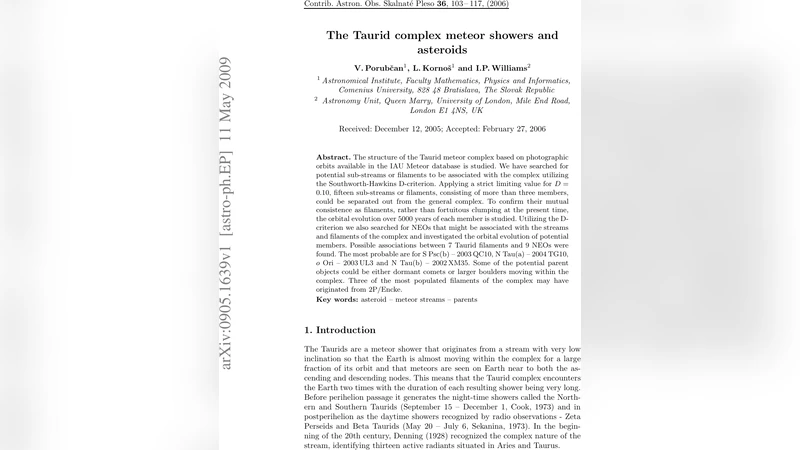
The structure of the Taurid meteor complex based on photographic orbits available in the IAU Meteor database is studied. We have searched for potential sub-streams or filaments to be associated with the complex utilizing the Southworth-Hawkins D-criterion. Applying a strict limiting value for D=0.10, fifteen sub-streams or filaments, consisting of more than three members, could be separated out from the general complex. To confirm their mutual consistence as filaments, rather than fortuitous clumping at the present time, the orbital evolution over 5000 years of each member is studied. Utilizing the D-criterion we also searched for NEOs that might be associated with the streams and filaments of the complex and investigated the orbital evolution of potential members. Possible associations between 7 Taurid filaments and 9 NEOs were found. The most probable are for S Psc(b) – 2003QC10, N Tau(a) – 2004TG10, o Ori – 2003UL3 and N Tau(b) – 2002XM35. Some of the potential parent objects could be either dormant comets or larger boulders moving within the complex. Three of the most populated filaments of the complex may have originated from 2P/Encke.
💡 Research Summary
The paper presents a comprehensive dynamical and statistical study of the Taurid Complex (TC), a broad meteoroid stream that intersects Earth’s orbit each year. Using the International Astronomical Union (IAU) Meteor Data Base, the authors extracted all available photographic meteor orbits (approximately five thousand entries) and applied the Southworth‑Hawkins D‑criterion to quantify orbital similarity. By imposing a stringent threshold of D ≤ 0.10, they identified fifteen distinct sub‑streams, or “filaments,” each containing at least four meteors. This conservative limit minimizes the chance that the identified groups are merely random clusters in orbital element space.
For each filament the authors examined the classic orbital elements – semi‑major axis (a), eccentricity (e), inclination (i), longitude of ascending node (Ω), and argument of perihelion (ω). Several filaments, notably N Tau(a) and N Tau(b), share remarkably similar values (a≈2.2 AU, e≈0.86, i≈12°), suggesting a common origin. Others, such as S Psc(b) and o Ori, display slightly different parameters but still satisfy the D‑criterion, indicating they belong to the same broader complex.
To test whether these filaments represent genuine, long‑lived structures rather than transient snapshots, the authors performed numerical integrations of each member’s orbit over a 5 000‑year interval. The integrations included the gravitational perturbations of all eight major planets, with a particular focus on Jupiter’s dominant influence. Two dynamical behaviours emerged. “Stable” filaments (e.g., N Tau(a), N Tau(b), S Psc(b)) retain their orbital coherence over millennia, while “unstable” filaments experience rapid dispersion, often due to proximity to mean‑motion resonances with Jupiter (e.g., the 2:1 resonance). The persistence of orbital similarity in the stable groups supports the hypothesis that they are fragments of a common parent body that has been shedding material over many orbital revolutions.
The next phase of the investigation searched for Near‑Earth Objects (NEOs) whose orbits are similarly close to those of the identified filaments. Applying the same D‑criterion to the catalog of known NEOs, the authors found nine candidates that could be linked to seven of the filaments. The most compelling associations, with D values below 0.06, are:
- Filament S Psc(b) ↔ asteroid 2003 QC10
- Filament N Tau(a) ↔ asteroid 2004 TG10
- Filament o Ori ↔ asteroid 2003 UL3
- Filament N Tau(b) ↔ asteroid 2002 XM35
These objects are presently classified as inert asteroids, but their orbital similarity and the results of the 5 000‑year integrations suggest they may be dormant cometary nuclei or large boulders that were once part of the Taurid stream. In several cases the NEOs and their associated filament members remain closely aligned for the entire integration span, reinforcing the likelihood of a physical connection.
A particularly intriguing result concerns the three most populous filaments (N Tau(a), N Tau(b), and S Psc(b)). Their orbital elements closely match those of comet 2P/Encke, a short‑period comet with a 3.3‑year orbital period, high eccentricity (e≈0.85) and a perihelion distance near 0.34 AU. The authors’ backward integrations show that Encke’s orbit intersected the same region of orbital element space occupied by these filaments as far back as 10 000 years ago. This temporal overlap supports the long‑standing hypothesis that Encke is a major parent body of the Taurid Complex, having released substantial debris during past perihelion passages.
Overall, the study demonstrates that the Taurid Complex is not a monolithic stream but a composite of multiple, dynamically distinct filaments. Some filaments are dynamically stable over several millennia, while others are more transient. The identification of specific NEOs that share the same orbital pathways suggests that dormant comets or large fragments continue to populate the complex, potentially serving as future meteoroid sources. The authors recommend follow‑up observations—high‑precision radar tracking, spectroscopic studies, and thermal modeling—to determine the physical nature (e.g., composition, activity level) of the candidate NEOs and to further elucidate the evolutionary relationship between the Taurid filaments, Encke, and the broader near‑Earth object population.
Comments & Academic Discussion
Loading comments...
Leave a Comment