The S-Matrix of AdS/CFT and Yangian Symmetry
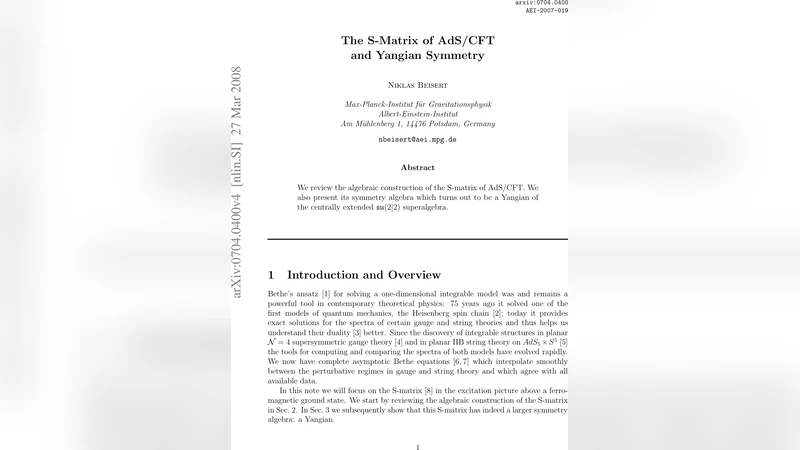
We review the algebraic construction of the S-matrix of AdS/CFT. We also present its symmetry algebra which turns out to be a Yangian of the centrally extended su(2|2) superalgebra.
💡 Research Summary
The paper provides a comprehensive algebraic construction of the two‑dimensional world‑sheet S‑matrix that underlies the integrable structure of the AdS₅/CFT₄ correspondence, and it demonstrates that the full symmetry of this S‑matrix is a Yangian extension of the centrally‑extended su(2|2) superalgebra. The authors begin by recalling that the planar N=4 super‑Yang‑Mills theory and its dual string theory on AdS₅×S⁵ admit an exact factorised scattering description, where the elementary excitations transform in the fundamental 4‑dimensional representation of a centrally‑extended su(2|2) algebra, denoted su(2|2)₍c₎. The central charges C, P and K encode the particle’s energy, momentum and a length‑changing operator that is characteristic of the dynamic spin‑chain picture.
The first technical step is to define su(2|2)₍c₎ explicitly, including its bosonic generators (R‑symmetry and su(2) rotations) and fermionic supercharges Q and S, together with the non‑trivial anticommutators that involve the central elements. The presence of these central extensions is crucial: they allow the representation to carry non‑zero momentum while preserving the superalgebraic relations, and they give rise to a non‑trivial dispersion relation that matches the string theory spectrum.
Next, the authors construct multi‑particle states by taking graded tensor products of the fundamental representation. On this tensor product space they introduce a coproduct Δ that acts in the standard way on the level‑zero generators (Δ(J⁽⁰⁾)=J⁽⁰⁾⊗1+1⊗J⁽⁰⁾) but acquires an additional bilinear term for the level‑one Yangian generators: Δ(J⁽¹⁾)=J⁽¹⁾⊗1+1⊗J⁽¹⁾+½ f^{abc} J⁽⁰⁾_b⊗J⁽⁰⁾_c, where f^{abc} are the structure constants of su(2|2)₍c₎. This non‑cocommutative coproduct is the hallmark of a Yangian symmetry and encodes the hidden infinite tower of conserved charges that guarantee integrability beyond the Lie‑algebraic level.
The S‑matrix itself is presented as an R‑matrix that intertwines the tensor product representations. Its matrix part is essentially the unique solution of the Yang‑Baxter equation compatible with su(2|2)₍c₎, while a scalar dressing factor φ(p₁,p₂) multiplies it. The dressing factor is fixed by imposing crossing symmetry and unitarity; it satisfies the BES (Beisert‑Eden‑Staudacher) integral equation and can be expressed in terms of Gamma functions and a square‑root branch cut structure. This factor captures the so‑called “dynamical” effects associated with the length‑changing central charge and ensures that the S‑matrix reproduces the exact magnon dispersion relation.
To prove Yangian invariance, the authors verify the intertwining relation Δᵒᵖ(J) R = R Δ(J) for all level‑zero and level‑one generators, where Δᵒᵖ denotes the opposite coproduct. The calculation shows that the non‑trivial bilinear term in the level‑one coproduct precisely cancels the extra contributions arising from the central extensions, confirming that the S‑matrix is a true Yangian invariant. Moreover, they discuss Drinfeld’s second realisation, demonstrating that the Yangian can be generated by a set of Chevalley‑type generators obeying Serre relations, and they argue that the infinite set of higher‑level charges maps directly onto the long‑range interactions appearing in the asymptotic Bethe ansatz for the AdS/CFT spectral problem.
In the concluding section the authors emphasize the physical implications of this algebraic structure. The Yangian symmetry explains why the asymptotic Bethe equations, which incorporate the dressing phase, correctly reproduce the planar spectrum up to wrapping corrections. It also provides a systematic framework for constructing transfer matrices, Baxter Q‑operators and for analysing finite‑size effects via the thermodynamic Bethe ansatz. The paper thus establishes that the centrally‑extended su(2|2) Yangian is the fundamental symmetry underlying the exact world‑sheet scattering in AdS/CFT, opening the way for further developments in higher‑loop calculations, non‑perturbative checks, and potential generalisations to other holographic dualities.
Comments & Academic Discussion
Loading comments...
Leave a Comment