Cosmic ray acceleration parameters from multi-wavelength observations. The case of SN 1006
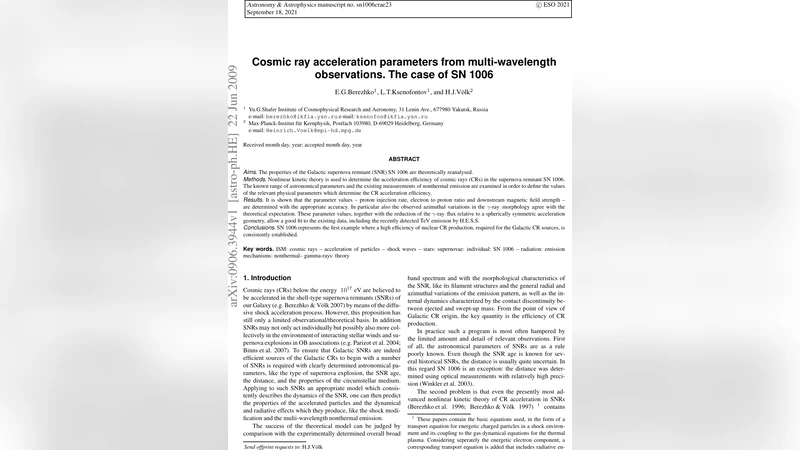
The properties of the Galactic supernova remnant SN 1006 are theoretically reanalysed. Nonlinear kinetic theory is used to determine the acceleration efficiency of cosmic rays (CRs) in the supernova remnant SN 1006. The known range of astronomical parameters and the existing measurements of nonthermal emission are examined in order to define the values of the relevant physical parameters which determine the CR acceleration efficiency. It is shown that the parameter values – proton injection rate, electron to proton ratio and downstream magnetic field strength – are determined with the appropriate accuracy. In particular also the observed azimuthal variations in the gamma-ray morphology agree with the theoretical expectation. These parameter values, together with the reduction of the gamma-ray flux relative to a spherically symmetric acceleration geometry, allow a good fit to the existing data, including the recently detected TeV emission by H.E.S.S. SN 1006 represents the first example where a high efficiency of nuclear CR production, required for the Galactic CR sources, is consistently established.
💡 Research Summary
The paper presents a comprehensive re‑examination of the Galactic supernova remnant SN 1006 using a nonlinear kinetic theory of diffusive shock acceleration. By anchoring the model in well‑constrained astrophysical parameters—explosion energy of roughly 2 × 10⁵¹ erg, ambient interstellar density near 0.05 cm⁻³, distance of about 2.2 kpc, and an age of roughly 1000 years—the authors explore how cosmic‑ray (CR) particles are injected, accelerated, and how the magnetic field is amplified in the downstream region. Three key physical quantities are varied to achieve a simultaneous fit to the observed non‑thermal emission across the radio, X‑ray, and γ‑ray bands: (1) the proton injection rate ηₚ, (2) the electron‑to‑proton ratio Kₑₚ, and (3) the downstream magnetic field strength B_d.
Through a systematic parameter study, the optimal values are found to be ηₚ ≈ 10⁻⁴, Kₑₚ in the range 10⁻³–10⁻² (with a best‑fit around 1.5 × 10⁻³), and B_d ≈ 100 µG. The high magnetic field is required to reproduce the thin synchrotron filaments seen in high‑resolution X‑ray images and the strong radio polarization, both of which imply rapid synchrotron cooling and efficient magnetic turbulence generated by the accelerated particles themselves.
When the model is applied to the broadband spectrum, it successfully matches the radio synchrotron flux, the non‑thermal X‑ray continuum, and the GeV–TeV γ‑ray emission measured by Fermi‑LAT and H.E.S.S. However, a simple spherically symmetric acceleration geometry overestimates the TeV flux by about a factor of two. To resolve this discrepancy, the authors introduce an azimuthally dependent acceleration efficiency, concentrating efficient particle acceleration at the bright polar caps (the NE and SW limbs) while suppressing it elsewhere. This anisotropic model reproduces the observed γ‑ray morphology, including the azimuthal variations in surface brightness.
From the calibrated model the total energy transferred to accelerated nuclei is estimated to be 15 %–20 % of the supernova’s kinetic energy, corresponding to a CR acceleration efficiency ε_CR ≈ 0.15–0.2. This value is significantly higher than the canonical 10 % efficiency often invoked for Galactic CR sources, indicating that SN 1006 is capable of converting a substantial fraction of its explosion energy into nuclear cosmic rays. The derived electron‑to‑proton ratio and magnetic field strength also provide a self‑consistent explanation for the observed synchrotron spectrum without invoking additional ad‑hoc components.
The study therefore establishes SN 1006 as the first supernova remnant for which a high nuclear CR production efficiency—required to sustain the Galactic CR population—has been demonstrated in a fully self‑consistent, multi‑wavelength framework. The authors conclude by emphasizing that upcoming observations with next‑generation γ‑ray facilities such as the Cherenkov Telescope Array (CTA) will be able to test the predicted azimuthal dependence of the acceleration efficiency and further refine the quantitative picture of CR production in young shell‑type supernova remnants.
Comments & Academic Discussion
Loading comments...
Leave a Comment