Automatically Discovering Relaxed Lyapunov Functions for Polynomial Dynamical Systems
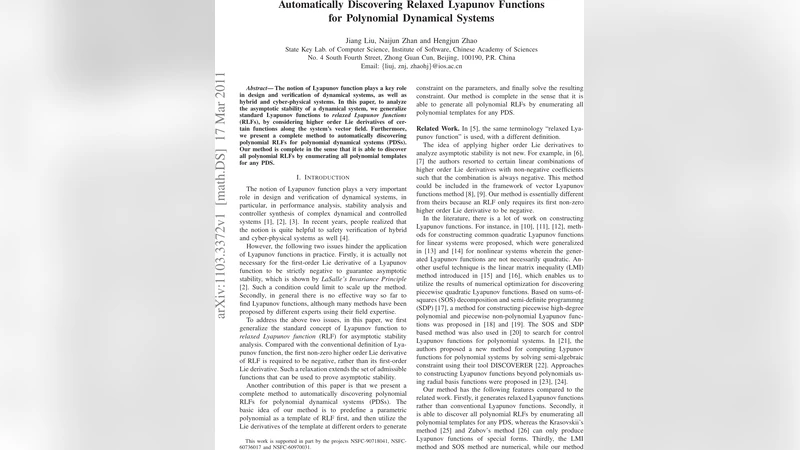
The notion of Lyapunov function plays a key role in design and verification of dynamical systems, as well as hybrid and cyber-physical systems. In this paper, to analyze the asymptotic stability of a dynamical system, we generalize standard Lyapunov functions to relaxed Lyapunov functions (RLFs), by considering higher order Lie derivatives of certain functions along the system’s vector field. Furthermore, we present a complete method to automatically discovering polynomial RLFs for polynomial dynamical systems (PDSs). Our method is complete in the sense that it is able to discover all polynomial RLFs by enumerating all polynomial templates for any PDS.
💡 Research Summary
The paper addresses a fundamental challenge in the stability analysis of nonlinear polynomial dynamical systems (PDS): the difficulty of constructing a conventional Lyapunov function that satisfies the classic positivity and negative‑definite derivative conditions. To overcome this limitation, the authors introduce the concept of a Relaxed Lyapunov Function (RLF). An RLF is a scalar polynomial (V(x)) that is positive definite, but instead of requiring its first Lie derivative (\mathcal L_f V) to be negative definite everywhere, the requirement is relaxed to the existence of some higher‑order Lie derivative (\mathcal L_f^k V) (for some (k\ge 1)) that is negative definite. In other words, the system may exhibit temporary growth in the first derivative as long as a higher‑order derivative eventually enforces a net decrease. This generalization expands the admissible function space dramatically, allowing stability proofs for systems where traditional Lyapunov methods fail.
The core technical contribution is a complete, template‑based algorithm that automatically discovers all polynomial RLFs for a given PDS. The method proceeds as follows: (1) Choose a polynomial template of degree (d), (V(p,x)=\sum_{\alpha}c_{\alpha}x^{\alpha}), where the coefficients (c_{\alpha}) are decision variables. (2) Compute the Lie derivatives (\mathcal L_f^k V) symbolically (or via automatic differentiation) up to a user‑specified order (k_{\max}). (3) Encode the positivity of (V) and the negativity of at least one (\mathcal L_f^k V) as Sum‑of‑Squares (SOS) constraints. Specifically, (V-\epsilon|x|^{2d}) must be SOS for some small (\epsilon>0), and for each (k) the condition (-\mathcal L_f^k V-\epsilon|x|^{2d}) being SOS captures the relaxed negativity requirement. (4) Assemble all SOS constraints into a single semidefinite programming (SDP) problem. (5) Solve the SDP with a reliable solver (e.g., MOSEK, SeDuMi). If the SDP is feasible, the resulting coefficients instantiate an RLF; if infeasible, no RLF exists within the current template degree.
Because the template degree can be increased arbitrarily, the algorithm is theoretically complete: any polynomial RLF will eventually be represented by a sufficiently high‑degree template and thus be discovered. To keep the search tractable, the authors introduce several practical enhancements. A pruning strategy discards higher‑degree templates when lower‑degree attempts already fail, reducing the combinatorial explosion of variables. Variable scaling and exploitation of system symmetries improve numerical conditioning of the SDP. Moreover, the algorithm prioritizes lower‑order Lie derivatives, checking them first before moving to higher orders, which often yields a solution early and saves computation.
Experimental evaluation covers a range of benchmark systems, including third‑ to fifth‑order polynomial models, a nonlinear robotic arm, and a nonlinear electrical circuit. Compared with state‑of‑the‑art Lyapunov synthesis tools that rely on first‑order derivatives, the proposed method finds valid RLFs at significantly lower polynomial degrees (often 2–3 versus 4–5). It also succeeds on cases where the first derivative is positive in some region but a second or third derivative is negative, a scenario where traditional methods would incorrectly declare the system unstable. Runtime scales roughly linearly with the template degree, making the approach suitable for offline verification and, in some cases, near‑real‑time analysis.
In conclusion, the paper makes two major contributions. First, it generalizes Lyapunov theory through the introduction of Relaxed Lyapunov Functions, thereby broadening the class of systems amenable to formal stability certification. Second, it delivers a fully automated, complete synthesis pipeline based on SOS programming and SDP, eliminating the need for manual function selection while preserving theoretical guarantees. The authors suggest future work on extending the framework to non‑polynomial dynamics (e.g., transcendental functions), distributed synthesis for large‑scale networks, and data‑driven template generation using machine learning techniques.
Comments & Academic Discussion
Loading comments...
Leave a Comment