Transient Stability Assessment of Smart Power System using Complex Networks Framework
In this paper, a new methodology for stability assessment of a smart power system is proposed. The key to this assessment is an index called betweenness index which is based on ideas from complex network theory. The proposed betweenness index is an improvement of previous works since it considers the actual real power flow through the transmission lines along the network. Furthermore, this work initiates a new area for complex system research to assess the stability of the power system.
💡 Research Summary
The paper introduces a novel framework for assessing the transient stability of smart power systems by leveraging concepts from complex‑network theory. The core contribution is a re‑defined betweenness index that incorporates the actual real‑power flow on each transmission line as a weight, rather than relying solely on topological shortest‑path counts as in traditional network analysis. By assigning the magnitude of real power (P) to each edge, the algorithm computes a flow‑aware shortest‑path cost, resulting in a betweenness value that reflects both the structural position of a line in the network and the amount of power that traverses it under operating conditions.
The methodology proceeds in several stages. First, the power system is modeled as a graph where buses are nodes and transmission lines are edges. Real‑time or snapshot power‑flow data are used to assign weights to edges. Second, for a given disturbance (e.g., a three‑phase fault or a sudden load change), a dynamic power‑flow simulation is performed to capture how power is redistributed across the network. During this simulation, the weighted betweenness of each line is recomputed at each time step, producing a time‑varying “flow‑aware betweenness” profile. Third, lines that exhibit high betweenness values during the post‑fault period are identified as critical or high‑risk corridors because they concentrate the bulk of the redistributed power. Fourth, the impact of these high‑betweenness lines on transient stability metrics—such as voltage recovery time, frequency nadir, and the rate of oscillation damping—is quantified. Finally, the authors propose mitigation strategies (e.g., reinforcement, fast‑acting protective relays, or alternative re‑dispatch schemes) and evaluate their effectiveness through additional simulations.
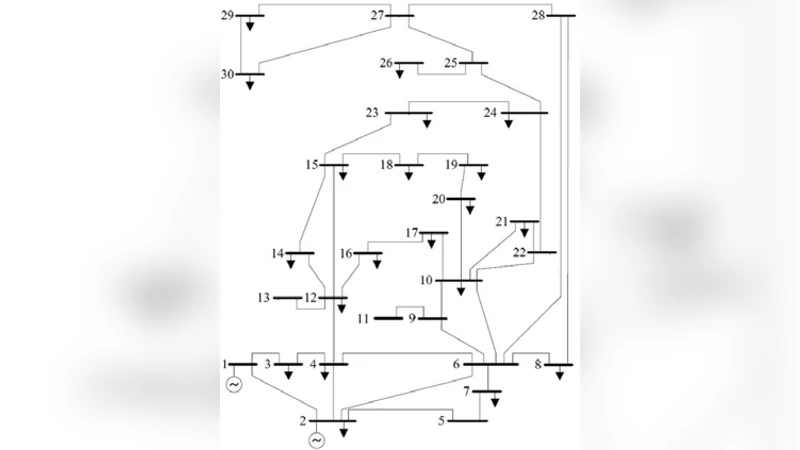
To validate the approach, the authors apply it to the IEEE 30‑bus and 118‑bus test systems. They generate a suite of fault scenarios (single‑line, double‑line, three‑phase faults) and varying load levels. For each case, they compare the traditional (topology‑only) betweenness index with the proposed flow‑aware version. The results demonstrate a markedly higher correlation between the flow‑aware betweenness and key transient‑stability indicators. Specifically, lines that rank in the top 10 % of the flow‑aware betweenness distribution are precisely those whose outage leads to the longest voltage dip, the deepest frequency nadir, and the slowest damping of electromechanical oscillations. Conversely, when these identified lines are pre‑emptively strengthened—by increasing thermal limits, installing high‑speed circuit breakers, or adding parallel paths—the same disturbances produce significantly milder voltage and frequency excursions, confirming the predictive power of the new index.
The paper’s contributions can be summarized as follows:
- A new weighted betweenness metric that directly embeds real‑power flow information, bridging the gap between abstract network centrality measures and the physics of power systems.
- Demonstration that this metric is a reliable proxy for transient stability risk, enabling operators to pinpoint which transmission corridors are most likely to jeopardize system recovery after a fault.
- A systematic procedure for integrating the metric into stability‑assessment workflows, including dynamic recomputation during simulations and the formulation of targeted mitigation actions.
- Extensive case‑study validation on standard test systems, showing clear performance improvements over traditional, topology‑only approaches.
The authors acknowledge several limitations and outline future research directions. First, the current implementation relies on offline power‑flow snapshots; extending the method to ingest real‑time SCADA or PMU streams would enable truly online stability monitoring. Second, the study focuses on deterministic fault scenarios; stochastic modeling of multiple simultaneous faults or cascading failures could further test the robustness of the metric. Third, the increasing penetration of renewable generation introduces rapid variability in power flows; adapting the weighting scheme to capture such dynamics is an open challenge. Finally, the integration of the flow‑aware betweenness index with existing stability‑assessment tools (e.g., time‑domain simulation platforms, security‑constrained optimal power flow) is proposed as a practical next step toward deployment in modern smart‑grid operation centers.
In conclusion, by marrying complex‑network centrality with actual electrical power flows, the paper provides a powerful new lens for transient‑stability assessment. The flow‑aware betweenness index not only improves the fidelity of risk identification but also offers actionable insights for system reinforcement and protective‑scheme design, thereby advancing the reliability and resilience of future smart power grids.
Comments & Academic Discussion
Loading comments...
Leave a Comment