Statistical Analysis of the Correlation between Active Galactic Nuclei and Ultra-High Energy Cosmic Rays
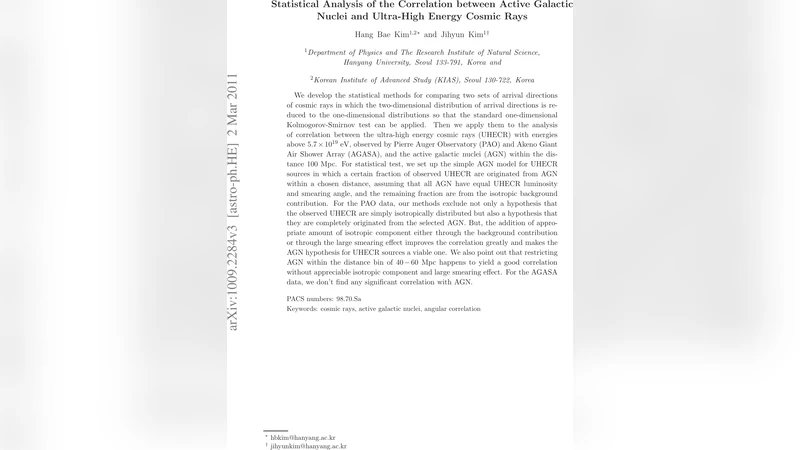
We develop the statistical methods for comparing two sets of arrival directions of cosmic rays in which the two-dimensional distribution of arrival directions is reduced to the one-dimensional distributions so that the standard one-dimensional Kolmogorov-Smirnov test can be applied. Then we apply them to the analysis of correlation between the ultra-high energy cosmic rays (UHECR) with energies above $5.7\times10^{19}$ eV, observed by Pierre Auger Observatory (PAO) and Akeno Giant Air Shower Array (AGASA), and the active galactic nuclei (AGN) within the distance 100 Mpc. For statistical test, we set up the simple AGN model for UHECR sources in which a certain fraction of observed UHECR are originated from AGN within a chosen distance, assuming that all AGN have equal luminosity and smearing angle of UHECR, and the remaining fraction are from the isotropic background contribution. For the PAO data, our methods exclude not only a hypotheses that the observed UHECR are simply isotropically distributed but also a hypothesis that they are completely originated from the selected AGN. But, the addition of appropriate amount of isotropic component either through the background contribution or through the large smearing effect improves the correlation greatly and makes the AGN hypothesis for UHECR sources a viable one. We also point out that restricting AGN within the distance bin of 40-60 Mpc happens to yield a good correlation without appreciable isotropic component and large smearing effect. For the AGASA data, we don’t find any significant correlation with AGN.
💡 Research Summary
The paper introduces a novel statistical framework for testing positional correlations between ultra‑high‑energy cosmic rays (UHECRs) and active galactic nuclei (AGN). Traditional two‑dimensional sky‑map analyses suffer from low statistical power because of limited event numbers and complex anisotropies. To overcome this, the authors first map each UHECR’s arrival direction onto a one‑dimensional cumulative distribution by computing its angular distance to every AGN within a chosen distance cut (≤ 100 Mpc) and then constructing a cumulative distribution function (CDF) of those distances. This “distance‑angle reduction” collapses the spherical data onto a single variable, enabling the use of the Kolmogorov‑Smirnov (KS) test, a non‑parametric method that compares the empirical CDF with a model CDF and yields a p‑value based on the maximum deviation D.
The model CDF is built from a mixed source hypothesis characterized by two parameters: (i) the fraction f of observed UHECRs that originate from the selected AGN, and (ii) a smearing angle σ that accounts for magnetic‑field‑induced deflections, modeled as a Gaussian spread around each AGN direction. The remaining (1 − f) fraction is assumed to be isotropic background. By scanning the (f, σ) plane, the authors locate regions where the KS p‑value is maximized, i.e., where the model best reproduces the data.
Data from the Pierre Auger Observatory (PAO) (27 events with E > 5.7 × 10¹⁹ eV) and from the Akeno Giant Air Shower Array (AGASA) (57 events with E > 4 × 10¹⁹ eV) are examined. The AGN catalogue consists of 442 objects within 100 Mpc, further divided into distance bins (0‑20, 20‑40, 40‑60, 60‑80, 80‑100 Mpc) to test whether a particular shell of the local universe drives any correlation.
For the PAO sample, the pure‑AGN hypothesis (f = 1, σ ≈ 0°) is strongly rejected (p < 0.001), as is the pure‑isotropy hypothesis (f = 0, p ≈ 0.02). However, when a moderate isotropic component is added (f ≈ 0.5–0.7) and a realistic smearing of σ ≈ 10°–30° is allowed, the KS p‑value rises to 0.2–0.5, indicating acceptable agreement. Notably, restricting the AGN to the 40–60 Mpc distance shell yields a good fit with only a modest smearing (σ ≈ 5°–15°) and without requiring a large isotropic fraction, suggesting that AGN in this shell could dominate the observed UHECR flux.
In contrast, the AGASA data show no statistically significant correlation for any (f, σ) combination; p‑values remain below 0.05 across the entire parameter space. This discrepancy may stem from the southern‑hemisphere bias of PAO (where most nearby AGN lie), different energy thresholds, or systematic differences between the two experiments.
The study’s key contributions are: (1) a practical method to reduce two‑dimensional sky distributions to a one‑dimensional form suitable for KS testing, (2) a quantitative demonstration that PAO UHECRs are inconsistent with both pure isotropy and pure AGN origin, yet compatible with a mixed model that includes realistic magnetic deflections, and (3) evidence that a specific distance range of AGN (40–60 Mpc) can explain the data without invoking a large isotropic background. These findings reinforce the view that AGN remain viable UHECR sources, but any realistic model must incorporate both magnetic smearing and a non‑negligible isotropic component.
Comments & Academic Discussion
Loading comments...
Leave a Comment