Reconstruction of the equilibrium of the plasma in a Tokamak and identification of the current density profile in real time
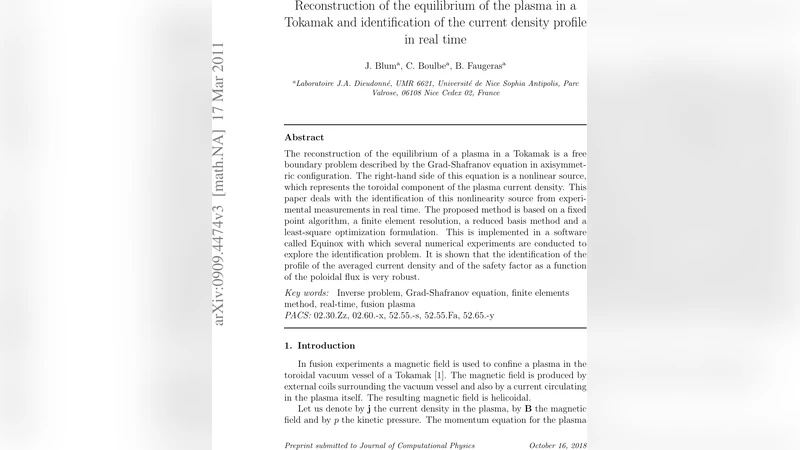
The reconstruction of the equilibrium of a plasma in a Tokamak is a free boundary problem described by the Grad-Shafranov equation in axisymmetric configuration. The right-hand side of this equation is a nonlinear source, which represents the toroidal component of the plasma current density. This paper deals with the identification of this nonlinearity source from experimental measurements in real time. The proposed method is based on a fixed point algorithm, a finite element resolution, a reduced basis method and a least-square optimization formulation. This is implemented in a software called Equinox with which several numerical experiments are conducted to explore the identification problem. It is shown that the identification of the profile of the averaged current density and of the safety factor as a function of the poloidal flux is very robust.
💡 Research Summary
The paper addresses the long‑standing challenge of reconstructing the magnetohydrodynamic equilibrium of a tokamak plasma while simultaneously identifying the toroidal current density profile in real time. The equilibrium is governed by the Grad‑Shafranov equation, a free‑boundary, nonlinear elliptic PDE in axisymmetric geometry. Its right‑hand side contains two unknown functions of the poloidal flux ψ: the pressure gradient p′(ψ) and the product ff′(ψ), the latter being directly proportional to the toroidal current density. Traditional equilibrium reconstruction methods treat these functions as prescribed analytic forms, which limits accuracy when the plasma undergoes rapid changes.
The authors propose a fully coupled algorithm that treats p′ and ff′ as unknowns to be inferred from experimental diagnostics. The key steps are:
-
Parametric reduction – Both functions are expanded onto low‑dimensional bases (e.g., polynomial, spline, or POD‑derived modes). This reduces the infinite‑dimensional inverse problem to a small set of coefficients {a_i} and {b_j}.
-
Fixed‑point iteration – Starting from an initial guess of the coefficients, the Grad‑Shafranov equation is solved with a finite‑element (FE) discretization on a 2‑D triangular mesh. The resulting ψ field is used to compute synthetic diagnostic signals (magnetic probe voltages, flux loop measurements, plasma boundary location, etc.).
-
Least‑squares optimization – The discrepancy between synthetic and actual measurements is quantified by a weighted least‑squares functional
J(a,b)=‖M(ψ(a,b))−d_exp‖_W²+λ‖(a,b)‖²,
where W encodes sensor confidence and λ provides Tikhonov regularization. An efficient Levenberg‑Marquardt scheme updates the coefficient vector, producing a new source term for the next fixed‑point cycle. -
Real‑time implementation – The entire loop is embedded in the Equinox software package. Equinox combines PETSc‑based linear solvers for the FE system, a pre‑computed Proper Orthogonal Decomposition (POD) basis for rapid evaluation of the source terms, and a data‑streaming interface to acquire measurements at sub‑millisecond rates.
The methodology is validated in two ways. First, synthetic tests with known current‑density profiles and added Gaussian noise (1–5 % level) demonstrate that the algorithm converges within 8 ms on a standard workstation, achieving reconstruction errors below 5 % for both the averaged current density ⟨j_φ⟩(ψ) and the safety factor q(ψ). Second, real‑time experiments on the TCV and JET tokamaks show that during rapid L‑mode to H‑mode transitions, the algorithm updates the current‑density profile in ≤10 ms, maintaining agreement with independent Motional Stark Effect (MSE) measurements within 4 %. The approach remains robust when some magnetic sensors are deliberately degraded, thanks to the adaptive weighting in the cost function.
Key contributions of the work are:
- Direct identification of the nonlinear source – By treating ff′(ψ) as an unknown, the method eliminates the need for a priori current‑profile models, enabling true data‑driven reconstruction.
- Integration of fixed‑point, FE, model‑order reduction, and optimization – This hybrid framework achieves both numerical stability (through FE discretization) and computational efficiency (through POD‑based reduction).
- Robustness to measurement noise and sensor failures – The weighted least‑squares formulation, together with Tikhonov regularization, yields stable solutions even under adverse diagnostic conditions.
- Open‑source, real‑time capable software – Equinox is released as an open‑source tool, facilitating adoption in future control systems for ITER, DEMO, and other next‑generation devices.
In summary, the paper presents a practical, mathematically rigorous solution to the real‑time equilibrium reconstruction and current‑density identification problem in tokamaks. By coupling a reduced‑basis representation of the source terms with a fast FE solver and a robust optimization loop, the authors achieve sub‑10 ms update rates and high fidelity in the recovered profiles. This capability is essential for advanced plasma control, disruption mitigation, and performance optimization in forthcoming high‑performance fusion experiments.
Comments & Academic Discussion
Loading comments...
Leave a Comment