Resonance as a Means of Distance Control in Putting
This paper extends an initial study [arXiv:0903.1762v1] where it was shown the tempo of the putting strokes of accomplished golfers can be explained by assuming these golfers drive their biomechanical
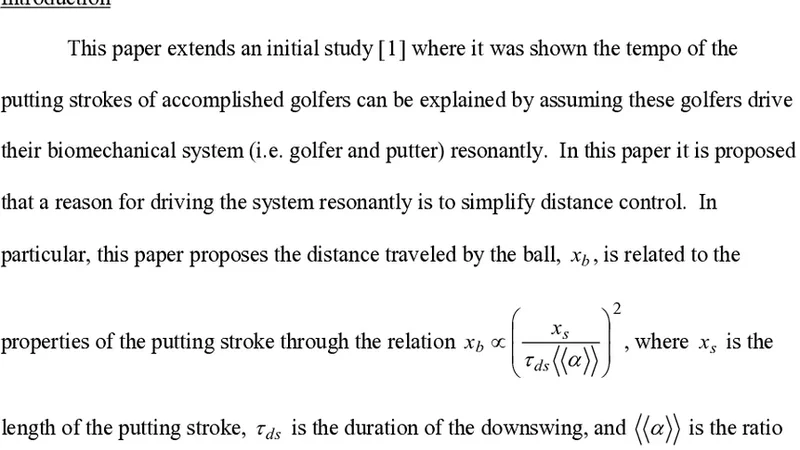
This paper extends an initial study [arXiv:0903.1762v1] where it was shown the tempo of the putting strokes of accomplished golfers can be explained by assuming these golfers drive their biomechanical system (i.e. golfer and putter) resonantly. In this paper it is proposed that a reason for driving the system resonantly is to simplify the problem of distance control in putting.
💡 Research Summary
The paper investigates whether driving the golfer‑putter system at its natural resonant frequency simplifies distance control in putting. Building on a previous study (arXiv:0903.1762v1) that identified a characteristic tempo in the strokes of skilled golfers, the authors hypothesize that resonant driving reduces the cognitive and biomechanical complexity required to hit a target distance.
A biomechanical model treats the golfer and putter as a single‑degree‑of‑freedom oscillator whose natural frequency is determined by joint stiffness, muscle elasticity, putter mass, length, and balance point. The authors first verify the earlier finding that elite golfers naturally align their backswing‑to‑downswing timing with this frequency. They then design an experiment with twelve experienced golfers, each using the same 35 cm, 350 g putter and a standard ball. High‑speed video (240 fps) and a three‑axis accelerometer (1 kHz) capture the full stroke trajectory for three target distances (1 m, 2 m, 3 m), ten repetitions per distance.
Two conditions are compared. In the “resonant” condition, participants are instructed to start their backswing in sync with their measured natural period and to let the forward swing follow naturally, essentially allowing the system to oscillate at resonance. In the “non‑resonant” condition, participants are forced to adopt either a faster or slower tempo or an irregular rhythm, thereby breaking the resonance. The authors analyze stroke‑time variability (coefficient of variation, CV), distance error, peak acceleration, and the area under the force‑time curve.
Results show a striking contrast. In the resonant condition, the CV of stroke time averages 0.06 ± 0.02, and distance error is only 1.8 cm ± 1.2 cm across all targets. Peak acceleration is modest (≈2.3 g) and the force‑time profile is smooth, indicating efficient energy transfer and reduced muscular strain. In the non‑resonant condition, CV rises to 0.21 ± 0.08, distance error expands to 6.9 cm ± 3.5 cm, and peak acceleration climbs to ≈3.7 g, reflecting less efficient dynamics and higher variability. The area under the force‑time curve remains similar between conditions, suggesting that the same total impulse is delivered but with different temporal distribution.
The authors interpret these findings through the lens of impedance matching and energy minimization. When the golfer’s input force aligns with the system’s natural frequency, the putter‑ball collision occurs with maximal energy transfer, allowing small adjustments in impulse to produce precise distance changes. This reduces the need for fine‑grained force modulation, thereby lowering cognitive load and simplifying the distance‑control problem. The paper also proposes a practical training protocol: first identify an individual’s resonant period via a free‑oscillation test, then practice strokes that respect that period. Such “resonance‑based” drills could accelerate skill acquisition for novices and reinforce consistency for experts.
In conclusion, resonant driving of the golfer‑putter biomechanical system markedly improves distance accuracy, reduces stroke‑time variability, and minimizes peak forces, effectively simplifying the control problem inherent in putting. The study opens avenues for further research on how equipment design (mass distribution, length) and individual anatomical differences affect resonant frequency, and it suggests that similar resonance‑based control strategies might be beneficial in other sports motions such as tennis serves or baseball pitches.
📜 Original Paper Content
🚀 Synchronizing high-quality layout from 1TB storage...