Some results on homology of Leibniz and Lie n-algebras
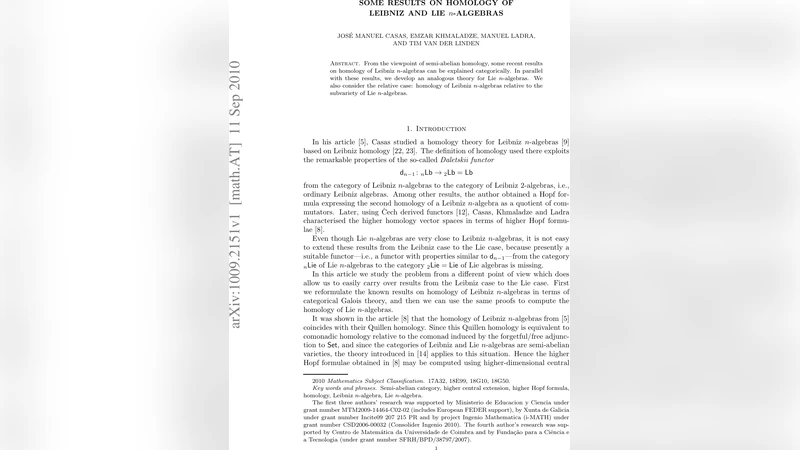
From the viewpoint of semi-abelian homology, some recent results on homology of Leibniz n-algebras can be explained categorically. In parallel with these results, we develop an analogous theory for Lie n-algebras. We also consider the relative case: homology of Leibniz n-algebras relative to the subvariety of Lie n-algebras.
💡 Research Summary
This paper places the homology of Leibniz n‑algebras and Lie n‑algebras within the framework of semi‑abelian homology, showing that many recent results can be understood categorically and extending the theory to a relative setting. The authors first establish that the category of Leibniz n‑algebras is semi‑abelian: it possesses finite limits, regular epimorphisms, and a well‑behaved notion of kernel and cokernel. Within this context they define “n‑central extensions,” a higher‑dimensional analogue of the classical central extensions used in the homology of ordinary Leibniz algebras. By proving that every regular epimorphism can be factored through an n‑central extension, they obtain a robust supply of projective presentations suitable for homological calculations.
The core technical tool is a standard (or Barr–Beck) complex adapted to n‑ary operations. The authors show that the k‑th homology group of a Leibniz n‑algebra coincides with the (k‑1)‑st cross‑effect of the underlying n‑ary functor. In other words, the homology measures precisely how far the n‑ary multiplication fails to be additive in each argument, and higher cross‑effects capture higher‑order failures. This yields explicit formulas for low‑dimensional homology and clarifies why, for Lie n‑algebras (where the bracket is alternating), many cross‑effects vanish, leading to a dramatically simpler homology.
Having set up the absolute theory, the paper turns to the relative case: the inclusion functor from Lie n‑algebras into Leibniz n‑algebras. The authors define relative homology as the homology of the mapping cone of the induced morphism of standard complexes. They prove a “relative central‑twist theorem” stating that the relative homology groups are exactly the differences between the cross‑effects of the Leibniz and Lie structures, twisted by the central kernel of the inclusion. In degree one, this relative homology coincides with the kernel of the canonical abelianization map from a Leibniz n‑algebra to its associated Lie n‑algebra, providing a concrete description of the obstruction to Lie‑type behavior.
Concrete calculations are carried out for free Leibniz n‑algebras and their associated free Lie n‑algebras. The authors compute that the second homology of a free Leibniz 3‑algebra is isomorphic to the first cross‑effect, while the corresponding Lie 3‑algebra has trivial second homology because all cross‑effects vanish. The relative homology in degree one is shown to be generated by the “twist” elements that measure the failure of the Leibniz bracket to be alternating. These examples illustrate how the abstract categorical machinery yields explicit, computable invariants.
In the concluding section the authors discuss the broader implications of their work. By embedding Leibniz and Lie n‑algebras into a semi‑abelian setting, they provide a unifying language that can be applied to other higher‑arity algebraic structures such as L∞‑algebras or A∞‑algebras. The relative homology framework offers a systematic way to compare different varieties of algebras, opening the door to a homological study of “change of operad” phenomena. Future research directions suggested include extending the cross‑effect analysis to non‑semi‑abelian contexts, investigating higher‑dimensional central extensions, and exploring connections with deformation theory and higher categorical algebra. Overall, the paper delivers a coherent categorical perspective on the homology of Leibniz and Lie n‑algebras, supplies concrete computational tools, and establishes a platform for further exploration of homological properties across a spectrum of higher‑arity algebraic theories.
Comments & Academic Discussion
Loading comments...
Leave a Comment