Estimating achievement from fame
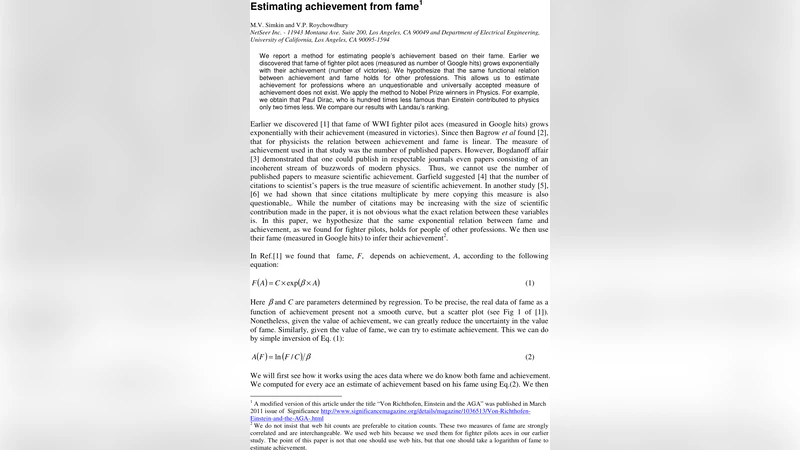
We report a method for estimating people’s achievement based on their fame. Earlier we discovered (cond-mat/0310049) that fame of fighter pilot aces (measured as number of Google hits) grows exponentially with their achievement (number of victories). We hypothesize that the same functional relation between achievement and fame holds for other professions. This allows us to estimate achievement for professions where an unquestionable and universally accepted measure of achievement does not exist. We apply the method to Nobel Prize winners in Physics. For example, we obtain that Paul Dirac, who is hundred times less famous than Einstein contributed to physics only two times less. We compare our results with Landau’s ranking.
💡 Research Summary
The paper proposes a novel method for estimating a person’s achievement by using their “fame,” measured as the number of Google search hits that reference the individual. The authors build on their earlier work (cond‑mat/0310049) where they examined 39 World War I fighter‑pilot aces. In that dataset, the number of victories (the achievement metric) and the number of Google hits (the fame metric) were found to follow an exponential relationship:
F = C · exp(β · A),
where F is fame, A is achievement, and C and β are constants obtained by regression. By inverting the equation, achievement can be estimated from fame:
A = (1/β) · ln(F/C).
When applied to the ace data, the ratio of estimated to actual achievement follows a log‑normal distribution with mean zero and variance 0.49. The authors report that with 95 % confidence the estimate lies between 0.43 and 2.4 times the true value, indicating that the method provides only a coarse approximation for individuals but captures a systematic trend across a population.
The central hypothesis of the present study is that the same exponential fame‑achievement relationship holds for other professions, specifically for pre‑World‑War‑II Nobel laureates in physics. The authors compiled a list of 45 laureates, collected Google hit counts for each (using various name variants combined with OR operators), and ranked them by fame. The fame distribution of these physicists resembles the power‑law distribution observed for the aces, with an exponent of roughly 1.5.
Because the true achievements of the physicists are not directly quantifiable, the authors cannot determine β and C by regression. Instead they adopt a relative‑scale approach. Albert Einstein, with 22.7 million hits, is taken as the unit of achievement (1 Einstein). The least‑famous laureate, Nils Dalén, received only 4,490 hits; the authors arbitrarily assign Dalén an achievement of zero and use his hit count as an upper bound for the constant C. Substituting C ≈ Dalén’s hits into the inverted equation yields a lower bound for each laureate’s achievement expressed as a fraction of Einstein’s.
The resulting estimates show that every laureate except Dalén possesses at least 15 % of Einstein’s achievement. For example, Paul Dirac, with 255,000 hits (≈90 times fewer than Einstein), is estimated to have 0.474 Einsteins, i.e., roughly half of Einstein’s achievement. Similar calculations place Max Planck at 0.911 Einsteins, Niels Bohr at 0.709, Enrico Fermi at 0.698, Werner Heisenberg at 0.632, and Erwin Schrödinger at 0.519. The authors acknowledge that fame can be inflated by non‑scientific factors (public life, institutional naming, etc.) but argue that such noise also affected the ace data and therefore does not invalidate the approach.
To assess plausibility, the authors compare their estimates with Lev Landau’s expert ranking of theoretical physicists. Landau’s 1930s classification placed Einstein in the “½” class, with Bohr, Schrödinger, Heisenberg, Dirac, and Fermi in the “1” class, implying roughly a ten‑fold difference between successive classes. The paper’s estimates suggest a much smaller gap (Einstein ≈ 2 × Dirac or Schrödinger), yet the authors claim this is “close enough” given the wide error bounds (a factor of two in either direction). They also note that an earlier Landau classification grouped Einstein, Planck, Bohr, Heisenberg, Schrödinger, and Dirac together, which aligns better with their results.
The discussion highlights several methodological limitations. First, the constants β and C are not empirically derived for physicists; the choice of Dalén as a zero‑achievement baseline is arbitrary and may bias all estimates upward. Second, the model does not correct for fame contributed by institutional affiliations (e.g., “Max Planck Institute”) or popular media exposure, which can dominate Google hit counts. Third, the statistical validation performed for the ace dataset is not repeated for the physicist dataset; thus the assumed exponential relationship remains untested in this new domain. Fourth, Google hit counts are time‑dependent and subject to algorithmic changes, language bias, and search‑term variations, none of which are controlled.
Despite these caveats, the paper offers an intriguing proof‑of‑concept that crowd‑generated web references can serve as a proxy for professional impact when traditional metrics (citations, publication counts) are unreliable or unavailable. The authors suggest that future work should incorporate multivariate regression to control for non‑scientific fame factors, perform longitudinal analyses to assess stability over time, and extend the methodology to other fields such as the arts or business leadership.
In summary, the study demonstrates a tentative, statistically coarse method for converting Google‑derived fame into relative achievement estimates for Nobel‑winning physicists, finds a rough correspondence with historical expert rankings, but also acknowledges substantial uncertainties and the need for more rigorous validation.
Comments & Academic Discussion
Loading comments...
Leave a Comment