Biomarkers set in context
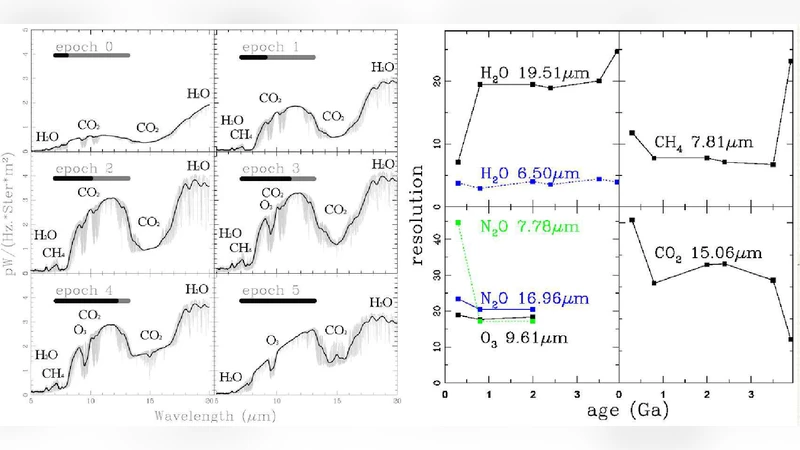
In a famous paper, Sagan et al.(1993) analyzed a spectrum of the Earth taken by the Galileo probe, searching for signatures of life. They concluded that the large amount of O2 and the simultaneous presence of CH4 traces are strongly suggestive of biology. The detection of a widespread red-absorbing pigment with no likely mineral origin supports the hypothesis of biophotosynthesis. The search for signs of life on possibly very different planets implies that we need to gather as much information as possible in order to understand how the observed atmosphere physically and chemically works. The Earth-Sun intensity ratio is about 10^{-7} in the thermal infrared (10 micrometer), and about 10^{-10} in the visible (0.5 micrometer). The interferometric systems suggested for Darwin and the Terrestrial Planet Finder Interferometer (TPF-I) mission operates in the mid-IR (5 - 20 micrometer), the coronagraph suggested for Terrestrial Planet Finder Coronagraph (TPF-C) in the visible (0.5 - 1 micrometer). For the former it is thus the thermal emission emanating from the planet that is detected and analyzed while for the later the reflected stellar flux is measured. The spectrum of the planet can contain signatures of atmospheric species that are important for habitability, like CO2 and H2O, or result from biological activity (O2, O3, CH4, and N2O). Both spectral regions contain atmospheric bio-indicators. The presence or absence of these spectral features will indicate similarities or differences with the atmospheres of terrestrial planets and are discussed in detail and set into context with the physical characteristics of a planet in this chapter.
💡 Research Summary
The chapter revisits the landmark 1993 Galileo Earth‑shine spectrum analysis by Sagan et al., emphasizing that the simultaneous detection of large amounts of molecular oxygen (O₂) and trace methane (CH₄) is a strong, chemically unstable signature that points to continuous biological production. The presence of a broad red‑absorbing pigment, most plausibly chlorophyll, further reinforces the hypothesis of photosynthetic life because no known mineral can reproduce that spectral feature. Building on this Earth benchmark, the authors discuss the observational strategies required for future exoplanet missions. Two wavelength regimes dominate the design space: the mid‑infrared (5–20 µm) where a planet’s thermal emission is measured, and the visible (0.5–1 µm) where reflected stellar light is captured. In the thermal IR the Earth‑Sun flux ratio is roughly 10⁻⁷, allowing interferometric concepts such as ESA’s Darwin and NASA’s Terrestrial Planet Finder Interferometer (TPF‑I) to isolate the planetary signal by nulling the host star. In the visible the flux ratio drops to about 10⁻¹⁰, demanding ultra‑high‑contrast coronagraphs like the proposed TPF‑C. Both regimes can reveal key atmospheric constituents: CO₂ and H₂O as habitability markers, and O₃, N₂O, O₂, and CH₄ as potential biosignatures. The authors stress that detecting any single molecule is insufficient; a coherent picture of atmospheric chemistry, temperature‑pressure structure, and surface‑atmosphere interactions must be constructed. For example, a sustained O₂–CH₄ coexistence requires active sources (photosynthesis, methanogenesis) and cannot be maintained by abiotic processes alone. Consequently, comprehensive photochemical and climate modeling is essential to rule out false positives. The chapter concludes that a synergistic, multi‑band approach—combining mid‑IR thermal emission data with visible reflected‑light spectra—offers the most robust pathway to assess exoplanetary atmospheres. By integrating high‑resolution spectroscopy, advanced starlight‑suppression techniques, and sophisticated atmospheric models, future missions can discriminate between purely physical‑chemical states and those indicative of life, thereby advancing the search for biosignatures beyond the Solar System.
Comments & Academic Discussion
Loading comments...
Leave a Comment