Aneka Cloud Application Platform and Its Integration with Windows Azure
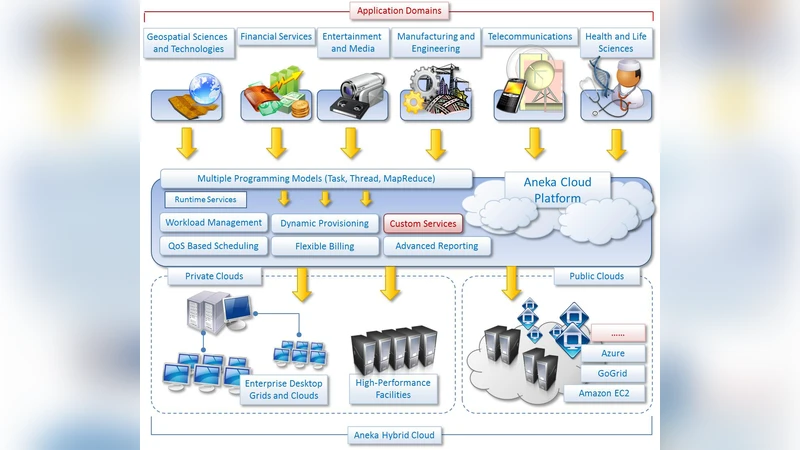
Aneka is an Application Platform-as-a-Service (Aneka PaaS) for Cloud Computing. It acts as a framework for building customized applications and deploying them on either public or private Clouds. One of the key features of Aneka is its support for provisioning resources on different public Cloud providers such as Amazon EC2, Windows Azure and GoGrid. In this chapter, we will present Aneka platform and its integration with one of the public Cloud infrastructures, Windows Azure, which enables the usage of Windows Azure Compute Service as a resource provider of Aneka PaaS. The integration of the two platforms will allow users to leverage the power of Windows Azure Platform for Aneka Cloud Computing, employing a large number of compute instances to run their applications in parallel. Furthermore, customers of the Windows Azure platform can benefit from the integration with Aneka PaaS by embracing the advanced features of Aneka in terms of multiple programming models, scheduling and management services, application execution services, accounting and pricing services and dynamic provisioning services. Finally, in addition to the Windows Azure Platform we will illustrate in this chapter the integration of Aneka PaaS with other public Cloud platforms such as Amazon EC2 and GoGrid, and virtual machine management platforms such as Xen Server. The new support of provisioning resources on Windows Azure once again proves the adaptability, extensibility and flexibility of Aneka.
💡 Research Summary
The chapter presents Aneka, an Application Platform‑as‑a‑Service (PaaS) designed to simplify the development, deployment, and management of cloud‑based applications, and details its integration with Microsoft Windows Azure. Aneka’s architecture is organized into three logical layers. The topmost Application Model Layer offers multiple programming abstractions—Task, Thread, MapReduce, Parameter Sweep, and others—allowing developers to express parallelism in the paradigm most natural to their problem domain. Beneath this, the Middleware Services Layer provides core cloud services such as a pluggable scheduler, resource manager, accounting and pricing engine, monitoring, and lifecycle management. These services are exposed through well‑defined interfaces, enabling developers to replace or extend them without affecting the rest of the system. The lowest Infrastructure Layer abstracts the underlying compute substrate and contains the Provisioning Service, which is responsible for acquiring and releasing virtual resources from a variety of providers (Amazon EC2, Windows Azure, GoGrid, XenServer, etc.).
The integration with Azure focuses on enabling the Azure Compute Service to act as a resource provider for Aneka. Azure’s traditional PaaS model is based on Web and Worker roles. Aneka maps its worker component onto an Azure Worker Role, packaging the Aneka runtime, .NET framework, and any application‑specific dependencies into a custom VHD image that is uploaded to Azure’s marketplace. The Provisioning Service is extended to call Azure’s REST API and .NET SDK, creating Cloud Services and scaling Worker Role instances on demand. Network connectivity is established through a virtual network (VNet) with appropriate port openings, and authentication tokens are refreshed automatically to maintain a secure channel between the Aneka master node and Azure workers.
Dynamic scaling is a key feature of the integration. Aneka’s scheduler continuously monitors the length of the task queue and the utilization of existing workers. When a threshold is crossed, the scheduler invokes Azure’s Scale‑Set API to add or remove instances, respecting user‑defined minimum and maximum limits. This two‑level scaling logic—Aneka’s workload‑driven decisions combined with Azure’s infrastructure‑level elasticity—prevents over‑provisioning while ensuring that sufficient compute capacity is available for bursty workloads.
The chapter enumerates several concrete benefits of this integration. First, elastic resource acquisition: users can instantly provision dozens or hundreds of Azure VMs, enabling large‑scale parallel execution without manual cloud‑portal interaction. Second, cost transparency: Aneka’s accounting module aggregates Azure usage metrics (instance hours, storage, bandwidth) and produces detailed cost reports, allowing organizations to attribute expenses to specific projects or users. Third, multi‑cloud flexibility: the same Aneka master can simultaneously manage resources from Azure, Amazon EC2, GoGrid, and private XenServer clusters, allowing workloads to be dispatched to the most appropriate environment based on data locality, performance, or price. Fourth, developer productivity: developers continue to use the familiar Aneka API; the underlying cloud provider is abstracted away, eliminating the need to write provider‑specific provisioning scripts.
The chapter also briefly describes Aneka’s integration with other public clouds and private virtualization platforms. For Amazon EC2 and GoGrid, separate provisioning plugins were built that wrap each provider’s REST endpoints, yet they reuse the same scheduling, accounting, and monitoring infrastructure as the Azure integration. In the case of XenServer, the XenAPI is used to spin up VMs on a private data center; a hybrid scheduler then balances tasks between the private XenServer pool and the public Azure pool, demonstrating a true hybrid‑cloud deployment model.
Technical challenges encountered during the Azure integration are discussed in depth. Network routing and security required the design of a VPN or ExpressRoute connection to protect traffic between the Aneka master and Azure workers, along with a token‑refresh mechanism to avoid authentication failures. Image management posed a latency problem because the custom VHD image is relatively large; the solution involved pre‑uploading the image to Azure Blob storage and leveraging Azure’s image caching to reduce provisioning time. Scaling policy coordination was necessary to prevent conflicts between Azure’s native auto‑scale feature and Aneka’s own dynamic provisioning; a shared metadata store was introduced so that only one scaling authority is active at any moment.
In conclusion, the integration of Aneka with Windows Azure demonstrates how a modular, plugin‑based PaaS can provide dynamic resource management, multiple programming models, and fine‑grained accounting across heterogeneous cloud environments. The approach validates Aneka’s adaptability, extensibility, and flexibility, positioning it as a viable platform for enterprises seeking to leverage public cloud elasticity while retaining control over scheduling, cost, and hybrid deployment strategies. Future work suggested includes extending support to container orchestration platforms such as Kubernetes, incorporating serverless function execution, and applying machine‑learning techniques for predictive scheduling and cost optimization.
Comments & Academic Discussion
Loading comments...
Leave a Comment