Classification of equivariant vector bundles over real projective plane
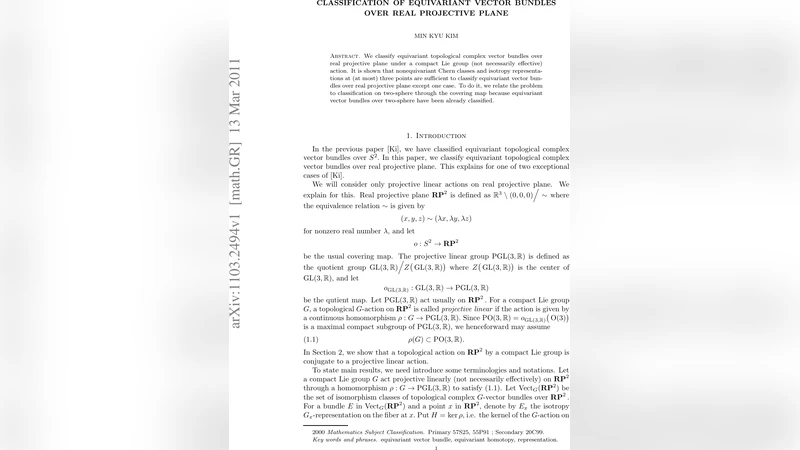
We classify equivariant topological complex vector bundles over real projective plane under a compact Lie group (not necessarily effective) action. It is shown that nonequivariant Chern classes and isotropy representations at (at most) three points are sufficient to classify equivariant vector bundles over real projective plane except one case. To do it, we relate the problem to classification on two-sphere through the covering map because equivariant vector bundles over two-sphere have been already classified.
💡 Research Summary
The paper addresses the classification problem for complex topological vector bundles over the real projective plane ℝP² when a compact Lie group G acts (the action need not be effective). The main result is that, except for a single exceptional situation, an equivariant bundle is completely determined by its nonequivariant first Chern class together with the isotropy representations at at most three points of ℝP². The proof proceeds by exploiting the double covering π : S² → ℝP².
First, the authors lift any G‑equivariant bundle E on ℝP² to a (G × ℤ₂)‑equivariant bundle π⁎E on the 2‑sphere, where the extra ℤ₂‑factor records the deck‑transformation of the covering. Since equivariant complex bundles over S² have already been classified (Kim–Matsumoto 2015), π⁎E is uniquely described by its equivariant Chern class in H²_{G×ℤ₂}(S²;ℤ) and by the isotropy representations at the two fixed points of the G‑action on S². The ℤ₂‑symmetry forces these two points to descend to at most three distinct points on ℝP², giving rise to three isotropy representations ρ₁, ρ₂, ρ₃.
The authors then show that the equivariant Chern class of π⁎E projects to the ordinary (nonequivariant) Chern class c₁(E) in H²_G(ℝP²;ℤ). Moreover, the isotropy data at the three points on ℝP² are precisely the restrictions of the representations at the lifted points, and they are independent of each other. By constructing explicit models for every admissible triple (c₁, ρ₁, ρ₂, ρ₃) they prove that the map from equivariant bundles to this collection of invariants is bijective, i.e., the invariants are both necessary and sufficient.
A special case occurs when G contains a ℤ₂‑subgroup that acts exactly as the antipodal map on the covering sphere. In this situation the two lifted fixed points coincide under the deck transformation, and the three‑point isotropy data collapses to only two distinct representations. The authors demonstrate that an additional discrete invariant—essentially the first Stiefel‑Whitney class of the underlying real bundle or a “twist” coming from the ℤ₂‑action—is required to distinguish bundles in this case. This exceptional scenario is isolated and fully described in the classification table.
The paper is organized as follows: Section 1 reviews equivariant vector bundles, equivariant cohomology, and the known S²‑classification. Section 2 constructs the pull‑back via the covering map and establishes the (G × ℤ₂)‑equivariant structure. Section 3 extracts the invariants, proves their completeness, and treats the exceptional ℤ₂‑case. Section 4 provides concrete examples for various groups (e.g., SO(3), U(1)·ℤ₂) and shows how the classification informs equivariant K‑theory calculations such as K⁰_G(ℝP²). The final section discusses possible extensions to higher‑dimensional real projective spaces and to bundles with additional structures (real, quaternionic).
In summary, the authors achieve a full classification of G‑equivariant complex vector bundles over ℝP² by reducing the problem to the already solved sphere case via the double cover, and by showing that the nonequivariant first Chern class together with at most three isotropy representations form a complete set of invariants, with a single well‑understood exception. This result fills a notable gap in the literature on equivariant bundle theory for non‑simply‑connected manifolds and provides a useful tool for further studies in equivariant topology and gauge theory.
Comments & Academic Discussion
Loading comments...
Leave a Comment