A locally compact non divisible abelian group whose character group is torsion free and divisible
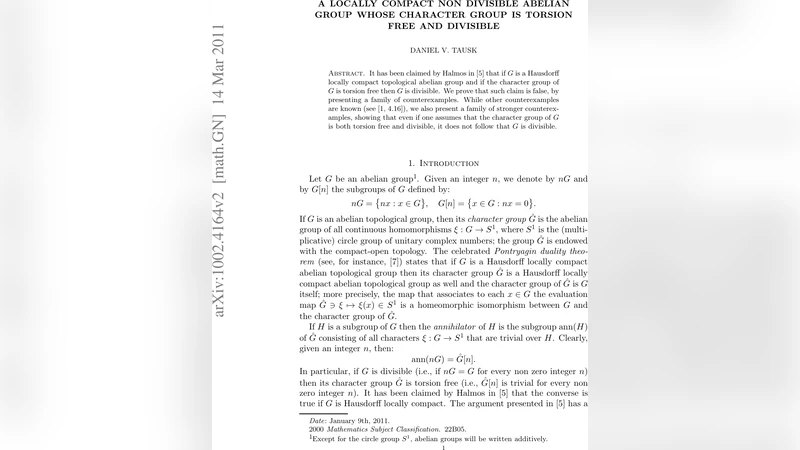
It has been claimed by Halmos in [Comment on the real line, Bull. Amer. Math. Soc., 50 (1944), 877-878] that if G is a Hausdorff locally compact topological abelian group and if the character group of G is torsion free then G is divisible. We prove that such claim is false, by presenting a family of counterexamples. While other counterexamples are known (see [D. L. Armacost, The structure of locally compact abelian groups, 1981]), we also present a family of stronger counterexamples, showing that even if one assumes that the character group of G is both torsion free and divisible, it does not follow that G is divisible.
💡 Research Summary
The paper addresses a long‑standing claim made by Paul Halmos in his 1944 note “Comment on the real line,” namely that for a Hausdorff locally compact abelian group (G), the torsion‑free property of its character group (\widehat G) forces (G) itself to be divisible. While earlier work by D. L. Armacost (1981) had already produced a counterexample showing that torsion‑free (\widehat G) does not guarantee divisibility of (G), the present article goes further. It constructs a family of counterexamples that are stronger in two senses: (i) the character groups are not only torsion‑free but also divisible, and (ii) the underlying groups (G) remain non‑divisible despite these enhanced dual properties.
The authors begin by recalling the relevant background from Pontryagin duality. For a locally compact abelian (LCA) group (G), the character group (\widehat G) consists of all continuous homomorphisms from (G) into the circle group (\mathbb T). The duality theorem asserts that the double dual (\widehat{\widehat G}) is canonically isomorphic to (G). A group is called divisible if for every integer (n\neq0) the map (x\mapsto nx) is surjective; it is torsion‑free if the same map is injective. Halmos’ claim essentially suggested that the algebraic “torsion‑free” condition on (\widehat G) would lift to the topological divisibility of (G).
The paper then reviews Armacost’s example, which uses a compact group with a non‑divisible component (for instance a solenoid) whose dual is torsion‑free but not divisible. This already disproves Halmos in its original form. However, Armacost’s construction does not address the stronger hypothesis that (\widehat G) might also be divisible.
The core contribution of the article is a systematic method for building LCA groups (G) whose duals enjoy both torsion‑free and divisible properties while (G) itself fails to be divisible. The construction proceeds as follows. Let (p) be a prime and consider the compact (p)-adic integer group (\mathbb Z_p). This group is not divisible: the multiplication‑by‑(p) map is not surjective. Next, embed a dense, divisible, torsion‑free subgroup (D\subset \mathbb Z_p); a concrete choice is the additive group of rational numbers whose denominators are powers of (p), i.e. (D={,a/p^k\mid a\in\mathbb Z,\ k\ge0,}). The subgroup (D) is isomorphic to the localization (\mathbb Z
Comments & Academic Discussion
Loading comments...
Leave a Comment