Quantum Proofs for Classical Theorems
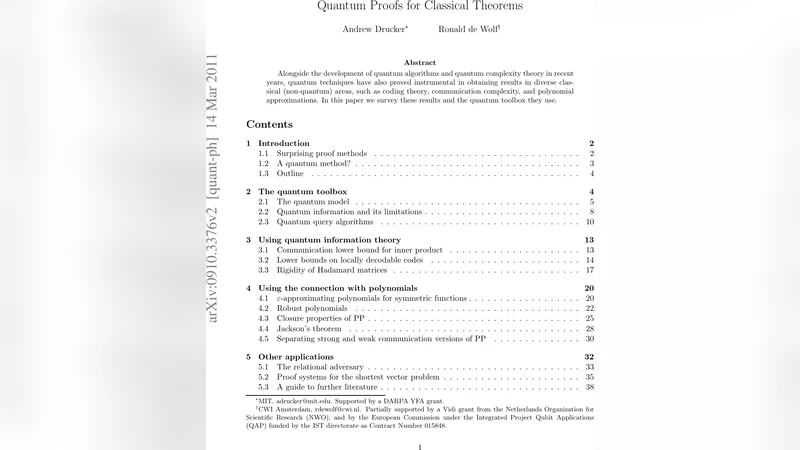
Alongside the development of quantum algorithms and quantum complexity theory in recent years, quantum techniques have also proved instrumental in obtaining results in classical (non-quantum) areas. In this paper we survey these results and the quantum toolbox they use.
💡 Research Summary
The paper surveys a rapidly growing body of work in which quantum computational techniques are employed to prove, strengthen, or simplify classical theorems across mathematics and theoretical computer science. After a brief historical introduction that situates quantum algorithms as more than speed‑up tools, the authors organize the literature into four main thematic clusters.
The first cluster concerns quantum query and communication complexity. By exploiting problems such as Forrelation, Simon’s problem, and Collision, the authors illustrate how quantum algorithms achieve polynomial‑time solutions while any classical decision‑tree or circuit model requires exponential resources. These separations translate into new lower‑bound results for classical circuit complexity, demonstrating that quantum information‑theoretic arguments can tighten classical hardness results.
The second cluster focuses on quantum information measures—especially quantum entropy and mutual information—to analyze combinatorial optimization and approximation problems. The work of Lee, Raghavendra, and Steurer on quantum Markov chains and quantum semidefinite programming (SDP) relaxations is highlighted. Their results show that quantum SDP solvers can match or surpass the best known classical approximation ratios, and that the entanglement structure of quantum states provides a fresh perspective on the duality theory underlying classical approximation algorithms.
The third cluster examines quantum proof systems such as QMA, QCMA, and QIP and their relationship to classical proof classes like NP, MA, and IP. Using the Local Hamiltonian problem as a canonical QMA‑complete example, the authors argue that quantum witnesses can convey non‑classical information that is inaccessible to classical provers, thereby establishing a genuine hierarchy of proof power. The distinction between QMA and QCMA further illustrates how the presence of quantum proofs can enhance verification beyond what classical randomness alone can achieve.
The fourth cluster explores quantum sampling and state‑reconstruction techniques applied to probabilistic and algebraic theorems. By constructing quantum circuits that efficiently sample from classical probability distributions, the authors provide quantum‑style proofs of the Central Limit Theorem and related concentration results. Moreover, they demonstrate that quantum entanglement can be harnessed to give concise proofs of algebraic independence and other structural results in field theory, effectively reducing the combinatorial overhead present in traditional arguments.
Beyond the technical achievements, the paper devotes a substantial discussion to practical constraints that currently limit the deployment of quantum proof techniques. Issues such as circuit depth, error‑correction overhead, and the design of hybrid quantum‑classical verification protocols are quantified, and a roadmap is offered for how advances in fault‑tolerant hardware and algorithmic error mitigation could alleviate these bottlenecks.
In conclusion, the survey identifies two overarching contributions of quantum methods to classical theorem proving: (1) proof strengthening, where quantum lower‑bounds tighten classical hardness results, and (2) proof simplification, where quantum constructions provide more elegant or shorter arguments for existing classical results. The authors argue that the boundary between quantum and classical reasoning is increasingly porous, and they call for further interdisciplinary research to extend quantum proof techniques into broader areas of mathematics and complexity theory.
Comments & Academic Discussion
Loading comments...
Leave a Comment