The algebraic difference of two random Cantor sets: The Larsson family
In this paper, we consider a family of random Cantor sets on the line and consider the question of whether the condition that the sum of the Hausdorff dimensions is larger than one implies the existence of interior points in the difference set of two…
Authors: Michel Dekking, Karoly Simon, Balazs Szekely
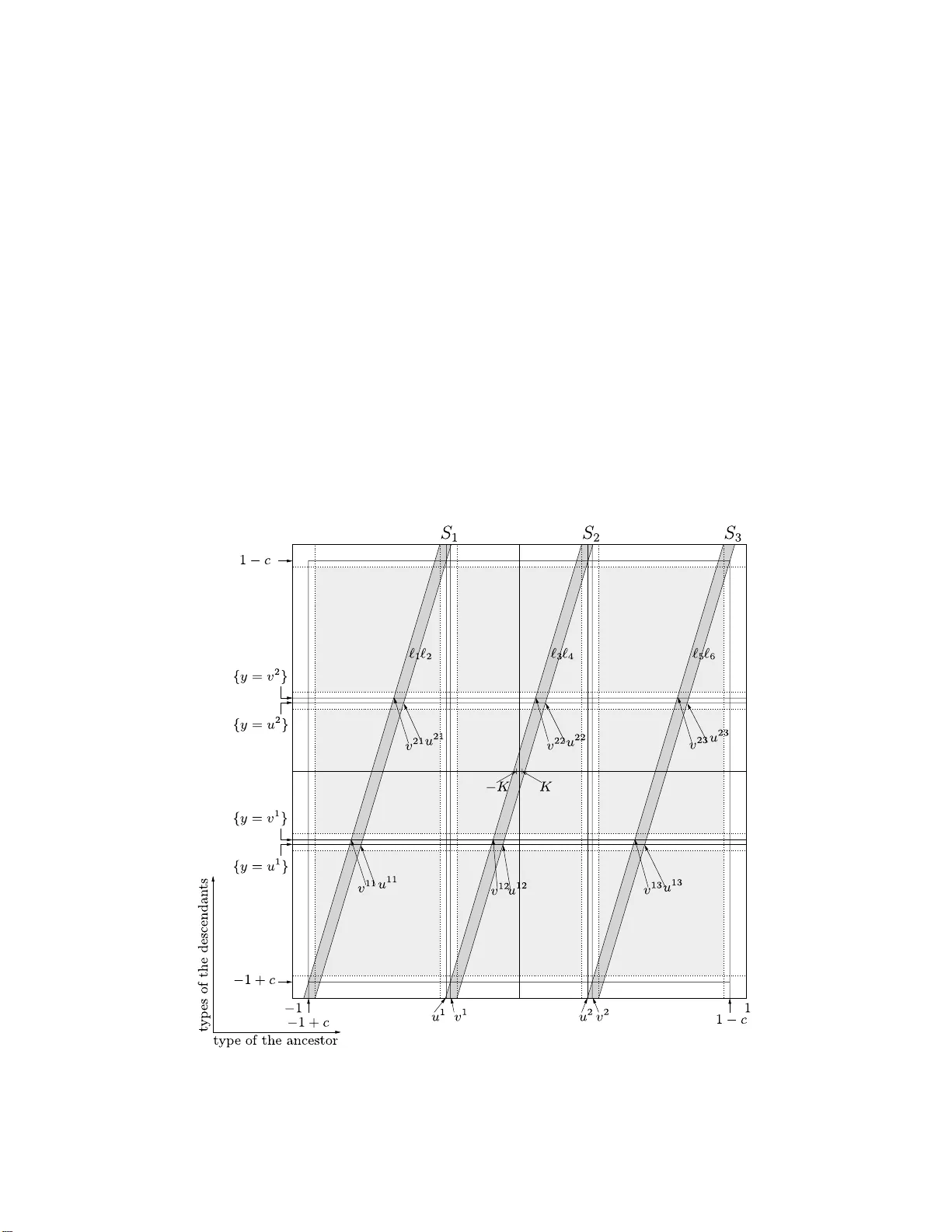
The Annals of Pr ob ability 2011, V ol. 39, No. 2, 549–58 6 DOI: 10.1214 /10-AOP558 c Institute of Mathematical Statistics , 2 011 THE ALGEBRA IC DIFFERENCE OF TW O RANDOM CANTOR SETS: THE LARSS ON F AMIL Y By Michel Dekking 1 , K ´ arol y Simon 1 , 2 and Bal ´ azs Sz ´ ekel y 3 T e chnic al University of Delft, T e chnic al University of Budap est and T e chnic al University of Budap est In th is pap er, we consider a family of rand om Cantor sets on the line and consider the q uestion of whether the cond ition th at the sum of the Hausdorff dimensions is larg er than one implies the existence of interio r p oints in the difference set of tw o indep endent copies. W e giv e a new and complete proof that this is the case for th e random Can tor sets introduced by P er Larsson. 1. In tro duction. Algebraic differences of Cantor sets o ccur naturally in the context of the dynamical b ehavi or of diffeomorphisms. F rom th ese stud - ies originated a co njecture by Pa lis and T ak ens [ 8 ], relating the s ize of th e arithmetic difference C 2 − C 1 = { y − x : x ∈ C 1 , y ∈ C 2 } to the Hausdorff dimensions of the t wo Can tor s ets C 1 and C 2 : if dim H C 1 + dim H C 2 > 1 , (1) then, generic al ly , it should b e true that C 2 − C 1 con tains an in terv al . F or generic dyn amically generated nonline ar Can tor sets, this wa s pr o ven in 2001 b y de Moreira and Y occoz [ 1 ]. The problem is op en for generic linear Cantor sets. The problem w as put into a probabilistic con text b y P er Larsson in his thesis [ 5 ] (see also [ 6 ]). He considers a t wo-parameter family of Received March 2009; rev ised Marc h 2010. 1 Supp orted in p art by th e NWO-OTKA common pro jec t. 2 Supp orted by OTKA F oun dation #K71693. 3 Supp orted by HSN Lab. AMS 2000 subje ct classific ations. Primary 28A80; secondary 60J80, 60J85. Key wor ds and phr ases. Random fractals, random iterated function systems, differ- ences of Can tor sets, Pa lis conjecture, multit y p e branching processes. This is an electr o nic reprint of the o r iginal article published by the Institute of Mathematica l Statistics in The Annals of Pr ob ability , 2011, V ol. 39 , No. 2, 54 9 –586 . This re pr int differs from the original in pagination and t yp ogr aphic detail. 1 2 M. DEKKING, K. S IMON AND B. SZ ´ EKEL Y Fig. 1. R e gions describ e d by e quations ( 3 ) and ( 4 ) . random Can tor sets C a,b , and claims to pr o ve that the P alis conjecture holds for all relev an t c h oices of the parameters a and b . Although the main idea of Larsson’s argument is brillian t, unfortunately , th e pro of cont ains significan t gaps and in correct reasoning. The aim of the present pap er is to giv e a correct p ro of of this th eorem. The most imp ortant error made by Larsson is as follo ws: during the constru ction, a m ultit yp e br anc hing pro ce ss with uncounta bly many t yp es app ears naturally . The n umber of in dividuals in the n th generatio n having t yp es wh ic h fall into th e set A is denoted Z n ( A ) and the probabilit y measure describin g the branching pro cess starting with a single type- x ind ividual is denoted by P x . Th e argument presented in Larsson’s pap er requires that for some p ositive δ , q , ρ > 1 and for a set A of whic h the interior con tains 0, we hav e that, u niformly , both in x and in n , the follo wing holds : P x ( Z n ( A ) > δ · ρ n ) > q . (2) Ho wev er, the main result in the theory of general multit yp e branc hing pro cesses [ 4 ], Theorem 14.1, in vok ed by Larsson implies ( 2 ) without an y uniformity . F urther (as shown in [ 3 ]), the idea p r esen ted in Larsson’s pap er wo rks only in the region (see also Figure 1 ) where 1 − 4 a − 2 b + 3 a 2 − 6 ab > 0 . (3) Although we use a differen t setup, the main idea pr esen ted here follo ws the line of Larsson’s pro of. THE DIFFERENCE OF RAND OM CAN TOR SETS 3 Fig. 2. The c onstruction of the Cantor set C a,b . The figur e shows C 1 a,b , . . . , C 4 a,b . W e remark that for lin ear Canto r sets of a differen t natur e, the firs t t wo authors inv estigated the s ame pr ob lem in [ 2 ]. F urther devel opments in this direction in [ 7 ] lead us to conjecture that in the critical case, th at is, dim H ( C a,b ) = 1 / 2, the difference set will a.s. cont ain no interv al. 1.1. L arsson ’s r andom Cantor sets. It is assu med thr oughout this pap er that a > 1 4 and 3 a + 2 b < 1 . (4) The first condition is a gro wth condition and since dim H C a,b = − log 2 log a , this cond ition is equ iv alen t to dim H C a,b > 1 / 2, w hic h is equ iv alen t to ( 1 ). The second condition is a geometric condition: Lars son’s C an tor set is a natural randomizatio n of the classical Can tor set; see Figure 2 . In the first step of the construction, interv als of length a are put in to the inte rv als [ b, 1 2 − a 2 ] and [ 1 2 + a 2 , 1 − b ] . Dismissin g th e trivial case 3 a + 2 b = 1 , this ob viously requires 3 a + 2 b < 1 . W e remark that it is useful to force a forbid den zone of length at least a in the mid dle sin ce otherwise the Newhouse thic kness of the Can tor set wo uld b e larger than 1, whic h yields an in terv al in the difference set by Newhouse’s theorem (see [ 8 ], page 63). The tw o in terv als of length a eac h ha ve ro om to mo ve in an in terv al of length 1 2 − a 2 − b , that is, there is a free space of size 1 2 − a 2 − b − a an d we d enote this gap b y g : g := 1 − 3 a − 2 b 2 . The construction is as follo ws: fi rst, remov e th e midd le a part, then the b parts from b oth th e b eginning and the end of the unit in terv al. Then, place in terv als of length a according to a un iform d istribution in the remaining t w o op en spaces [ b, 1 2 − a 2 ] and [ 1 2 + a 2 , 1 − b ] . These tw o ran d omly chosen interv als of length a are called th e level- one intervals of the random Cant or set C a,b . W e write C 1 a,b for their union. In b ot h of the t w o lev el-one in terv als, w e r ep eat the same construction indep enden tly of eac h other and of the previous step. In this wa y , w e obtain f our disjoint interv als of length a 2 . W e emphasize that, b eca use of in dep end ence, th e relativ e p ositi ons of these second lev el 4 M. DEKKING, K. S IMON AND B. SZ ´ EKEL Y in terv als in the fir st lev el ones are, in general, completely different. Similarly , w e construct the 2 n lev el- n inte rv als of length a n . W e call their un ion C n a,b . Larsson’s random Can tor set is then defined b y C a,b := ∞ \ n =1 C n a,b . See Figure 2 . The next theorem w as stated b y P . Larsson. Theorem 1. L et C 1 , C 2 b e indep endent r andom Cantor sets having the same distribution as C a,b define d ab ove. Then, the algebr aic differ e nc e C 2 − C 1 almost sur e ly c ontains an interval. This pap er is organized as follo ws. In the next s ection, w e give an elemen- tary p r o of of the fact th at the p robabilit y that C 2 − C 1 con tains an interv al is either 0 or 1. F or the m ain part of the p r o of, our starting p oin t is the observ ation that C 2 − C 1 can b e view ed as a 45 ◦ pro jection of the pro du ct set C 1 × C 2 . This leads, in Section 3.1 , to th e in tr o duction of the lev el- n squares formed as the pro d uct of lev el- n inte rv als of the Canto r sets C 1 , C 2 . W e remark that Larsson do es not u se these squares at all. Th en, based on the family of th ese squares w e w ill construct the in tr insic branching pro cess and state our Main Lemma , wh ic h will replace ( 2 ). In S ection 4 , w e prov e Theorem 1 , assumin g the Main Lemm a . In Sections 5 – 10 , we giv e a pr o of of the Main Lemma . 2. A 0–1 la w. Undoub tedly , Larsson introdu ced his Canto r sets as a natural r andomization of the classical triadic Can tor set. Actually , these sets can also b e considered as very simp le examples of statistically self-similar sets, whic h p ermits us to giv e a simple p ro of of the 0–1 la w for the int erv al prop erty . A set C is statistic al ly self-similar if there is a collectio n of m random functions { ϕ 1 , . . . , ϕ m } such that C = m [ i =1 ϕ i ( C i ) , where the C i are indep enden t rand om sets with the same distribution as C . F or Larsson’s sets, m = 2 and th e rand om f unctions are the affine fu n ctions ϕ 1 ( x ) = ax + b + U 1 and ϕ 2 ( x ) = ax + (1 + a ) / 2 + U 2 , where U 1 and U 2 are indep endent random v ariables, b oth uniformly dis- tributed o v er [0 , g ]. Pr opos ition 1. P ( C 2 − C 1 ⊃ I ) = 0 or 1 . THE DIFFERENCE OF RAND OM CAN TOR SETS 5 Pr oof. F or 1 ≤ i, j ≤ 2 , let C i,j b e ind ep endent copies of C = C a,b and let C 1 = ϕ 1 ( C 1 , 1 ) ∪ ϕ 2 ( C 1 , 2 ) , C 2 = ϕ 1 ( C 2 , 1 ) ∪ ϕ 2 ( C 2 , 2 ) b e the self-similarit y equations for C 1 and C 2 . W e will also write “ C 2 − C 1 con tains an in terv al” equiv alen tly as “ C 2 − C 1 has nonempt y in terior.” Using the facts that for arbitrary subsets A, B , C and D of R , ( A ∪ B ) − ( C ∪ D ) ⊃ ( A − C ) ∪ ( B − D ) , that ϕ ( A − B ) = ϕ ( A ) − ϕ ( B ) for affin e functions ϕ : R → R and that affine functions are con tinuous, we can set up the follo win g c h ain of (in)equalities: p := P ( C 2 − C 1 ⊃ I ) = 1 − P (Int( C 2 − C 1 ) = ∅ ) ≥ 1 − P (Int( ϕ 1 ( C 2 , 1 ) − ϕ 1 ( C 1 , 1 )) = ∅ , Int ( ϕ 2 ( C 2 , 2 ) − ϕ 2 ( C 1 , 2 )) = ∅ ) = 1 − P (Int( ϕ 1 ( C 2 , 1 ) − ϕ 1 ( C 1 , 1 )) = ∅ ) P ( In t( ϕ 2 ( C 2 , 2 ) − ϕ 2 ( C 1 , 2 )) = ∅ ) = 1 − P (Int( ϕ 1 ( C 2 , 1 − C 1 , 1 )) = ∅ ) P (Int( ϕ 2 ( C 2 , 2 − C 1 , 2 )) = ∅ ) = 1 − P (Int( C 2 , 1 − C 1 , 1 ) = ∅ ) P (Int( C 2 , 2 − C 1 , 2 ) = ∅ ) = 1 − (1 − p ) 2 . This implies that p ≤ p 2 and hence p = 0 or 1. 3. Notatio n and the Main Lemma . In th e r emainder of the pap er, w e fix a pair ( a, b ) s atisfying condition ( 4 ) and alwa ys d eal with Larsson’s Can tor sets, so w e will supp ress the lab els a, b . 3.1. The ge ometry of the algebr aic differ enc e C 2 − C 1 . The 45 ◦ pro jection of a p oint ( x 1 , x 2 ) ∈ R 2 on to the x 2 -axis is denoted b y Pro j 45 ◦ . That is, Pro j 45 ◦ ( x 1 , x 2 ) := x 2 − x 1 . The follo w ing tr ivial fact is the motiv ation for constru cting our branching pro cess of lab eled squares: x ∈ Pro j 45 ◦ ( C 1 × C 2 ) if and only if x ∈ C 2 − C 1 . So, C 2 − C 1 = ∞ \ n =0 Pro j 45 ◦ ( C n 1 × C n 2 ) . W e can naturally lab el the squares in C n 1 × C n 2 as follo ws: w e call the upp er-left first lev el square Q 1 and contin ue lab eling the firs t lev el squares 6 M. DEKKING, K. S IMON AND B. SZ ´ EKEL Y Fig. 3. The first level squar es Q 1 , . . . , Q 4 and four se c ond level squar es Q 21 , Q 22 , Q 23 , Q 24 . Q 2 , Q 3 , Q 4 in the clockwise direction; then, within eac h of these squ ares, w e con tinue in this w a y; see Figure 3 . F or an x ∈ [ − 1 , 1] , w e write e ( x ) f or that line with slop e 1 wh ic h in tersects the v ertical axis at x . As we observ ed ab ov e x ∈ C 2 − C 1 if and only if e ( x ) ∩ ( C 1 × C 2 ) 6 = ∅ . (5) Fix x and an arb itrary n . Let S n b e the set of all a n × a n squares con tained in [0 , 1] 2 . Note that for eve ry Q ∈ S n , by the statistical s elf-similarit y of the construction, the p robabilit y of the ev en t e ( x ) ∩ ( Q ∩ ( C 1 × C 2 )) 6 = ∅ conditional on Q ⊂ C n 1 × C n 2 is equal to the probability of the even t e (Φ) ∩ ( C 1 × C 2 ) 6 = ∅ , wh ere we construct Φ = Φ( Q, x ) as follo ws: w e rescale th e square Q (whic h is an a n × a n square) b y the factor 1 /a n , then w e c ho ose Φ su c h that the line segment e (Φ) ∩ [0 , 1] 2 is the rescaled cop y of e ( x ) ∩ Q ; see Figure 4 . More pr ecisely , if ( u, v ) is the low er-left corner of Q , that is, Q = [ u, u + a n ] × [ v , v + a n ], then we d efine Φ( Q, x ) := ( u − v + x a n , if e ( x ) in tersects Q , Θ , otherwise, (6) where Θ is a symbol representing the emptiness of the in tersection. Obser ve that Φ( Q, x ) > 0 if and only if the cen ter of Q is lo cated b elo w the line e ( x ) THE DIFFERENCE OF RAND OM CAN TOR SETS 7 Fig. 4. A level- n squar e Q and its r esc ale d typ e Φ( Q, x ) . and e ( x ) m eets Q . F urther, Φ( Q, x ) = 1 if e ( x ) inte rsects Q at the upp er-left corner and Φ( Q, x ) = − 1 if e ( x ) in tersects Q at the lo wer-righ t corner. 3.2. The pr ob ability sp ac e . W e wr ite T := S ∞ n =0 { 1 , 2 } n for the dya dic tree, w ith no d es i n = i 1 i 2 . . . i n , where i k is 1 or 2 , and ro ot Λ. F or th e construction of Larsson’s Can tor set, the p robabilit y space is Ω 1 = [0 , g ] T [recall that g = (1 − 3 a − 2 b ) / 2]. An elemen t of Ω 1 is denoted b y U , that is, the v alue at the nod e i 1 i 2 . . . i n is U i 1 i 2 ...i n . The corresp onding σ -a lgebra is B 1 := Q T B [0 , g ]. Finally , the probabilit y measure for Larsson’s Cant or set is P 1 := δ 0 × Y T \{ Λ } Uniform[0 , g ] , where δ 0 is the Dirac mass at 0 associated with the mass at the ro ot Λ . Note that the randomness starts at lev el 1. So, the probabilit y space for C 1 × C 2 is as follo ws: Ω := Ω 1 × Ω 1 , B := B 1 × B 1 , P := P 1 × P 1 . (7) An element of Ω is a pair of lab eled binary tr ees. T he 4 n lev el- n pairs of in dices ( i 1 i 2 . . . i n , j 1 j 2 . . . j n ) are natur ally asso ciated with leve l- n squares Q ′ ( i 1 i 2 ...i n ,j 1 j 2 ...j n ) of size a n × a n whose relativ e p ositions are giv en b y U i 1 i 2 ...i n and U j 1 j 2 ...j n . Note, ho wev er, that (to simplify the notation) w e ha v e give n new indices to these squares and p ositions: Q 1 := Q ′ 1 , 2 , Q 2 := Q ′ 2 , 2 , Q 3 := Q ′ 2 , 1 , Q 4 := Q ′ 1 , 1 and similarly f or higher ord er squares and their p ositions (see Figure 3 ). 8 M. DEKKING, K. S IMON AND B. SZ ´ EKEL Y 3.3. The br anching pr o c ess. On the probability space Ω , w e defi n e a m ul- tit yp e branc hing pro cess Z = ( Z n ) ∞ n =0 . F or a Borel set A, the natural num b er Z n ( A ) represents th e num b er of ob jects in generation n whose t yp e falls into the set A . The typ e sp ace T is a su bset of [ − 1 , 1], but for the moment w e can think of T = [ − 1 , 1]. The ob jects of the n th generation are squares Q ∈ S n and, giv en a fixed x ∈ [ − 1 , 1], their t yp e is Φ( Q, x ) , as defin ed in ( 6 ). Note that although w e sp eak of Θ as a type, it is not an elemen t of T . The pr o cess ( Z n ) is a Mark ov chain whose states are collect ions of squares lab eled by their types. The transition mec hanism is as describ ed in Section 3.1 . The initial cond ition of the chain is the square [0 , 1] × [0 , 1], with t yp e x (also called the anc estor of th e br anc hing pro cess). As usu al, we then w rite, for n ≥ 1 , P x ( Z n ( A 1 ) = r 1 , . . . , Z n ( A k ) = r k ) = P ( Z n ( A 1 ) = r 1 , . . . , Z n ( A k ) = r k |Z 0 ( { x } ) = 1) for all k ≥ 1 , A 1 , . . . , A k ⊂ T and nonnegativ e inte gers r 1 , . . . , r k . A collection of squares all w ith typ e Θ is an absorb ing state: it only generates squares with t yp e Θ. This is ob v ious f rom th e defi nition of Φ( Q, x ) , but we w ill extend this pr op ert y to the case of smaller type sp aces T , wh ere, b y definition, a square has type Θ if its t yp e is not in T (this will b e further explained in Section 6.1 ). A ma jor role in our analysis is pla y ed b y the expectations E x [ Z n ( A )] for A ⊂ T , n ≥ 1. Let us defin e, for i = 1 , 2 , 3 , 4 , Z i 1 ( A ) = 1 , if Φ( Q i , x ) ∈ A , 0 , otherwise. (8) Then, Z 1 ( A ) = Z 1 1 ( A ) + · · · + Z 4 1 ( A ) and so E x [ Z 1 ( A )] = Z Ω Z 1 ( A ) d P x = Z Ω 4 X i =1 Z i 1 ( A ) d P x = 4 X i =1 P x (Φ( Q i , x ) ∈ A ) = 4 X i =1 Z A f x,i ( y ) d y , where the f x,i are the densities of the rand om v ariables Φ( Q i , x ) (apart from an atom in Θ ). In Section 5.2 , these densities will b e determined explicitly . It follo ws that for n = 1 , M n ( x, A ) := E x [ Z n ( A )] has a densit y m 1 ( x, y ), called the kernel of the branching pr o cess, giv en by m ( x, y ) := m 1 ( x, y ) = 4 X i =1 f x,i ( y ) . (9) THE DIFFERENCE OF RAND OM CAN TOR SETS 9 W e remark that if M 1 has a d ensit y , then M n also h as a den sit y . Let us write m n ( x, · ) for the densit y of M n ( x, · ) . The branching str ucture of Z yields (see [ 4 ], page 67) m n +1 ( x, y ) = Z T m n ( x, z ) m 1 ( z , y ) d z . (10) The main p roblem to b e solv ed is that the natural c hoice of T = [ − 1 , 1] as t y p e s pace d o es not w ork b ecause of condition (C) b elo w and b eca use we need the uniformity alluded to in equation ( 2 ). Since the definition of T is complicated, we p ostp one it to S ection 6 . Ho wev er, here w e collect the most imp ortan t pr op erties of T : (A) T is the disjoint un ion of finitely man y closed interv als; (B) ther e exists a K > 0 suc h that [ − K, K ] ⊂ T ; (C) the k ernel m n ( x, y ) d efined in ( 10 ) is uniformly p ositiv e on T × T [see cond ition ( C1 ) b elo w] and it h as Perron–F robeniu s eigen v alue greater than 1 [see condition ( C2 ) b elo w]. 3.4. The asym ptotic b ehavior of the br anching pr o c ess Z . W e will pr o ve in Sections 6 , 7 and 8 that there exists an intege r n 0 suc h that m n 0 is a uniformly b ound ed f u nction, that is, there exist 0 < a min < a max suc h that for all x, y ∈ T , we ha ve 0 < a min ≤ m n 0 ( x, y ) ≤ a max < ∞ . (C1) In the next step, w e consider the follo wing t wo oper ators: g ( x ) 7→ Z R m 1 ( x, y ) · g ( y ) d y , h ( y ) 7→ Z R h ( x ) · m 1 ( x, y ) d x . (11) W e cite the follo wing theorem fr om [ 4 ], Theorem 10.1. Theorem 2 (Harris). It fol lows fr om ( C1 ) that the op er ators in ( 11 ) have a c ommon dominant eig envalue ρ . L et µ ( x ) and ν ( y ) b e the c orr e- sp onding eigenfunctions of the first and se c ond op er ator in ( 11 ), r esp e c- tively. Then, the fu nctions µ ( x ) and ν ( y ) ar e b ounde d and uniformly p os- itive. Mor e over, ap art fr om a sc aling, µ and ν ar e the onl y nonn e gative eigenfunctions of these op er ators. F urther, if we norm alize µ and ν so that R µ ( x ) ν ( x ) d x = 1 , which wil l b e henc eforth assume d, then, for al l x, y ∈ T , as n → ∞ , m n ( x, y ) ρ n − µ ( x ) ν ( y ) ≤ C 1 µ ( x ) ν ( y )∆ n , wher e the b ound ∆ < 1 c an b e taken indep endently of x and y , a nd the c onstant C 1 is indep endent of x, y and n . 10 M. DEKKING, K. S IMON AND B. SZ ´ EKEL Y Later in this pap er, w e will pr o ve that in ou r case , this P erron–F rob enius eigen v alue is greater than one: ρ > 1 . (C2) Using Theorem 2 , Harris prov es that Z n ( A ) in fact gro ws exp on entially with rate ρ . I ntro ducing W n ( A ) := Z n ( A ) ρ n , he obtains (see [ 4 ], Theorem 14.1 ) th e f ollo wing result. Theorem 3 (Ha rris). If sup x ∈ T E x [ Z 1 ( T ) 2 ] < ∞ , (C3) then it fol lows fr om ( C1 ) and ( C2 ) tha t for al l x ∈ T , P x lim n →∞ W n ( A ) = : W ( A ) = 1 . (12) F urther, for every Bor el me asur able A ⊂ T with L eb 1 ( A ) > 0 , we ha ve P x ( W ( A ) > 0) > 0 . (13) Mor e over, let A and B b e su b sets of T such that their L eb esgue me asur es ar e p ositive. Then, the r elation W ( B ) = R B ν ( y ) d y R A ν ( y ) d y W ( A ) holds P x almost sur ely for an y x ∈ T . W e are go ing to use this theorem to prov e our Main Lemma , whic h summarizes ev erything we need concerning our branching pro cess. Roughly sp eaking, the Main Lemm a sa ys th at for the br anc hing p ro cess asso ciated to Larsson’s Canto r set, the statemen t in Theorem 3 h olds u niformly both in n and x for an app ropriately c hosen small in terv al of x ’s. Main Le mma. Ther e exist p ositive numb ers δ and q , an N ∈ N and a smal l interval [ − K, K ] ⊂ T c enter e d at the origin such that the f ol lowing ine quality holds: inf n ≥ N inf x ∈ [ − K ,K ] P x ( Z n ([ − K, 0]) > δ ρ n , Z n ([0 , K ]) > δ ρ n ) ≥ q . (14) 4. The pro of of Theorem 1 . In Section 3.1 , w e defin ed the t yp e of a square Q b y means of its intersect ion with a line e ( x ). Here, w e will elab orate on this in tersection. THE DIFFERENCE OF RAND OM CAN TOR SETS 11 4.1. Nic e i nterse ction of a squar e with a line e ( x ) . W e sa y th at a squ are Q has a nic e interse ction with e ( x ) if Φ( Q, x ) ∈ [ − K, K ] , where K comes from Main Lemma . F or s mall K, this means that the cen ter of Q is close to the line e ( x ). Let A 0 = { [0 , 1] 2 } , A n b e the set { Q ∈ S n : Q ⊂ C n 1 × C n 2 } and A n x b e the set of squares from A n ha ving nice in tersection with e ( x ). That is, for x ∈ T and n ≥ 1 , w e d efine A n x := { Q ∈ A n : | Φ( Q, x ) | ≤ K } . Moreo ve r, for m ≥ 0 and a square Q ∈ A m x , we w rite l + n ( Q, x ) and ( l − n ( Q, x ) ) for the n um b ers of lev el-( m + n ) squares conta ined in Q whic h ha ve nice in tersection with e ( x ) with cen ter b elo w an d ab o v e the line e ( x ) , resp ectiv ely . That is, for a Q = Q i 1 ...i m , let l + n ( Q, x ) = # { Q i 1 ...i m j 1 ...j n ∈ A m + n : 0 ≤ Φ ( Q i 1 ...i m j 1 ...j n , x ) ≤ K } . Similarly , let l − n ( Q, x ) = # { Q i 1 ...i m j 1 ...j n ∈ A m + n : − K ≤ Φ ( Q i 1 ...i m j 1 ...j n , x ) ≤ 0 } . Finally , for ev ery n ≥ 1 , x ∈ T and Q ∈ A m x , w e d efine the ev ent A n ( Q, x ) := { l − n ( Q, x ) > δ ρ n , l + n ( Q, x ) > δ ρ n } , where δ comes from th e Main Lemma . Note that the self-similarit y of the construction of the squares and the Main Lemma for the und er lyin g branch- ing pro cess imply the follo wing: for n ≥ N and a square Q ∈ S m , w e ha ve P ( A n ( Q, x ) | Q ∈ A m x ) (15) = P Φ( Q,x ) ( Z n ([ − K, 0]) > δ ρ n , Z n ([0 , K ]) > δ ρ n ) ≥ q . 4.2. The differ enc e set C 2 − C 1 c ontains an interval with p ositive P pr ob- ability. W e in tro d uce the in terv al I := [ − K a N , K a N ] with N and K f rom the Main Lemma . Note that | I | := L eb 1 ( I ) = 2 K a N . Our goal is to pro v e that P ( C 2 − C 1 ⊃ I ) > 0 . First, we divide the int erv al I in to 4 2 N in terv als I i 1 of equal lengt h with indices ± 1 , . . . , ± 1 2 4 2 N . Then, w e divide all of these interv als in to 4 3 N in- terv als I i 1 i 2 of equal length. If w e hav e already defined the ( k − 1)th lev el in terv als, then we define the k th lev el in terv als I i 1 ...i k b y sub dividing eac h 12 M. DEKKING, K. S IMON AND B. SZ ´ EKEL Y ( k − 1)th level int erv al I i 1 ...i k − 1 in to 4 ( k +1) N in terv als of equal length with indices ± 1 , . . . , ± 1 2 4 ( k +1) N . W e denote the cen ter of I i 1 ...i k b y z i 1 ...i k . That is, I i 1 ...i k = [ z i 1 ...i k − K a N 4 − [2+ ··· +( k +1)] N , z i 1 ...i k + K a N 4 − [2+ ··· +( k +1)] N ] , where the z i 1 ...i k are equally spaced in I i 1 ...i k − 1 . Note that the in terv al I i 1 ...i k has length | I i 1 ...i k | = 2 K a N 4 − [2+ ··· +( k +1)] N < 2 K a g k , (16) where w e put g k := (1 + · · · + ( k + 1)) N = 1 2 ( k + 1)( k + 2) N . In the follo win g, we will go from generation g k − 1 to generation g k . Definition 1. W e sa y that the eve nt B k ( z i 1 ...i k ) o ccurs if ther e exists some square Q ∈ A g k − 1 , itself h a vin g nice intersect ion with e ( z i 1 ...i k ), suc h that A ( k +1) N ( Q, z i 1 ...i k ) holds—cf. Figure 5 . In form u lae, B k ( z i 1 ...i k ) = [ Q ∈A g k − 1 z i 1 ...i k A ( k +1) N ( Q, z i 1 ...i k ) . (17) The follo wing lemma is one of the key stat emen ts of the argument. Lemma 1. Assume that B k ( z i 1 ...i k ) o c cu rs with the squar e Q . L et Q + and Q − b e the c ol le ctions of level- g k squar es within Q having nic e interse ction with e ( z i 1 ...i k ) with c enter b elow and ab ove the line e ( z i 1 ...i k ) , r esp e ctively. Then, (1) Pro j 45 ◦ [ e Q ∈Q + e Q ⊃ I i 1 ...i k , Pro j 45 ◦ [ e Q ∈Q − e Q ⊃ I i 1 ...i k . (2) F or every i k +1 = ± 1 , . . . , ± 1 2 4 ( k +2) N , the line e ( z i 1 ...i k i k +1 ) has nic e in- terse ction with al l squar es fr om either Q + or Q − . Thus, the line e ( z i 1 ...i k i k +1 ) has nic e interse ction with at le ast δ ρ ( k +1) N squar es c ontaine d in Q such that either al l have c enter b elow the line e ( z i 1 ...i k ) or al l have c enter ab ove the line e ( z i 1 ...i k ) . Pr oof. Cho ose an arbitrary y ∈ I i 1 ...i k . Without loss of generalit y , we ma y assume that y ≤ z i 1 ...i k . Then, to sho w b oth (1) and (2), it is enough to pro v e that e ( y ) has nice in tersection w ith all squares from Q + . THE DIFFERENCE OF RAND OM CAN TOR SETS 13 Fig. 5. Event B k ( z i 1 ...i k ) : ther e is a level- g k − 1 squar e Q i n which the numb er of strip e d level- g k squar es (the nic ely interse cting ones) is at le ast δ ρ N ( k +1) , b oth for the squar es with c enter ab ove and the squar es with c enter b el ow the li ne e ( z i 1 ...i k ) . Fig. 6. Nic e inters e ctions. Fix an arbitrary Q ∈ Q + . By the d efinition of Q + , the square Q is a lev el- g k square suc h th at its lo we r-left corner is in b et wee n th e parallel lines e ( z i 1 ...i k ) and e ( z i 1 ...i k − K a g k ). So, f or ev ery p oint y ∗ ∈ [ z i 1 ...i k − K a g k , z i 1 ...i k ] , the line e ( y ∗ ) has nice int ersection with Q ; see Fig ure 6 . T o show that for any y ∈ I i 1 ...i k ∩ ( −∞ , z i 1 ...i k ] , e ( y ) has nice in tersection with all squares from Q + , it is enough to pro v e that I i 1 ...i k ∩ ( −∞ , z i 1 ...i k ] ⊂ [ z i 1 ...i k − K a g k , z i 1 ...i k ] , 14 M. DEKKING, K. S IMON AND B. SZ ´ EKEL Y based on the previous paragraph. Ho wev er, since | I i 1 ...i k ∩ ( −∞ , z i 1 ...i k ] | = 1 2 | I i 1 ...i k | < K a g k , this follo w s using ( 16 ). Definition 2. Let E 0 := A N ([0 , 1] 2 , 0) and let E k := T i 1 ...i k B k ( z i 1 ...i k ) . Lemma 2. The fol lowing ine quality holds: P ( C 2 − C 1 ⊃ I ) ≥ q Y k ≥ 1 P ( E k | E k − 1 ) . (18) Pr oof. Using the fact that I = [ − K a N , K a N ] = S i 1 ...i k I i 1 ...i k , it follo ws immediately from Lemma 1 that if the ev ent E k holds, then the ev ent S k := { Pro j 45 ◦ ( C g k 1 × C g k 2 ) ⊃ I } will hold. Th erefore, E k ⊂ S k . Since the sets C g k 1 × C g k 2 are decreasing, we obtain that S k ⊃ S k +1 . Thus, P ( C 2 − C 1 ⊃ I ) = P \ k ≥ 1 S k = lim k →∞ P ( S k ) ≥ inf k ≥ 1 P ( E k ) ≥ P ( E 0 ) Y k ≥ 1 P ( E k | E k − 1 ) . The last inequalit y holds since P ( E 0 ) Y i ≥ 1 P ( E i | E i − 1 ) ≤ P ( E 0 ) P ( E 1 | E 0 ) · · · P ( E k | E k − 1 ) = p P ( E k E k − 1 ) ≤ P ( E k ) , where p = P ( E 0 ) P ( E 0 ) P ( E 1 E 0 ) P ( E 1 ) · · · P ( E k − 1 E k − 2 ) P ( E k − 1 ) ≤ 1 . Since the Main Lemma yields P ( E 0 ) ≥ q , one obtains the statemen t of th e lemma. In Lemma 3 , w e giv e a lo we r b ound for P ( E k | E k − 1 ) for ev ery k . Lemma 3. F or any k ≥ 1 , we ha ve P ( E k | E k − 1 ) ≥ 1 − 4 2 N + ··· +( k + 1) N (1 − q ) δρ kN . THE DIFFERENCE OF RAND OM CAN TOR SETS 15 Pr oof. W e recall that E k w as defined as E k := \ i 1 ...i k B k ( z i 1 ...i k ) . Therefore, we hav e to prov e that P [ i 1 ...i k B c k ( z i 1 ...i k ) E k − 1 ≤ 4 2 N + ··· +( k + 1) N (1 − q ) δρ kN . Note that the num b er of indices i 1 . . . i k on the left-hand side is equal to 4 2 N + ··· +( k + 1) N . Th er efore, it is enough to show that for eac h index i 1 . . . i k , w e ha v e P ( B c k ( z i 1 ...i k ) | E k − 1 ) ≤ (1 − q ) δρ kN . By Definition 1 , to see this, w e ha ve to pro ve that P \ Q ∈A g k − 1 z i 1 ...i k A c ( k +1) N ( Q, z i 1 ...i k ) E k − 1 ≤ (1 − q ) δρ kN . (19) W e assume E k − 1 , so, in p articular, w e kno w that B k − 1 ( z i 1 ...i k − 1 ) holds. That is, there exists a leve l- g k − 2 square Q big suc h that the ev en t A k N ( Q big , z i 1 ...i k − 1 ) holds. By d efinition, this means that we can fi nd at lea st [ δ ρ k N ] + 1 squares in Q big in A g k − 1 z i 1 ...i k − 1 ha ving center b elo w, and at least as many squ ares ha v- ing cen ter ab ov e, the line e ( z i 1 ...i k − 1 ). Using the second part of Lemma 1 (for k instead of k + 1 ), we obtain that the line e ( z i 1 ...i k ) has nice in tersec- tion with either all th e squares ab ov e or with all the squares b elo w the line e ( z i 1 ...i k − 1 ). Without loss of generalit y , we ma y assume the former. Ho wev er, for all these squares Q , the ev ents A c ( k +1) N ( Q, z i 1 ...i k ) are (con- ditionally) indep enden t, so, to obtain ( 19 ), it is enough to sho w that P ( A c ( k +1) N ( Q, z i 1 ...i k ) | Q ∈ A g k − 1 z i 1 ...i k ) ≤ 1 − q (20) and this follo ws directly from equation ( 15 ). Lemma 4. F or al l n ≥ 1 , we have ∞ Y j =1 (1 − 4 [2+ ··· +( j +1)] n (1 − q ) δρ j n ) > 0 . (21) Pr oof. W e hav e to sh o w that P ∞ j =1 a j con verges, where a j = 4 (1 / 2) j ( j +1) n (1 − q ) δρ j n . It is therefore sufficien t that a j ≤ e − j for all large j . This is true since 16 M. DEKKING, K. S IMON AND B. SZ ´ EKEL Y 1 j log a j = 1 2 ( j + 1) n log 4 + 1 j δ ( ρ n ) j log(1 − q ) ≤ − 1 , whic h holds for j large enough since ρ n > 1 and log(1 − q ) < 0 . Therefore, using Lemmas 2 , 3 an d 4 , w e obtain that P ( C 2 − C 1 ⊃ I ) ≥ q ∞ Y k =1 (1 − 4 [2+ ··· +( k +1)] N (1 − q ) δρ kN ) > 0 . Com bining this with Prop osition 1 from Section 2 , this completes the pr o of of Theorem 1 . In the next six sectio ns, w e p r o ve our Main Lemma . 5. Distribution of types. In this section, the densit y fu nction of Φ( Q, x ) will b e determined for the four squares Q fr om S 1 . 5.1. The distribution of Φ( Q, x ) . Let U 1 , U 2 , U 3 , U 4 b e four indep endent Uniform([0 , g ])-distributed random v ariables. Th e left corners of the t wo lev el-one in terv als of the random C an tor set C i are d etermined by U 2 i − 1 , U 2 i for i = 1 , 2. Let ( u i , v i ) b e the lo wer-left corner of the squares Q i , i = 1 , . . . , 4 (see Figure 7 ). Then, ( u 1 , v 1 ) = b + U 1 , 1 2 + a 2 + U 4 , ( u 2 , v 2 ) = 1 2 + a 2 + U 2 , 1 2 + a 2 + U 4 , ( u 3 , v 3 ) = 1 2 + a 2 + U 2 , b + U 3 , ( u 4 , v 4 ) = ( b + U 1 , b + U 3 ) . F or an x ∈ [ − 1 , 1] , w e define Φ i ( x ) := Φ ( Q i , x ). F rom ( 6 ), simple compu- tations yield Φ 1 ( x ) = 1 a − 1 2 − a 2 + b + U 1 − U 4 + x , if 1 a − 1 2 − a 2 + b + U 1 − U 4 + x ∈ [ − 1 , 1] , Θ , otherwise , (22) Φ 2 ( x ) = ( 1 a ( U 2 − U 4 + x ) , if 1 a ( U 2 − U 4 + x ) ∈ [ − 1 , 1] , Θ , otherwise THE DIFFERENCE OF RAND OM CAN TOR SETS 17 Fig. 7. I f x is an element of the b old vertic al li ne, then the li ne e ( x ) interse cts exactly two squar es. If x is an element of one of the two plain vertic al lines, then e ( x ) interse cts one squar e. If x is an element of one of the four dotte d vertic al lines, then e ( x ) i nterse cts at most one squar e. If x is such that a ≤ x ≤ 1 − 2 a − 2 b or − 1 + 2 a + 2 b ≤ x ≤ − a, then e ( x ) interse cts at most two squar es wi th pr ob ability one. If x is such that − 1 2 + 5 a 2 + b ≤ x ≤ a or − a ≤ x ≤ 1 2 − 5 a 2 − b, then e ( x ) interse cts exactly two squar es. and, similarly , Φ 3 ( x ) = 1 a 1 2 + a 2 − b + U 2 − U 3 + x , if 1 a 1 2 + a 2 − b + U 2 − U 3 + x ∈ [ − 1 , 1] , Θ , otherwise , 18 M. DEKKING, K. S IMON AND B. SZ ´ EKEL Y Fig. 8. The supp ort of the density functions in the sim ple c ase. (23) Φ 4 ( x ) = ( 1 a ( U 1 − U 3 + x ) , if 1 a ( U 1 − U 3 + x ) ∈ [ − 1 , 1] , Θ , otherwise . T o get a b etter geometric understand ing of the distribu tion of the rand om v ariables Φ i ( x ) , we define the three slan ted strip es S k , k = 1 , 2 , 3 (see Figure 8 ), in suc h a wa y that S k ⊂ [ − 1 , 1] 2 is b ound ed b y th e lines ℓ 2 k − 1 , ℓ 2 k , w here ℓ 1 ( x ) = 1 a x + 1 a (1 − a − 2 b ) , ℓ 2 ( x ) = 1 a x + 2 , ℓ 3 ( x ) = 1 a x + g a , (24) ℓ 4 ( x ) = 1 a x − g a , ℓ 5 ( x ) = 1 a x − 2 , ℓ 6 ( x ) = 1 a x − 1 a (1 − a − 2 b ) . An immediate calculat ion sho w s that the follo wing resu lt h olds. Lemma 5. F or every x ∈ [ − 1 , 1] and e v ery i = 1 , . . . , 4 , if Φ i ( x ) 6 = Θ , then ( x, Φ i ( x )) ∈ S 1 ∪ S 2 ∪ S 3 . THE DIFFERENCE OF RAND OM CAN TOR SETS 19 Let us call ℓ j the graph of the fu nction ℓ j ( x ). Observe that the reflection in the origin of ℓ j is ℓ 7 − j for j = 1 , . . . , 6. F or a p oint ( x 1 , x 2 ) ∈ R 2 , we write π m ( x 1 , x 2 ) := x m , m = 1 , 2. W e then defin e c > 0 by − 1 + c := π 1 ( ℓ 1 ∩ { y = x } ) and obtain c = 2 b 1 − a . By symmetry , it follo ws th at 1 − c = π 1 ( ℓ 6 ∩ { y = x } ) . Using the fact th at − 1 + 2 b = π 1 ( ℓ 1 ∩ { y = − 1 } ) , it follo ws f rom th e symmetry men tioned ab o v e th at x / ∈ ( − 1 + 2 b, 1 − 2 b ) (25) = ⇒ e ( x ) do es not in tersect an y lev el-one square . The functions ℓ 1 ( x ), ℓ 6 ( x ) hav e rep elling fixed p oint − 1 + c , 1 − c, resp ec- tiv ely . Therefore, x ∈ [ − 1 , − 1 + c ) ∪ (1 − c, 1] (26) = ⇒ ∃ n suc h that ( x ) ∩ Q = ∅ for all Q ∈ S n . With pr obabilit y 1 , no line e ( x ) can in tersect more than t w o d escendan ts, in fact, [ − 1 + 2 b, 1 − 2 b ] can b e partitioned in to five sets, according to whic h descendan ts can b e pro du ced, give n b y (see also Figure 7 ) A − 1 = − 1 + 2 b, − 1 2 + a 2 + b , A + 1 = 1 2 − a 2 − b, 1 − 2 b , A − 2 = − 1 2 + a 2 + b, − a , A + 2 = a, 1 2 − a 2 − b , (27) A 3 = − a, a . Lemma 6. If x ∈ A 3 , then x c an only pr o duc e desc endants with typ e Φ 2 ( x ) and/or Φ 4 ( x ) . If x ∈ A + 1 (r esp. x ∈ A − 1 ), then x c an pr o duc e at most one desc endant with typ e Φ 1 ( x ) [ r e sp. Φ 3 ( x ) ]. If x ∈ A + 2 , then ther e ar e two p ossibilities. First, if x pr o duc es Φ 1 ( x ) , then Φ 2 ( x ) and Φ 4 ( x ) c annot b e b orn. Se c ond, if x pr o duc es any of Φ 2 ( x ) and Φ 4 ( x ) , then Φ 1 ( x ) c annot b e b orn. If x ∈ A − 2 , then ther e ar e two similar p ossibilities. Pr oof. In Figure 7 , observe that Pro j 45 ◦ ( Q 1 ) ∩ Pro j 45 ◦ ( Q 4 ) 6 = ∅ can happ en only in the extreme situation if the b ottom of the s q u are Q 1 is the same as the b otto m of the dotted square w hic h con tains Q 1 on Figure 3 . This means that U 4 = 0 , whic h happ en s with probabilit y zero. Similarly , Pro j 45 ◦ ( Q 3 ) ∩ Pro j 45 ◦ ( Q 4 ) 6 = ∅ happ en s only if U 2 = 0 , whic h also has prob- abilit y zero. Pro j 45 ◦ ( Q 1 ) ∩ Pro j 45 ◦ ( Q 3 ) = ∅ alwa ys holds, which completes the pro of of our lemma. 20 M. DEKKING, K. S IMON AND B. SZ ´ EKEL Y 5.2. The density functions. In th is su bsection, we will d etermine the den- sit y f u nctions f Φ i ( x ) ( y ) of the ran d om v ariables Φ i ( x ), i = 1 , 2 , 3 , 4 , giv en explicitly by ( 22 ) and ( 23 ). W e do n ot call them pr ob ability densit y func- tions since the Φ i ( x ) ma y b e equal to Θ with p ositiv e probabilit y for some x . The p robabilit y d ensit y fu nction of the d ifference of tw o ind ep enden t Uniform([0 , g ])-distributed ran d om v ariables is the triangular distribution giv en b y f △ ( z ) = 0 if | z | > g and for 0 ≤ | z | ≤ g b y f △ ( z ) = 1 g 2 ( g − | z | ) . (28) T o get f Φ i ( x ) ( y ) , we apply simple transformations to f △ ( z ) and fi nd f Φ i ( x ) ( y ) = af △ ( ay + c i − x ) 1 [ − 1 , 1] ( y ) (29) with c 1 = − c 3 = 1 2 + a 2 − b and c 2 = c 4 = 0 . F rom the definition, P (Φ i ( x ) = Θ) = 1 − Z [ − 1 , 1] f Φ i ( x ) ( y ) d y . 6. A uniformly p osit iv e k ernel. Here, and in the next tw o sections, we are going to define the t yp e space T of the branc hing pro cess introd u ced in Section 3.3 . In order to ensure that cond itions ( C1 ), ( C2 ), ( C3 ) of Sectio n 3.4 h old, w e intro d uce a typ e space T whic h also satisfies pr op erties (A), (B), (C) of Section 3.3 . It follo ws from ( 26 ) that w e must c ho ose our type space T ⊂ [ − 1 + c, 1 − c ]. Unfortunately , the construction of the type space T satisfying the ab o v e conditions is qu ite inv olve d and tec hnical for those v alues of the p arameters a, b which do not satisfy ( 3 ). Th erefore, w e split the pr esen tation int o tw o parts. In th is s ection, we present the construction of T across three lemmas: Lemmas 7A , 8A and 9A . I n the n ext section, we present the general case with the corresp ond ing Lemmas 7 , 8 and 9 . The main d ifference b et w een these lemmas lies in the pro ofs of Lemmas 7 and 7A . Lemma 8 is almost the same as Lemma 8A . Finally , the pro of of Lemma 9 follo ws the same line as the pro of of Lemma 9A , but is more tec hnical. 6.1. Desc endant distr ibutions and the kernel of the br anching pr o c ess. W e introd uce the random v ariables X 1 ( x ) , X 2 ( x ) , X 3 ( x ) , X 4 ( x ) for 1 ≤ i ≤ 4 b y X i ( x ) = Φ i ( x ) , if Φ i ( x ) ∈ T , Θ , otherwise. (30) So, the densit y of X i ( x ) is f x,i ( y ) := f Φ i ( x ) ( y ) 1 T ( y ) (31) THE DIFFERENCE OF RAND OM CAN TOR SETS 21 for i = 1 , . . . , 4. In general, X i ( x ) also has an atom: P ( X i ( x ) = Θ) = 1 − R T f x,i ( y ) d y . Recall [see equatio n ( 9 )] that the ke rnel of the branc h ing pr o cess can b e expressed as the sum of the d ensit y functions of the random v ariables X i ( x ), i = 1 , . . . , 4 : m ( x, y ) = f x, 1 ( y ) + f x, 2 ( y ) + f x, 3 ( y ) + f x, 4 ( y ) . The structure of the su pp ort of this k ern el is v ery imp ortan t for the sequel. Since the fu nctions f x,i ( y ) ( i = 1 , 2 , 3 , 4) are piecewise con tin uous on [ − 1 , 1], m ( · , · ) is piecewise cont inuous on [ − 1 , 1] × [ − 1 , 1]. The supp ort of m ( · , · ) is a subset of the th ree slan ting strip es S k , k = 1 , 2 , 3 , introdu ced earlier; see also Figure 8 . Fig. 9. Some p oints and lines r elate d to the kernel m ( x, y ) i f l = 1 . 22 M. DEKKING, K. S IMON AND B. SZ ´ EKEL Y 6.2. The p ossible holes in the supp ort of the ke rnel of Z . W e ha v e seen in ( 26 ) that the b ranc hing p ro cess with ancestor typ e in the set [ − 1 , − 1 + c ] or [1 − c, 1] dies out in a finite n umber of generations almost su rely . Therefore, it is r easonable to restrict the t yp e space to [ − 1 + c + ε, 1 − c − ε ] for some small p ositiv e ε . How ev er, in some cases, we ha v e to mak e fu rther restrictions. Namely , for i = 1 , 2 , we d efine u i := π 1 ( ℓ 2 i ∩ { y = 1 − c } ) , v i := π 1 ( ℓ 2 i +1 ∩ { y = − 1 + c } ); (32) see Figure 8 . Clearly , u 1 − v 1 = u 2 − v 2 and an easy calcula tion sho ws that v 1 < u 1 ⇐ ⇒ c < g 2 a . (33) W e remark that this condition is equiv alent to the condition in equation ( 3 ) (see also Figure 1 ). On the other hand, if u i < v i , i = 1 , 2 , holds, then, for x ∈ [ u i , v i ] , the set E 1 ( x ) := { y : m ( x, y ) > 0 } (34) is con tained in [ − 1 , − 1 + c ] ∪ [1 − c, 1]. This implies that the pro cess dies out in fi nitely many steps for x ∈ [ u i , v i ] (see Figure 9 ). Th erefore, if the condition stated in ( 33 ) d o es not hold, then we hav e to mak e more r estrictions on our t y p e space [ − 1 + c + ε, 1 − c − ε ]. Th is is wh at we are going to do in Section 8 . F o r the con venience of the reader, in Sectio n 7 , w e treat the simpler case when ( 33 ) holds. 7. A un iformly p ositiv e kernel in the simple case. In the remainder of this section, we will pro ve that if ( 33 ) holds, that is, v 1 < u 1 , then we ca n c h o ose a sufficien tly sm all ε 0 > 0 s u c h that T = [ − 1 + c + ε 0 , 1 − c − ε 0 ] satisfies conditions ( C1 ), ( C2 ) and ( C3 ) [and also prop er ties (A), (B), (C)]. The k ernel in the simple case is illustrated in Figure 8 . Lemma 7A. Assume that v 1 < u 1 . Fix an ε > 0 satisfying ε < g 2 a − c. (35) F urther, in this simpler c ase, let T = T ( ε ) = [ − 1 + c + ε, 1 − c − ε ] . (36) Then, the kernel m ( x, y ) of the br anching pr o c ess Z has the fol low ing pr op- erty: ∃ κ > 0 such that ∀ x ∈ T , the set E 1 ( x ) c ontains an interval of length κ. (37) THE DIFFERENCE OF RAND OM CAN TOR SETS 23 Pr oof. There are t wo p ossibilities for the shap e of E 1 ( x ) [defined in ( 34 )]: (1) E 1 ( x ) c onsists of two intervals : [ − 1 + c + ε, ℓ 2 k + 1 ( x )) ∪ ( ℓ 2 k ( x ) , 1 − c − ε ] (for k = 1 or k = 2). The length of one of these in terv als is at least half of ℓ 3 ( u 1 ) − ( − 1 + c + ε ), that is, κ 1 = 1 2 · ( g a − 2 c ). (2) E 1 ( x ) = ( ℓ 2 k − 1 ( x ) , ℓ 2 k ( x )) ( for some 1 ≤ k ≤ 3) is an op en interval with length κ 2 = 4 a g . Summarizing these cases, define κ = min { κ 1 , κ 2 } . Lemma 8A. L et m ε b e the kernel in L emma 7A with typ e sp ac e T = T ( ε ) , as in ( 36 ). One c an cho ose ε > 0 which satisfies ( 35 ) such that the lar ge st eigenvalue of m ε is lar ger than 1. F r om now on, we fix such an ε and c al l it ε 0 . Pr oof. Let T (0) := [ − 1 + c, 1 − c ], with corresp onding kernel m 0 . Define [as in ( 11 )] the op erator T ε for all ε ≥ 0 b y T ε h ( y ) = Z R h ( x ) m ε ( x, y ) d x for functions with supp( h ) ⊂ T ( ε ). W e shall prov e that 4 a is an eigen v alue of the op erato r T 0 with eigenfun c- tion h ( x ) = 1 T (0) ( x ): T 0 h ( y ) = Z R h ( x ) m 0 ( x, y ) d x = Z R h ( x ) 4 X i =1 f x,i ( y ) ! 1 T (0) ( y ) d x = 4 ah ( y ) Z T (0) 4 X i =1 f △ ( ay + c i − x ) d x = 4 ah ( y ) , pro vided w e show that for all i = 1 , 2 , 3 , 4 , Z [ − 1+ c, 1 − c ] f △ ( ay + c i − x ) d x = 1 . Since f △ is a probabilit y density w ith sup p ort lying in [ − g , g ], it then su ffices to sho w that for all y ∈ [ − 1 + c, 1 − c ] and for i = 1 , 2 , 3 , 4, we hav e ay + c i − 1 + c ≤ − g and ay + c i + 1 − c ≥ g . 24 M. DEKKING, K. S IMON AND B. SZ ´ EKEL Y T aking the w orst case for y , this b oils do wn to sh o w in g a (1 − c ) + c i − 1 + c ≤ − g and a ( − 1 + c ) + c i + 1 − c ≥ g . F or i = 1 , w e h a ve c 1 = ( a + 1) / 2 − b , so there we ha ve to c heck that (1 − c )( a − 1) + a + 1 2 − b ≤ − g and (1 − c )(1 − a ) + a + 1 2 − b ≥ g . First, note that since c 3 = − c 1 , the case i = 3 is co v ered b y the case i = 1. F urther, note that the left inequalit y imp lies the righ t one s ince a + 1 > 2 b alw ays holds. Moreo ver, a + 1 > 2 b also give s that th e left inequalit y will imply b oth inequalities for i = 2 , 4. The calculatio n is then completed by substituting c = 2 b/ (1 − a ) in the left inequalit y , w h ic h turns out to b e an equalit y . The conclusion of the lemma follo ws from a simple fact noted by Lars son [ 6 ]: if the tw o kernels m 0 and m ε are close to eac h other in L 2 -sense, then the eigen v alues of the op erators T 0 and T ε are close to eac h other. Lemma 9A. L et T b e as in L emma 8A . Then ther e exists an index n such tha t for al l x ∈ T , { y : m n ( x, y ) > 0 } = T . Since the function m n ( · , · ) is p iecewise con tin uous on the compact set T , Lemma 9A implies that there exists an a min > 0 such that m ( x, y ) ≥ a min for any x, y ∈ T . F urther, using the fact that m ( x, · ) is b oun ded, we immediately obtain that a max := sup x ∈ T E x Z 2 1 ( T ) is finite. Therefore, w e ha v e the follo win g result. Corollar y 1. L et T b e as in L emma 8A . The br anching pr o c ess Z with typ e sp ac e T sa tisfies c onditions ( C1 ) and ( C3 ). Pr oof of Lemm a 9A . Basically , w e will prov e that if ( 37 ) holds, then Lemma 9A also h olds since the slop e of the lines ℓ i is equal to 1 a , whic h is bigger than one. Let E n ( x ) = { y : m n ( x, y ) > 0 } . W e will pro v e that in b oth cases of the pro of of Lemma 7A , th e sequence ( E n ( x )) r eac hes the whole t y p e space in a finite n u m b er of steps, uniformly in n and x ∈ T . W e can deriv e E n +1 ( x ) from E n ( x ) by means of the equation m n +1 ( x, y ) = Z T m n ( x, z ) m 1 ( z , y ) d z , whic h implies that E n +1 ( x ) = [ y ∈ E n ( x ) E 1 ( y ) . (38) In the pro of of Lemm a 7A , we treated t w o separate case s. W e con tinue this pro of according to those t wo cases: THE DIFFERENCE OF RAND OM CAN TOR SETS 25 (1) E 1 ( x ) c onsists of two i ntervals. T ak e th e longer one, so its length is at least κ 1 = 1 2 · ( g 4 a − 2 c ). Th e follo wing tw o f acts hold. This interv al conta ins either − 1 + c + ε or 1 − c − ε, and if E n ( x ) con tains one of these p oin ts, then E n +1 ( x ) also con tains the s ame p oint b ecause of ( 38 ). Th erefore, if E n ( x ) 6 = T and is of the form, for example, [ − 1 + c + ε, − 1 + c + ε + s ) for some p ositiv e s, then E n +1 ( x ) ⊃ [ − 1 + c + ε, − 1 + c + ε + 1 a s ) or E n +1 ( x ) = T . Hence, if E 1 ( x ) = [ − 1 + c + ε, − 1 + c + ε + s ) , then in n 1 ( x ) = log 1 /a 2(1 − c − ε ) s steps, E n ( x ) reac hes T , that is, E n 1 ( x ) ( x ) = T . s ≥ κ 1 implies that n 1 ( x ) ≤ ⌈ log 1 /a ( 2(1 − c − ε ) κ 1 ) ⌉ = n ∗ 1 . (2) E 1 ( x ) = ( ℓ 2 k − 1 ( x ) , ℓ 2 k ( x )) ( for some 1 ≤ k ≤ 3) is an op en i nterval with length κ 2 = 4 a g . I f , for some n, E n ( x ) do es not conta in either − 1 + c + ε or 1 − c − ε, then we ha v e th ree p ossibilities for E n +1 ( x ): (i) it do es not con tain any of these tw o p oin ts; (ii) it conta ins one of th em; (iii) it equals T . In case (iii) we obtained what we wan ted. In case (i), the length of E n +1 ( x ) equals 1 a | E n ( x ) | + 2 g a ; in case (ii), we hav e E n + n ∗ 1 ( x ) = T b y (1) ab o v e, so w e estimate the n um b er of necessary iterations fr om b elo w if w e s upp ose that case (i) h app ens in eac h step then case (ii) in n ∗ 1 n umber of steps. As in ( 1 ), we h av e a uniform b ound f or the n umb er of iteratio ns in ( 2 ): n ∗ 2 = ⌈ log 1 /a ( 2(1 − c − ε ) κ 2 ) ⌉ . Therefore, in this case, w e hav e E n ∗ 1 + n ∗ 2 ( x ) = T for an y x . Summarizing these considerations, one obtains that for n ≥ n ∗ 1 + n ∗ 2 , one h as E n ( x ) = T . 8. A uniformly p ositiv e k ernel in t he general case. The construction of T consists of tw o steps. W e w ill call an y op en su bset of [ − 1 , 1] a pr e- typ e sp ac e . First, w e in d uctiv ely construct a sequence of pre-t yp e s paces T 0 ⊃ T 1 ⊃ · · · ⊃ T l and pr o ve that T r , r = 0 , . . . , l, consists of 3 r disjoin t op en interv als of equal length. Those elements of T l whic h are “far” fr om the endp oin ts of the comp on ents of T l satisfy ( 39 ). Unfortu nately , th e same do es not h old for the p oin ts close to the the b oun d ary of the comp onents of T l . So, as a second step of the construction of T , w e remo v e a small neigh b orho o d of the b oun dary of T l from T l . Lemma 7. Ther e exists a r estriction of the pr e- typ e sp ac e ( − 1 + c, 1 − c ) to a close d set T such that the kernel m of the br anching pr o c ess Z with typ e sp ac e T sa tisfies ∃ κ > 0 such that ∀ x ∈ T , the set E 1 ( x ) c ontains an interval of length κ. (39) 26 M. DEKKING, K. S IMON AND B. SZ ´ EKEL Y F urther, T c onsists of 3 l disjoint close d intervals of e qu al length for some l ∈ N . M or e over, 0 is c ontaine d in the interior of T . Pr oof. W e recall that u 1 , v 1 w ere defined in ( 32 ) and w e tak e the pr e- t y p e space T 0 := ( − 1 + c, 1 − c ). If v k < u k , then we defin e l := 0 an d the pro of of ( 39 ) w as ac hieved in Lemma 7A . So, w e can assum e th at u k ≤ v k , k = 1 , 2. T o ensure th at ( 39 ) holds, w e need to r emo ve th e in terv als [ u 1 , v 1 ] and [ u 2 , v 2 ] from the pre-t yp e space T 0 (see Figure 9 ). So, w e restrict ourselv es to the next p re-t yp e sp ace: T 1 = T 0 \ { [ u 1 , v 1 ] ∪ [ u 2 , v 2 ] } . T he size of eac h of the in terv als remov ed is 1 := v 1 − u 1 = v 2 − u 2 . W e define the second generation endp oints u i 1 k and v i 1 k as follo ws: u i 1 k = π 1 ( { y = u i 1 } ∩ ℓ 2 k ) and v i 1 k = π 1 ( { y = v i 1 } ∩ ℓ 2 k − 1 ) , where i 1 = 1 , 2 and k = 1 , 2 , 3; see Figure 9 . I f v i 1 k < u i 1 k , then we defin e l := 1. Otherwise, w e con tinue d efi ning the sets T r and the endp oints of the subtracted in terv als v i 1 ...i r and u i 1 ...i r ( i 1 = 1 , 2, i 2 , . . . , i r = 1 , 2 , 3 ) as follo ws: assuming that u i 1 ...i r − 1 ≤ v i 1 ...i r − 1 , w e define the lev el- r endp oin ts as u i 1 ...i r − 1 k = π 1 ( { y = u i 1 ...i r − 1 } ∩ ℓ 2 k ) and (40) v i 1 ...i r − 1 k = π 1 ( { y = v i 1 ...i r − 1 } ∩ ℓ 2 k − 1 ) for i 1 = 1 , 2 and i 2 , . . . , i r − 1 , k = 1 , 2 , 3. Pu t T r = T r − 1 \ { [ u i 1 i 2 ...i r , v i 1 i 2 ...i r ] , i 1 = 1 , 2 , i 2 , . . . , i r = 1 , 2 , 3 } . (41) The size of eac h of the interv als remo v ed is r := v i 1 i 2 ...i r − u i 1 i 2 ...i r . Using ℓ 2 k ( x ) − ℓ 2 k − 1 ( x ) = 2 g /a (see also the left-hand side of Figure 10 ), one can easily c hec k that ∀ r ≥ 1 , ρ r +1 = aρ r − 2 g and ρ 1 = v 1 − u 1 . (42) Consider the smallest r ≥ 1 for whic h v i 1 ...i r +1 < u i 1 ...i r +1 or, equiv alen tly , ρ r +1 < 0 . W e then set l = r and th e recursion ends. Th e fac t th at l is finite is immediate from ( 42 ). W e can represen t T l − 1 and T l as follo ws: T l − 1 = 3 l − 1 [ j =1 ( γ j , δ j ) , T l = 3 l [ i =1 ( α i , θ i ) . Using ( 40 ), it follo ws from elementa ry geo metry (see Figure 10 ) th at ∀ i, ∃ j, ∃ k : α i = π 1 ( { ( x, y ) : y = γ j } ∩ ℓ 2 k − 1 ) , (43) θ i = π 1 ( { ( x, y ) : y = δ j } ∩ ℓ 2 k ) . W e n eed fu rther restrictions b ec ause condition ( 39 ) is n ot satisfied around the endp oin ts α i , β i . Therefore, w e remo v e sufficient ly small interv als f r om THE DIFFERENCE OF RAND OM CAN TOR SETS 27 Fig. 10. The r e cursion of { ρ r } r . On the left-hand side, r ≤ l − 1 . b oth ends of eac h of the 3 l in terv als of T l . Namely , w e d efine the t yp e space of the pro cess b y T ( ε ) := 3 l [ i =1 [ α i + ε, β i − ε ] , (44) where 0 < ε < g a − 1 2 ρ l . (45) This b ound w ill b e u sed in part (c) at the end of this p ro of. F or any j ∈ { 1 , . . . , 3 l − 1 } , we can fi nd i ′ ∈ { 1 , . . . , 3 l } such that [ γ j + ε, δ j − ε ] = 2 [ m =0 [ α i ′ + m + ε, β i ′ + m − ε ] ∪ 2 [ h =1 R ( j ) h , (46) where R ( j ) h , h = 1 , 2 , are in terv als of le ngth ρ l + 2 ε ; see Figure 10 . F u rther, for ev ery 1 ≤ i ≤ 3 l , 1 ≤ j ≤ 3 l − 1 , the set ( α i + ε, β i − ε ) × ( γ j + ε, δ j − ε ) ∩ T ( ε ) × T ( ε ) consists of three congruent squares aligned on top of eac h other, of side-length s := β i − α i − 2 ε. The distance b et w een t wo neigh b oring squ ares is ρ l + 2 ε . W e no w p ro v e that ( 39 ) holds. Th at is, we wa nt to estimate the length of the longest int erv al in E 1 ( x ) from b elo w. The argumen t us es only element ary geometry . 28 M. DEKKING, K. S IMON AND B. SZ ´ EKEL Y F or an y x ∈ T ( ε ) , there is a uniqu e k ∈ { 1 , 2 , 3 } such that E 1 ( x ) ⊆ ( ℓ 2 k ( x ) , ℓ 2 k − 1 ( x )) holds. Using ( 24 ), one can immediately see th at the length of the in terv al ( ℓ 2 k ( x ) , ℓ 2 k − 1 ( x )) is 2 g a . Geometrically , this means that the v ertical line through x intersects the strip e S k in a (v ertical) in terv al of length 2 g a . Since there are many holes in T ( ε ), for some x ∈ T ( ε ) , the set E 1 ( x ) consists of at most three sub in terv als of ( ℓ 2 k ( x ) , ℓ 2 k − 1 ( x )); see Figur e 10 . W e p ro v e that the maxim u m length of th ese inte rv als is uniformly b ounded a wa y from zero. Fix a comp onen t [ α i + ε, β i − ε ] ⊂ T ( ε ) and let x ∈ [ α i + ε, β i − ε ] . F or this i, w e c ho ose j and k according to the form ula ( 43 ). W e now d istinguish three p ossibilities for x ∈ T ( ε ): (a) fi rst we assu me that the in tersection of the v ertical lin e throu gh x with the strip e S k is not con tained in the r ectangle [ α i + ε, β i − ε ] × [ γ j + ε, δ j − ε ] [see Figure 10 ], then, using the fact that the slop e of the lines ℓ m , m = 1 , . . . , 6 , is 1 /a > 3 , b y elemen tary geometry , w e obtain th at the set E 1 ( x ) con tains an in terv al of length κ := 1 a ε − ε > 2 ε > 0 (see Figure 10 B); (b) n ext, w e assum e that there exists m ∈ { 0 , 1 , 2 } suc h th at the inter- section of the v ertical line through x with the strip e S k is cont ained in the square [ α i + ε, β i − ε ] × [ α i ′ + m + ε, β i ′ + m − ε ], where i ′ is defined as in ( 46 )— in this case, the set E 1 ( x ) = ( ℓ 2 k ( x ) , ℓ 2 k − 1 ( x )) and then the assertio n holds with the c h oice of κ := 2 g a > 0 [see ( 45 )]; (c) fi nally , w e assum e that the intersect ion of the v ertical line through x with the strip e S k has a nonempt y intersecti on with one of the r ectangles [ α i + ε, β i − ε ] × R ( j ) h , h = 1 , 2—in th is case, by element ary geometry (see Figure 10 A), E 1 ( x ) con tains an in terv al of length at least κ := min s, 1 2 · ( ℓ 2 k − 1 ( x ) − ℓ 2 k ( x )) − ( ρ l + 2 ε ) = min s, 1 2 2 g a − ( ρ l + 2 ε ) . It follo ws from ( 45 ) that κ > 0. W e will no w d eal with the problem of still ha ving a k ernel with largest eigen v alue larger than 1. Lemma 8. L e t m ε b e the kernel in L emma 7 with typ e sp ac e T = T ( ε ) . One c an cho ose ε so smal l that the lar gest eigenvalue of m ε is lar ger than 1. Pr oof. Changing T 0 to T l in the p ro of of Lemm a 8A , we obtain the pro of of Lemma 8 . More precisely , it is enough to pro v e that 4 a is an eigen- v alue of the op erator T l with eigenfun ction h ( x ) = 1 T l ( x ) , where T l is defi ned THE DIFFERENCE OF RAND OM CAN TOR SETS 29 Fig. 11. Strip e S k and level- l squar es. 30 M. DEKKING, K. S IMON AND B. SZ ´ EKEL Y in the pro of of Lemma 7 : T l h ( y ) = Z R h ( x ) m ( x, y ) d x = Z R h ( x ) 4 X i =1 f x,i ( y ) ! 1 T l ( y ) d x = 4 ah ( y ) Z T l 4 X i =1 f △ ( ay + c i − x ) d x = 4 ah ( y ) , pro vided w e show that for all i = 1 , 2 , 3 , 4 and for all y ∈ T l , Z T l f △ ( ay + c i − x ) d x = 1 . So, w e ha v e to sho w that for all y ∈ T l and for i = 1 , 2 , 3 , 4, w e ha v e { x : f △ ( ay + c i − x ) > 0 } ⊂ T l . (47) This h olds sin ce we ha v e constructed the in termediate type space T l so that this pr op ert y is satisfied; see the left figure in Figure 11 . W e hav e subtracted in terv als of the form ( u i 1 ...i r k , v i 1 ...i r k ) in ( 41 ) during the con- struction of su ccessive int ermediate t yp e spaces T r +1 , r = 0 , . . . , l − 1. If y ∈ T r +1 , then eac h inte rv al of the form ( u i 1 ...i r k , v i 1 ...i r k ) is disjoint from [ ℓ − 1 2 k − 1 ( y ) , ℓ − 1 2 k ( y )] for all y ∈ T l and k = 1 , 2 , 3. Therefore, for an y y ∈ T l , w e ha ve [ ℓ − 1 2 k − 1 ( y ) , ℓ − 1 2 k ( y )] ⊂ T l . F urther, for an y i = 1 , 2 , 3 , 4 , there exists a p ositiv e integ er k i ( k 1 = 1, k 2 = k 4 = 2 , k 3 = 3 ) suc h that { x : f △ ( ay + c i − x ) > 0 } = ( ℓ − 1 2 k i − 1 ( y ) , ℓ − 1 2 k i ( y )) . Hence, ( 47 ) holds. The pro of is no w completed analogously to the pro of of Lemma 8A . Lemma 9. L et T b e as in L emma 8 . Ther e then exists an n such that for al l x ∈ T , { y : m n ( x, y ) > 0 } = T . Since the function m n ( · , · ) is piecewise con tinuous on the compact set T , Lemma 9 implies that there exists an a min > 0 suc h that m ( x, y ) ≥ a min for an y x, y ∈ T . F urther, usin g the fact that m ( x, · ) is b ou n ded, w e im m edi- ately obtain that a max := su p x ∈ T E x [ Z 2 1 ( T )] is finite. Ther efore, w e ha ve the follo wing result. Corollar y 2. L et T b e as in L emma 8 . The br anching pr o c ess Z with typ e sp ac e T satisfies the c onditions ( C1 ) and ( C3 ). THE DIFFERENCE OF RAND OM CAN TOR SETS 31 Pr oof of Lemma 9 . W e will pr o ve the lemma in tw o steps. R ecall the definition of E n ( x ): E n ( x ) = { y : m n ( x, y ) > 0 } . Step 1. ∀ x ∈ T , ∃ i, n such that [ α i + ε, β i − ε ] ⊂ E n ( x ) implies that E n + l ( x ) = T . Step 2. Ther e e xi sts an N such that for every x ∈ T , we c an find a p ositive inte ger n ( x ) ≤ N su c h that the fol lowing hol ds: ∃ i, [ α i + ε, β i − ε ] ⊂ E n ( x ) ( x ) . As a corollary of these t wo stat emen ts, we obtain that th e assertion of the lemma holds with the choic e n = N + l . Namely , for any x ∈ T , we ha v e E N + l ( x ) = T . Pr oof of St ep 1 . T o v erify Step 1 , we first observ e that b y ( 38 ), w e ha v e E n +1 ( x ) = [ y ∈ E n ( x ) E 1 ( y ) (48) = [ y ∈ E n ( x ) (( ℓ 2 ( y ) , ℓ 1 ( y )) ∪ ( ℓ 4 ( y ) , ℓ 3 ( y )) ∪ ( ℓ 6 ( y ) , ℓ 5 ( y ))) ∩ T . Fix an i ∈ { 1 , . . . , 3 l } . First, w e defin e α i,l − r and β i,l − r for r = 0 , . . . , l , in- ductiv ely . F or r = 0 , let ( α i,l , β i,l ) := ( α i , β i ). Assum e th at w e ha ve already defined ( α i,l − r , β i,l − r ). Usin g ( 40 ), we defi n e α i,l − ( r +1) and β i,l − ( r +1) as the unique num b ers satisfying α i,l − r = π 1 ( { ( x, y ) : y = α i,l − ( r +1) } ∩ ℓ 2 k ( r ) − 1 ) , (49) β i,l − r = π 1 ( { ( x, y ) : y = β i,l − ( r +1) } ∩ ℓ 2 k ( r ) ) , where k ( r ) = 1 , 2 , 3. Then, by the construction, we ha v e ( α i, 0 , β i, 0 ) = ( − 1 + c, 1 − c ) . Let x ∈ T . According to the assumption of Step 1 , w e can find i, n suc h that [ α i + ε, β i − ε ] = ( α i , β i ) ∩ T ⊂ E n ( x ) (50 ) holds. Using induction, w e pro v e that E n + r ( x ) ⊃ ( α i,l − r , β i,l − r ) ∩ T for 0 ≤ r ≤ l . (51) Namely , for r = 0 , the assertion in th e induction is iden tical to ( 50 ). W e n o w supp ose that ( 51 ) holds for r < l . By ( 48 ) and ( 49 ), we h a v e E n + r +1 ( x ) = [ y ∈ E n + r ( x ) E 1 ( y ) 32 M. DEKKING, K. S IMON AND B. SZ ´ EKEL Y ⊃ [ y ∈ ( α i,l − r ,β i,l − r ) ∩ T ( ℓ 2 k ( r ) ( y ) , ℓ 2 k ( r ) − 1 ( y )) ∩ T = ( α i,l − ( r +1) , β i,l − ( r +1) ) ∩ T , whic h completes th e pro of of ( 51 ). W e app ly ( 51 ) f or r = l . This yields that E n + l = ( − 1 + c, 1 − c ) ∩ T = T h olds. Pr oof of Ste p 2 . First, observe that the largest inte rv al in E 1 ( x ) either has an endp oin t that is an endp oin t of a connected comp onen t of T [this happ ens in case (a) and (c) in the end of the pro of of Lemma 7 ] or E 1 ( x ) = ( ℓ 2 k 1 ( x ) , ℓ 2 k 1 − 1 ( x )) [whic h is case (b) in the same pro of ]. Ho w ev er, in the last ca se, using ( 48 ), after N 1 steps, where N 1 is the sm allest solution of the in equalit y ( 2 a ) N 1 · 2 g a > s , we obtain that the largest inte rv al con tained in E N 1 ( x ) has an endp oin t of a connecte d comp onen t of T (see Figure 10 ) and its le ngth is grea ter than κ . In this w ay , b ecause of the symmetry b et ween the end p oints of the connected comp onent s of T , fr om no w on, we m a y assume that [ α i + ε, α i + ε + z 1 ) ⊂ E 1 ( x ) , where z 1 ≥ κ . Using ( 48 ), we can write E 2 ( x ) ⊃ [ y ∈ [ α i + ε,α i + ε + z 1 ) ( ℓ 2 k 1 ( y ) , ℓ 2 k 1 − 1 ( y )) ∩ T = ( ℓ 2 k 1 ( α i + ε ) , ℓ 2 k 1 − 1 ( α i + ε + z 1 )) ∩ T (52) = [ α (2) + ε, α (2) + ε + z 2 ) ∩ T for some k 1 ∈ { 1 , 2 , 3 } , left endp oin t α (2) ∈ T and z 2 > 1 a z 1 ≥ 1 a κ . If z 2 < s, then the largest connected comp onent of E 2 ( x ) has a left endp oin t of one of the connected comp onent s of T , α (2) , but th e other endp oin t is in th e in terior of the same connected comp onen t of T . If z 2 ≥ s , th en E 2 ( x ) clearly conta ins a connected comp on ent of T . F or E n ( x ), n ≥ 3 , w e can inductive ly define k n , left endp oin t α ( n ) and length z n in the same wa y as ab o v e. Observe that z n > ( 1 a ) n − 1 κ for any n ≥ 2. Let N 2 the smallest solution of the inequalit y ( 1 a ) N 2 − 1 κ > s . Then, E N 2 ( x ) con tains a connected comp onen t of T . Let N = N 1 + N 2 . Th en, E N ( x ) con tains a connected comp onen t of T . 9. Uniform exp onentia l gro w th. In this s ection, w e w an t to pro v e an extension of Theorem 3 stating th at the p opulation can gro w uniformly exp onenti ally starting fr om an y elemen t of a sp ecial interv al. F or the precise statemen t, see Lemma 12 . First, we w ill determine the densit y of the measur e P x ( Z 1 ( A ) ∈ · ). W e use the notation of Lemma 6 and define, for x 1 , x 2 ∈ T , P x 1 ,x 2 := P x 1 ⊗ P x 2 , THE DIFFERENCE OF RAND OM CAN TOR SETS 33 the con v olution of the measures P x 1 and P x 2 . Recalling the definitions of A + 1 , A + 2 , A 3 , A − 2 , A − 1 in equation ( 27 ) and the definition of f x,i , i = 1 , 2 , 3 , 4, in equation ( 31 ), w e can state the follo wing lemma. Lemma 10. F or x ∈ T , A ⊂ T and a natur al numb er L, we have the fol low ing e quation for any n ≥ 1 : P x ( Z n +1 ( A ) = L ) = Z T P z ( Z n ( A ) = L ) h 1 ( x, z ) d z (53) + Z T Z T P z 1 ,z 2 ( Z n ( A ) = L ) h 2 ( x, z 1 , z 2 ) d z 1 d z 2 , wher e h 1 ( x, z ) : T × T → R + and h 2 ( x, z 1 , z 2 ) : T × T × T → R + ar e define d as h 1 ( x, z ) = f x, 1 ( z ) , if x ∈ A + 1 ∩ T , f x, 1 ( z ) + 2 f x, 2 ( z ) 1 − Z T f x, 4 ( y ) d y , if x ∈ A + 2 ∩ T , 2 f x, 2 ( z ) 1 − Z T f x, 4 ( y ) d y , if x ∈ A 3 ∩ T , f x, 3 ( z ) + 2 f x, 2 ( z ) 1 − Z T f x, 4 ( y ) d y , if x ∈ A − 2 ∩ T , f x, 3 ( z ) , if x ∈ A − 1 ∩ T and h 2 ( x, z 1 , z 2 ) = 2 f x, 2 ( z 1 ) f x, 4 ( z 2 ) , if x ∈ ( A 3 ∪ A + 2 ∪ A − 2 ) ∩ T , 0 , otherwise. Both ar e b ounde d and pie c ewise uniformly c ontinuous fu nctions in x on T for any fixe d z , z 1 , z 2 ∈ T . Pr oof. The decomp osition ( 53 ) is obtained from the Chapman–Kolmogoro v equation, that is, by conditioning on the fir st generation. In the corresp ond- ing formula ( 54 ), we use one of the conclusions of Lemma 6 , that is, that exactly t wo squares in generation 1 can only b e generated b y Q 2 and Q 4 : P x ( Z n +1 ( A ) = L ) = Z T P z ( Z n ( A ) = L ) P x ( Z 1 (d z ) = 1) (54) + Z T Z T P z 1 ,z 2 ( Z n ( A ) = L ) P x ( Z 2 1 (d z 1 ) = 1 , Z 4 1 (d z 2 ) = 1) . W e ha v e to determine the den s it y function h 1 ( x, z ) of exactly one descendan t with t yp e d z and the densit y fun ction h 2 ( x, z 1 , z 2 ) of exactly t wo d escen- dan ts with t yp e d z 1 d z 2 . T o p er f orm the compu tation, w e n ote that the 34 M. DEKKING, K. S IMON AND B. SZ ´ EKEL Y statemen t of L emma 6 remains v alid if we r eplace Φ i ( x ) by X i ( x ) b ecause of the definition of X i ( x ) in equation ( 30 ). One can decomp ose the prob ab ility of h aving exactly one descendant su c h that the t yp e of this descendan t falls in to the set ( −∞ , z ] (for an y real z ) as follo ws: P x ( Z 1 (( −∞ , z ]) = 1) = 4 X i =1 P ( X i ( x ) ∈ ( −∞ , z ] , X j ( x ) = Θ , ∀ j 6 = i ) . The decomp osition in Lemma 6 , tog ether with the remark in the first paragraph of this pro of, imp lies that { X 2 ( x ) 6 = Θ } ∪ { X 4 ( x ) 6 = Θ } , { X 1 ( x ) 6 = Θ } and { X 3 ( x ) 6 = Θ } are d isjoin t ev ents for an y x ∈ T . Therefore, one obtains P x ( Z 1 (( −∞ , z ]) = 1) = P ( X 1 ( x ) ∈ ( −∞ , z ]) + 2 P ( X 2 ( x ) ∈ ( −∞ , z ]) P ( X 4 ( x ) = Θ) + P ( X 3 ( x ) ∈ ( −∞ , z ]) , using the fact that X 2 ( x ) and X 4 ( x ) are indep enden t and iden tically dis- tributed. Since X i ( x ) has density f x,i , one gets that this equals Z ( −∞ ,z ] f x, 1 ( y ) d y · 1 ( A + 1 ∪ A + 2 ) ∩ T ( x ) + 2 Z ( −∞ ,z ] f x, 2 ( y ) d y 1 − Z T f x, 4 ( y ) d y · 1 ( A 3 ∪ A + 2 ∪ A − 2 ) ∩ T ( x ) + Z ( −∞ ,z ] f x, 3 ( y ) d y · 1 ( A − 1 ∪ A − 2 ) ∩ T ( x ) = Z ( −∞ ,z ] h 1 ( x, y ) d y . Let us n ext deal with exactly tw o descend ants with t yp es falling into ( −∞ , z 1 ] (resp. ( −∞ , z 2 ]). This prob ab ility equals 2 P ( X 2 ( x ) ∈ ( −∞ , z 1 ] , X 4 ( x ) ∈ ( −∞ , z 2 ]) . Since X 2 ( x ) and X 4 ( x ) are ind ep endent and id entical ly distributed, one obtains that this equals 2 Z ( −∞ ,z 1 ] f x, 2 ( y ) d y Z ( −∞ ,z 2 ] f x, 4 ( y ) d y · 1 ( A 3 ∪ A + 2 ∪ A − 2 ) ∩ T ( x ) = Z ( −∞ ,z 1 ] Z ( −∞ ,z 2 ] h 2 ( x, y 1 , y 2 ) d y 1 d y 2 . Summarizing these considerations, one obtains ( 53 ). THE DIFFERENCE OF RAND OM CAN TOR SETS 35 The piecewise con tin uit y of h 1 ( x, z ) and h 2 ( x, z 1 , z 2 ) in x follo ws from the definitions of h 1 and h 2 , resp ectiv ely . Since they hav e compact supp ort, h 1 and h 2 are piecewise uniformly con tinuous in x . Let A ⊂ T suc h that the L eb esgue measure of A is p ositiv e. Let W n ( A ) = Z n ( A ) ρ − n and W ( A ) = lim n →∞ W n ( A ) , whic h almost surely exists by The- orem 3 . W e need a stronger r esult: the random v ariable W ( A ) is strictly separated from 0 with un iformly p ositive probabilit y for some neigh b orh o od of the initial t yp e 0. This is sho wn in the next lemma. Lemma 11. F or some neighb orho o d J ⊂ T of 0 and p ositive numb ers y and r , we have inf x ∈ J P x ( W ( A ) > y ) ≥ r. (55) Pr oof. Lemma 10 implies that P x ( W n +1 ( A ) ≤ y ) = P x ( Z n +1 ( A ) ≤ ρ n +1 y ) = Z T P z ( W n ( A ) ≤ ρy ) h 1 ( x, z ) d z (56) + Z T Z T P z 1 ,z 2 ( W n ( A ) ≤ ρy ) h 2 ( x, z 1 , z 2 ) d z 1 d z 2 . W e will in v estigate the conv ergence of the last t w o terms in ( 56 ). Theorem 3 implies that w e h a ve, for all z ∈ T , lim n →∞ P z ( W n ( A ) ≤ y ) = P z ( W ( A ) ≤ y ) (57) if y ∈ Con t( P z ,A ) , where Con t( P z ,A ) denotes the set of con tin uit y p oin ts of the distribution fun ction on the right- hand side of ( 57 ). Next, we seek the weak con vergence of the measure P z 1 ,z 2 ( W n ( A ) ∈ · ), whic h is the conv olution of the measures P z 1 ( W n ( A ) ∈ · ) and P z 2 ( W n ( A ) ∈ · ). Since they are wea kly conv ergen t, the con v olution is also w eakly con v ergen t. So, lim n →∞ P z 1 ,z 2 ( W n ( A ) ≤ y ) = P z 1 ,z 2 ( W ( A ) ≤ y ) (58) if y ∈ Cont( P z 1 ,z 2 ,A ). Let, for z , z 1 , z 2 ∈ T , y > 0 and ε a small p ositiv e n umber (to b e c hosen later), t y := t ( z , z 1 , z 2 ; y , ε ) b e a real num b er suc h that y ≤ t y < y + ε and ρt y ∈ Con t( P z ,A ) ∩ Con t( P z 1 ,z 2 ,A ) , 36 M. DEKKING, K. S IMON AND B. SZ ´ EKEL Y and let us define the follo wing t w o fu nctions: θ n +1 ( x, y , A ) = Z T P z ( W n ( A ) ≤ ρt y ) h 1 ( x, z ) d z + Z T Z T P z 1 ,z 2 ( W n ( A ) ≤ ρt y ) h 2 ( x, z 1 , z 2 ) d z 1 d z 2 , θ ( x, y , A ) = Z T P z ( W ( A ) ≤ ρt y ) h 1 ( x, z ) d z + Z T Z T P z 1 ,z 2 ( W ( A ) ≤ ρt y ) h 2 ( x, z 1 , z 2 ) d z 1 d z 2 . Using the decomp osition ( 56 ), the definition of t y and the righ t-con tinuit y of distribution fun ctions, we can d eriv e the follo win g b ounds: P x ( W n +1 ( A ) ≤ y ) ≤ θ n +1 ( x, y , A ) ≤ P x ( W n +1 ( A ) ≤ y + ε ) . By us in g ( 57 ), ( 5 8 ) and the b ounded conv ergence theorem, w e get that θ n ( x, y , A ) con ve rges as n → ∞ , so P x ( W ( A ) ≤ y ) ≤ θ ( x, y , A ) ≤ P x ( W ( A ) ≤ y + ε ) . (59) Using the piecewise con tin uit y of h 1 and h 2 in x (Lemma 10 ) and b oun ded con vergence, one can see that θ n ( x, y , A ) and θ ( x, y , A ) are piecewise con tin- uous on T in x . Using inequality ( 13 ) in Theorem 3 and the right-co nt inuit y of distribu tion functions, w e can find t wo p ositiv e n u mb ers r , u such that P 0 ( W ( A ) > u ) > 2 r or, equiv alently , P 0 ( W ( A ) ≤ u ) ≤ 1 − 2 r . Let y = u − ε for some p ositiv e ε < u . Using the second inequalit y of ( 59 ), one gets θ (0 , y , A ) ≤ P 0 ( W ( A ) ≤ y + ε ) ≤ 1 − 2 r . Since θ ( x, y , A ) is piecewise co nti nuous on T , there exist an in terv al J ⊂ T wh ic h is a neigh b orhoo d of 0 suc h that the b ound θ ( x, y , A ) is uniformly s m aller than 1 on this in terv al, that is, sup x ∈ J θ ( x, y , A ) ≤ 1 − r . The first inequalit y of ( 59 ) im p lies that sup x ∈ J P x ( W ( A ) ≤ y ) ≤ sup x ∈ J θ ( x, y , A ) ≤ 1 − r , which yields the requ ir ed b ound in ( 55 ). Lemma 12. Ther e exist two p ositive numb e rs η , r , an inte ger N and a numb er K with 0 < K < 1 8 such that inf n ≥ N inf x ∈ [ − K ,K ] P x ( Z n ([ − K, K ]) > η ρ n ) > r 2 . Pr oof. W e apply Lemma 11 with A = T and obtain the num b ers y , r and the s et J . Let K b e a p ositiv e n umber such that K < 1 8 and [ − K, K ] ⊂ J . W e then ha v e inf x ∈ [ − K ,K ] P x ( W ( T ) > y ) ≥ r . THE DIFFERENCE OF RAND OM CAN TOR SETS 37 Using Theorem 3 , w e get that W ([ − K, K ]) = γ W ( T ) holds P x almost surely for an y x ∈ T , where γ = R [ − K, K ] ν ( z ) d z R T ν ( z ) d z . Hence, w e ha v e the b ound inf x ∈ [ − K ,K ] P x ( W ([ − K, K ]) > η + ε ) > r, where η + ε = γ y for s ome p ositiv e η and ε . This and the second inequalit y of ( 59 ) together imply that θ ( x, η , [ − K, K ]) is uniformly smaller than 1: sup x ∈ [ − K ,K ] θ ( x, η , [ − K, K ]) ≤ sup x ∈ [ − K ,K ] P x ( W ([ − K, K ]) ≤ η + ε ) ≤ 1 − r. (60) W e will sh o w that θ n ( x, η , [ − K , K ]) conv erges uniformly to θ ( x, η , [ − K, K ]) on [ − K, K ] as n tends to infinit y . W riting E n := W n ([ − K, K ]) ≤ ρη t and E := W ([ − K, K ]) ≤ ρη t , using trivial estimations, one gets the follo wing c hain of in equalities: sup x ∈ [ − K ,K ] | θ n +1 ( x, η , [ − K , K ]) − θ ( x, η , [ − K, K ]) | ≤ sup x ∈ [ − K ,K ] Z T | P z ( E n ) P z ( E ) | h 1 ( x, z ) d z + sup x ∈ [ − K ,K ] Z T Z T | P z 1 ,z 2 ( E n ) − P z 1 ,z 2 ( E ) | h 2 ( x, z 1 , z 2 ) d z 1 d z 2 ≤ s up x,z ∈ T h 1 ( x, z ) · Z T | P z ( E n ) − P z ( E ) | d z + sup x,z 1 ,z 2 ∈ T h 2 ( x, z 1 , z 2 ) · Z T Z T | P z 1 ,z 2 ( E n ) − P z 1 ,z 2 ( E ) | d z 1 d z 2 . By b ounded con v ergence, b oth in tegrals in the last exp ression con verge to 0. Th e suprema are fi n ite since h 1 and h 2 are b ounded (see Lemma 11 ). So, θ n ( x, η , [ − K , K ]) uniformly conv erges to θ ( x, η , [ − K, K ]) on [ − K, K ]. Therefore, there exists an index N suc h th at for n ≥ N , sup x ∈ [ − K ,K ] | θ n ( x, η , [ − K , K ]) − θ ( x, η , [ − K, K ]) | ≤ r 2 . 38 M. DEKKING, K. S IMON AND B. SZ ´ EKEL Y Using the first inequalit y of ( 59 ), the triangular inequalit y , ( 60 ) an d Lemma 11 , one can write sup x ∈ [ − K ,K ] P x ( W n ([ − K, K ]) ≤ η ) ≤ su p x ∈ [ − K ,K ] θ n ( x, η , [ − K , K ]) ≤ s up x ∈ [ − K ,K ] θ ( x, η , [ − K, K ]) + sup x ∈ [ − K ,K ] | θ n ( x, η , [ − K , K ]) − θ ( x, η , [ − K, K ]) | ≤ 1 − r + r 2 = 1 − r 2 for n ≥ N . This giv es the conclusion of the lemma. 10. The pro of of the Main Lemma . W e fi rst rep eat the Main Lemma . Main Lemma. Ther e exist thr e e p ositive numb ers δ , q , K and an index N suc h that inf n>N inf x ∈ [ − K ,K ] P x ( Z n ([0 , K ]) > δ ρ n & Z n ([ − K, 0]) > δ ρ n ) > q . Pr oof. T ak e K as defined in Lemma 12 . Since [ − K, K ] = [ − K, 0] ∪ [0 , K ] and t yp e 0 has pr obabilit y 0 to o ccur , it f ollo ws directly from Lemma 12 that one of P x ( Z n ([0 , K ]) > δ ρ n ) and P x ( Z n ([ − K, 0]) > δ ρ n ) is larger than r / 4 for all x ∈ [ − K , K ] and n > N . But, then, by symmetry , b oth of these probabilities are larger than r / 4. No w, tak e an y x ∈ [ − K, K ]. Since K < 1 8 , it follo ws that with a p ositiv e probabilit y den oted b y p 2 , 4 , in the first generation, the squ ares Q 2 and Q 4 — with resp ecti v e t yp es x 2 and x 4 from a subinterv al of [ − K, K ]—will b e present . But, by th e ab o v e, these t wo sq u ares w ill, indep end en tly of eac h other and with p robabilit y at least r / 4, generate more than δ ρ n squares with t y p e in [0 , K ] (resp. [ − K, 0] ) in generatio n n + 1. Th us, for all x ∈ [ − K, K ] and n > N , P x ( Z n +1 ([0 , K ]) > δ ρ n & Z n +1 ([ − K, 0]) > δ ρ n ) > p 2 , 4 · r 4 · r 4 . So, replacing δ by δ /ρ , N b y N + 1 and defining q = p 2 , 4 r 2 / 16, this prov es the Main Lemma . Ac kno wledgmen t. W e wish to thank an anon ymous r eferee for meticu- lously reading ou r pap er an d pr op osing a large num b er of v aluable improv e- men ts. THE DIFFERENCE OF RAND OM CAN TOR SETS 39 REFERENCES [1] d e A. Moreira, C. G . T. and Yoccoz, J.-C. (2001). Stable intersections of regu- lar Can tor sets with large H ausdorff dimensions. Ann. of Math. (2) 154 45–96. MR1847588 [2] De kking, M. and Simon, K. (2008). On the size of the algebraic difference of tw o random Cantor sets. R andom Str uctur es Algorithms 32 205–222. MR2387557 [3] Du, C . (2003 ). The difference set of tw o Ca ntor sets revisited. Master thesis, Delft Univ. T ec hnology . [4] Ha rris, T. E. (1963). The The ory of Br anching Pr o c esses . Die Grund lehr en der Math- ematischen Wissenschaften 119 . Springer, Berlin. MR0163361 [5] Larsson, P. (1991). The difference set of t w o Cantor sets. Ph.D. t hesis, U.U .D.M. Rep ort 1991:11, U ppsala Univ., Up psala, Sweden. [6] Larsson, P. (1990 ). L’ensem b le diff´ erence de d eux ensembles de Can tor al´ eatoires. C. R. A c ad. Sci. Paris S´ er. I Math. 310 735–738. MR1055239 [7] De kking, M. and Don, H. (2010). Correlated fractal p ercolation and th e Palis con- jecture. J. Stat. Phys. 139 307–325. MR2602964 [8] P a lis, J. and T aken s, F. (199 3). Hyp erb olicity and Sens itive Chaotic Dynamics at Homo clini c B i fur c ations . Cambridge Studies i n A dvanc e d Mathematics 35 . Cam- bridge Univ . Press, Cambridge. MR1237641 M. Dekking Delft Institute of Applied M a thematic s Technical University of Delf t Mekel weg 4 2628 CD Delft The Netherlands E-mail: F.M.Dekking@tudelft.nl K. Simon B. Sz ´ ekel y Institute of Ma thema tics Technical University of Budapest H-1529 P.O. Box 91 Budapest Hungar y E-mail: simonk@math.bme.hu szbalazs@math.bme.h u
Original Paper
Loading high-quality paper...
Comments & Academic Discussion
Loading comments...
Leave a Comment