Inverting a permutation is as hard as unordered search
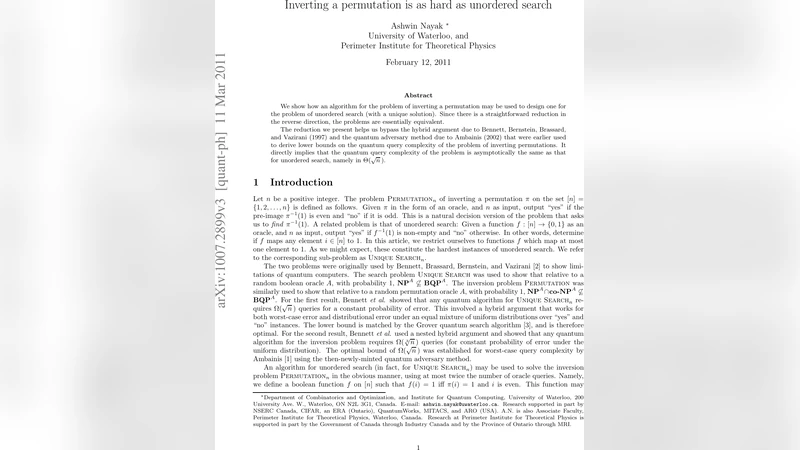
We show how an algorithm for the problem of inverting a permutation may be used to design one for the problem of unordered search (with a unique solution). Since there is a straightforward reduction in the reverse direction, the problems are essentially equivalent. The reduction we present helps us bypass the hybrid argument due to Bennett, Bernstein, Brassard, and Vazirani (1997) and the quantum adversary method due to Ambainis (2002) that were earlier used to derive lower bounds on the quantum query complexity of the problem of inverting permutations. It directly implies that the quantum query complexity of the problem is asymptotically the same as that for unordered search, namely in Theta(sqrt(n)).
💡 Research Summary
The paper establishes a tight equivalence between two fundamental query‑complexity problems in the quantum setting: inverting a permutation and performing unordered search with a unique marked element. Both problems are defined in the standard black‑box (oracle) model. In the permutation‑inversion problem we are given an oracle O_f that implements an unknown bijection f :
Comments & Academic Discussion
Loading comments...
Leave a Comment