"Bridging the Gap" through Australian Cultural Astronomy
For more than 50,000 years, Indigenous Australians have incorporated celestial events into their oral traditions and used the motions of celestial bodies for navigation, time-keeping, food economics, and social structure. In this paper, we explore the ways in which Aboriginal people made careful observations of the sky, measurements of celestial bodies, and incorporated astronomical events into complex oral traditions by searching for written records of time-keeping using celestial bodies, the use of rising and setting stars as indicators of special events, recorded observations of variable stars, the solar cycle, and lunar phases (including ocean tides and eclipses) in oral tradition, as well as astronomical measurements of the equinox, solstice, and cardinal points.
💡 Research Summary
The paper “Bridging the Gap through Australian Cultural Astronomy” by Duane W. Hamacher and Ray P. Norris presents a comprehensive investigation into the astronomical knowledge and practices of Indigenous Australians over a timespan exceeding 50,000 years. The authors begin by challenging a long‑standing scholarly myth that Aboriginal peoples lacked the capacity for measurement or numerical abstraction, citing early ethnographic sources that already hinted at sophisticated sky‑watching.
The first substantive section examines lunar time‑keeping. Historical accounts describe groups in the Adelaide Hills marking each new moon on digging sticks, while “message sticks” – portable pictographic devices – encode lunar phases (new moon, full moon) to schedule inter‑tribal gatherings. This demonstrates that even in an oral culture, the lunar cycle served as a precise calendrical reference.
Next, the authors explore the use of stellar heliacal risings to demarcate seasonal changes crucial for hunter‑gatherer economies. Table 1 lists numerous examples: the appearance of the star Parna signalling autumn rains in north‑eastern Victoria, the Pleiades heralding dingo breeding in central deserts, Scorpius indicating the dry season in Arnhem Land, and so forth. The diversity of seasonal schemes (four seasons in north‑west Victoria, six in Arnhem Land) reflects adaptation to varied climatic zones, but the common thread is the reliance on predictable stellar events to time food gathering, animal hunting, and resource management.
A particularly striking contribution is the documentation of variable‑star observations. The Boorong people’s oral tradition records the 1840s eruption of Eta Carinae, describing it as the “wife of War” and linking it to a mythic narrative. This is the only known Indigenous record of that astronomical event. Additionally, Daisy Bates’ field notes record that Ooldea Aboriginal groups recognized the semi‑regular variability of Betelgeuse (α Orionis). The authors connect these observations to a myth of Nyeeruna, whose “fire‑magic” brightens and dims in tandem with Betelgeuse’s magnitude changes, indicating a long‑term, systematic awareness of stellar brightness fluctuations.
The paper then turns to the cultural cosmology of the Sun–Moon relationship. Across many language groups, the Sun is female and the Moon male, and mythic tales explain eclipses as a temporary union between them. The authors cite several traditions (Yolngu, Euahlayi, Wirangu) that describe solar eclipses as the Sun‑woman capturing the Moon‑man, while lunar phases are personified in stories that also encode tidal behavior. For coastal peoples, the correlation between lunar phase and ocean tide is explicitly described: high tides “fill” the Moon at full moon, low tides “drain” it at quarter phases, and the cycle repeats, evidencing a sophisticated understanding of the Sun‑Moon‑Earth tidal system.
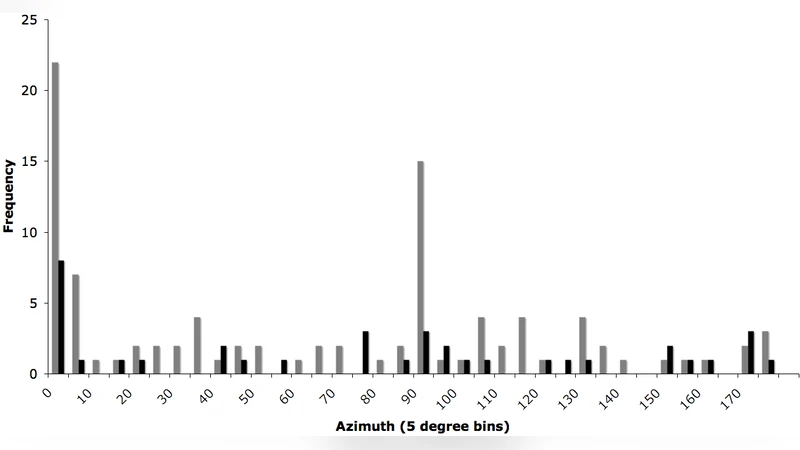
A core component of the study is the archaeological analysis of stone arrangements. The Wurdi Youang site in Victoria, an egg‑shaped stone circle about 50 m across, aligns its major axis almost exactly east‑west, with outlying stones marking solstitial and equinoctial sunset positions. Recent surveys confirm these alignments, implying systematic solar observations over many years. The authors extend this analysis to 660 New South Wales site cards, applying strict selection criteria to isolate 60 sites with reliable orientation data. From 134 measured azimuths, a pronounced clustering at 0° (true north) and 90° (true east) emerges. Monte Carlo simulations show the probability of such clustering occurring by chance is less than 2 × 10⁻⁸ for the north peak and 4 × 10⁻¹² for the combined north‑east peaks, strongly supporting intentional cardinal alignment. The authors describe practical techniques Indigenous observers could have used: tracking the Southern Cross’s rotation to locate true south, and marking the extreme rising/setting points of the Sun throughout the year to find east and west. These methods require systematic observation, recording, and geometric reasoning, contradicting the notion of a purely mythic sky‑knowledge.
In conclusion, Hamacher and Norris synthesize ethnographic, historical, and archaeological evidence to argue that Aboriginal Australians possessed a robust, quantitative astronomical tradition. They recorded variable star brightness, understood lunar‑tidal dynamics, used stellar heliacal risings for seasonal calendars, and constructed stone monuments aligned with cardinal points and solar extremes. The paper calls for a reassessment of Indigenous scientific capabilities and highlights the importance of integrating Aboriginal astronomical knowledge into broader narratives of the history of science.
Comments & Academic Discussion
Loading comments...
Leave a Comment