Generic Approach for Hierarchical Modulation Performance Analysis: Application to DVB-SH and DVB-S2
Broadcasting systems have to deal with channel variability in order to offer the best rate to the users. Hierarchical modulation is a practical solution to provide different rates to the receivers in function of the channel quality. Unfortunately, th…
Authors: Hugo Meric, Jer^ome Lacan, Caroline Amiot-Bazile
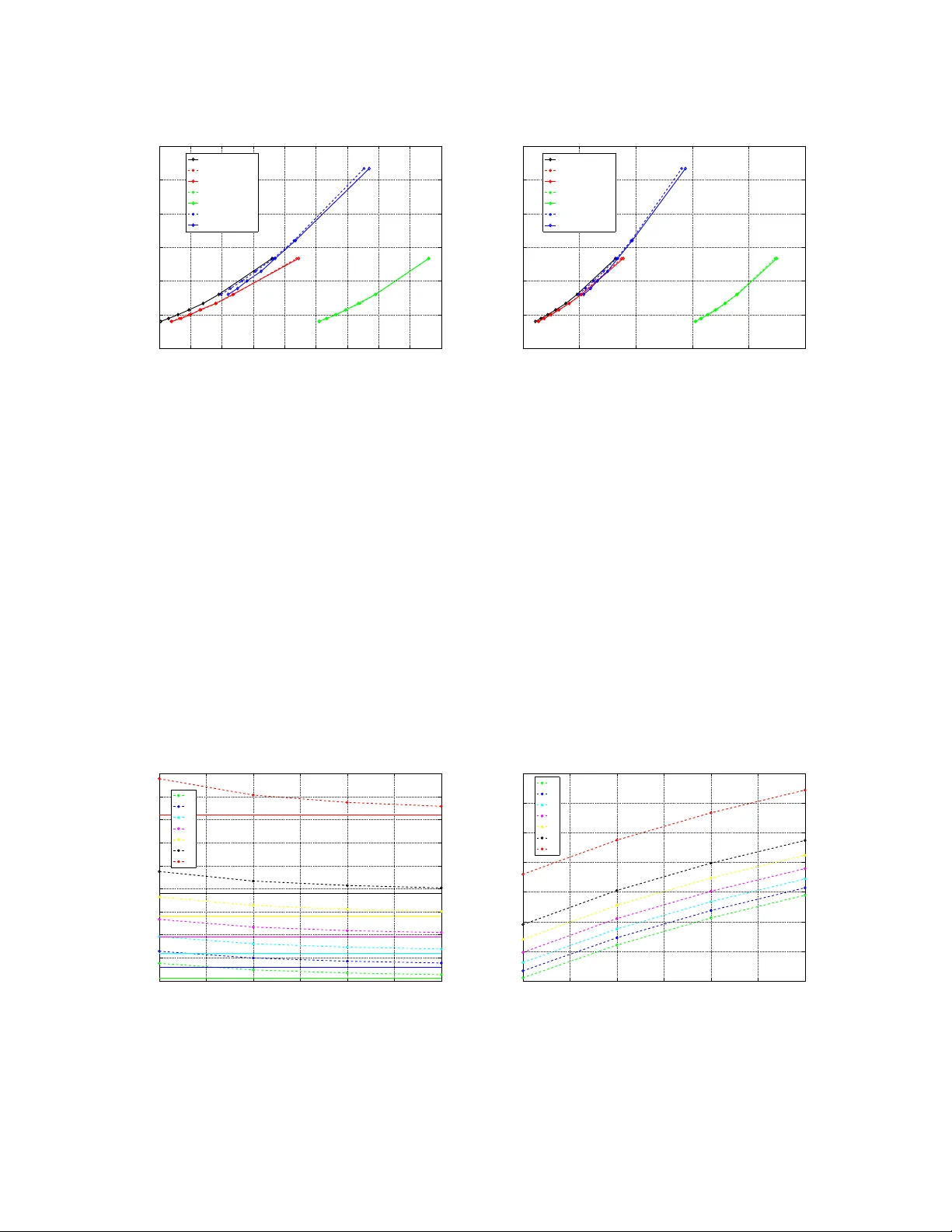
1 Generic Approach for Hierarchical Modulation Performance Analysis: Application to D VB-SH and D VB-S2 Hugo M ´ eric ∗ † , J ´ er ˆ ome Lacan † ∗ , Caroline Amiot-Bazile ‡ , Fabrice Arnal § and Marie-Laure Boucheret † ∗ ∗ T ´ eSA, T oulouse, France † Uni versit ´ e de T oulouse, T oulouse, France ‡ CNES, T oulouse, France § Thales Alenia Space, T oulouse, France Email: hugo.meric@isae.fr , jerome.lacan@isae.fr , caroline.amiot-bazile@cnes.fr , fabrice.arnal@thalesaleniaspace.com, marie-laure.boucheret@enseeiht.fr Abstract Broadcasting systems hav e to deal with channel variabi lity in order to offer the best rate to the users. Hierarchical modulation is a practical solution to provide dif ferent rates to the recei vers in function of the channel quality . Unfortunately , the performance e valuation of such modulations requires time consuming simulations. W e propose in this paper a nov el approach based on the channel capacity to av oid these simulations. The method allo ws to study the performance of hierarchical and also classical modulations combined with error correcting codes. W e will also compare hierarchical modulation with time sharing strategy in terms of achiev able rates and indisponibility . Our work will be applied to the D VB-SH and DVB-S2 standards, which both consider hierarchical modulation as an optional feature. Index T erms Hierarchical Modulation, Channel Capacity , Digital V ideo Broadcasting, System Performance. I . I N T RO D U C T I O N In most broadcast applications, all the receivers do not experience the same signal-to-noise ratio (SNR). For instance, in satellite communications the channel quality decreases with the presence of clouds in Ku or Ka band, or with shadowing ef fects of the en vironment in lower bands. The material in this paper will be presented in part at WTS 2011, New-Y ork, United States, April 2011. It is available online at http://arxiv .org/abs/1103.1305. October 22, 2018 DRAFT 2 The first solution for broadcasting is to design the system for the worst-case reception. Ho we ver , this solution does not take into account the v ariability of channel qualities. This holds a loss of spectrum efficienc y for users with good reception. Then, two other schemes hav e been proposed in [ 1 ] and [ 2 ] to improve the first one: time division multiplexing with variable coding and modulation, and superposition coding. Time division multiplexing consists in using a first couple modulation/coding rate during a fraction of time, and then using an other modulation/coding rate for the remaining time. All the population can receiv e the first part of the signal called the High Priority (HP) signal and only the receivers in good conditions receiv e the second one called the Low Priority (LP) signal. Unlike time sharing, superposition coding sends information for all the recei vers all the time. This scheme was shown to be optimal for the continuous Gaussian channel [ 2 ]. In superposition coding, the av ailable energy is shared to se veral service flows which are send simultaneously and in the same band. Hierarchical modulation is a practical implementation of superposition coding. Figure 1 presents the principle of the hierarchical modulation with a non-uniform 16-QAM. The idea is to merge two different streams at the modulation step. The HP stream is used to select the quadrant, and the LP stream selects the position inside the quadrant. In good conditions receiv ers can decode both streams, unlike bad receivers which only locate the quadrant and then decode the HP stream as a QPSK constellation. At the service le vel, the tw o streams are either dependent or independent . A practical example of dependent streams is H.264/SVC encoded video. This standard generates se veral video layers, where each layer improv es the video quality but requires all the underlying layers. Scalable V ideo Coding can be used with time division multiplexing [ 3 ] or hierarchical modulation [ 4 ]. In this paper , we suppose that the streams are dependent although the study can be e xtended to the other case. Even if hierarchical modulation is not a new concept, its use in most recent broadcast satellite standard, D VB-SH [ 6 ] and D VB-S2 [ 5 ], has motiv ated its analysis and development by the satellite community research. This article is focused on the performance analysis of hierarchical modulation and the comparison with time sharing. W e propose here a new approach to ev aluate the performance of hierarchical modulation. The method is based on the channel capacity and relies on the fact that the real code at coding rate R is similar to a theoretical ideal code at coding rate ˜ R in terms of decoding threshold. Our approach is applied to D VB-SH and D VB-S2, where it helps to decide the good coding strategy for a system with constraints. The paper presents our work as follo ws: • In Section II , we compute the capacity for any hierarchical modulation. A first comparison between time sharing and hierarchical modulation is done by comparing their set of theoritical achie vable rates, called the capacity region. • In Section III , we propose a method using the capacity to ev aluate the performance of hierarchical modulations in terms of spectral efficiency and required E s / N 0 for a tar geted Bit Error Rate (BER) or Packet Error Rate (PER). Then, we obtain the achie v able rates for real codes using hierarchical modulation or time sharing. • Section IV introduces the notion of indisponibility which requires SNR distribution. This allows to complete our comparison between the two studied schemes. Section V concludes the paper by summarizing the results. October 22, 2018 DRAFT 3 Q 0000 0010 0001 1110 1100 1111 1101 1010 1000 1011 1001 0101 0111 0110 0100 I 00 11 2d h 2d l Hierarchical 16−QAM 00 11 HP LP Encoder Encoder Fig. 1: Hierarchical Modulation using a non-uniform 16-QAM I I . C A P AC I T Y O F T H E H I E R A R CH I C A L M O D U L A T I O N This section defines and computes the channel capacity for any hierarchical modulation. Then, the capacity is used to compare two different schemes: time division multiplexing and superposition coding. Our performance analysis method presented in Section III is also based on the capacity . A. Computation of the capacity A channel can be considered as a system consisting of an input alphabet, an output alphabet and a probability transition matrix p ( y | x ) . W e define two random v ariables X , Y representing the input and output alphabets respectiv ely . The mutual information between X and Y , noted I ( X ; Y ) , measures the amount of information con veyed by Y about X. For two discrete random variables X and Y , the expression of the mutual information is I ( X ; Y ) = X x ∈X X y ∈Y p ( x ) p ( y | x ) log 2 p ( y | x ) p ( y ) . (1) Using this notion, the channel capacity is then giv en by C = max p ( x ) I ( X ; Y ) , (2) where the maximum is computed o ver all possible input distributions [ 7 ]. Here we consider the memoryless discrete input and continuous output Gaussian channel. The discrete inputs x i are obtained using a modulation and belong to a set of discrete points χ ⊂ R 2 of size | χ | = M = 2 m called the constellation. Thus, each symbol of the constellation carries m bits. Reference [ 8 , Chapter 3] gives an e xplicit formula ( 3 ) for the capacity in this particular case. C = log 2 ( M ) − 1 M M X i =1 + ∞ Z −∞ + ∞ Z −∞ p ( y | x i ) log 2 P M j =1 p ( y | x j ) p ( y | x i ) ! d y (3) Equation ( 3 ) computes the capacity for one stream using all the bits. W e are now interested to ev aluate the capacity of a stream using a subset of the m bits. Reference [ 9 ] presents the case where each stream uses one bit. The idea is to modify the input random variable X by the input bits used in each stream. W e define b i as the value of the i th bit of the label of any constellation point x . Suppose the stream uses k bits among m in the positions j 1 , October 22, 2018 DRAFT 4 ..., j k . For any integer i, let l n ( i ) denote the n th bit in the binary representation of i such as i = P + ∞ n =1 l n ( i )2 n − 1 . Then using ( 1 ) with the ne w input variable and continuous output, the capacity of the stream is C = 1 2 k 2 k − 1 X i =0 + ∞ Z −∞ + ∞ Z −∞ p ( y | b j 1 = l 1 ( i ) , ..., b j k = l k ( i )) | {z } sum over all possible k-uplets log 2 p ( y | b j 1 = l 1 ( i ) , ..., b j k = l k ( i )) p ( y ) d y , (4) where p ( y ) = 1 2 k P 2 k − 1 i =0 p ( y | b j 1 = l 1 ( i ) , ..., b j k = l k ( i )) . Let L n ( x ) denote the n th bit of the label of any constellation point x . W e introduce χ i the subset of χ defined as follows χ i = { x ∈ χ | L j 1 ( x ) = l 1 ( i ) , ..., L j k ( x ) = l k ( i ) } . (5) The set χ i depends on i and the positions of the bits inv olved in the stream. Figure 2 shows an example of subsets for a 16-QAM with a particular mapping, where the stream uses bits 1 and 2 (in that case k = 2 , j 1 = 1 and j 2 = 2 ). 000000000 000000000 000000000 000000000 000000000 111111111 111111111 111111111 111111111 111111111 000000000 000000000 000000000 000000000 000000000 111111111 111111111 111111111 111111111 111111111 000000000 000000000 000000000 000000000 000000000 111111111 111111111 111111111 111111111 111111111 000000000 000000000 000000000 000000000 000000000 111111111 111111111 111111111 111111111 111111111 00000 00000 00000 00000 00000 00000 00000 00000 00000 11111 11111 11111 11111 11111 11111 11111 11111 11111 00000 00000 00000 00000 00000 00000 00000 00000 00000 11111 11111 11111 11111 11111 11111 11111 11111 11111 00000 00000 00000 00000 00000 00000 00000 00000 00000 11111 11111 11111 11111 11111 11111 11111 11111 11111 00000 00000 00000 00000 00000 00000 00000 00000 00000 11111 11111 11111 11111 11111 11111 11111 11111 11111 00000 00000 00000 00000 00000 00000 00000 00000 00000 11111 11111 11111 11111 11111 11111 11111 11111 11111 I Q 00 00 00 00 10 10 10 10 11 11 11 11 01 01 01 11 01 10 00 11 01 00 10 01 11 01 00 10 11 01 10 00 Fig. 2: Examples of χ 0 (vertical lines) and χ 3 (horizontal lines) Then the conditional probability density function of y in ( 4 ) can be written p ( y | b j 1 = l 1 ( i ) , ..., b j k = l k ( i )) = X x ∈ χ i p ( y | x ) p ( x | x ∈ χ i ) = 1 | χ i | X x ∈ χ i p ( y | x ) , (6) where | χ i | = 2 m − k for all i. Moreover , the transition distrib ution p ( y | x ) for a Gaussian channel is p ( y | x ) = 1 π N 0 exp − k y − x k 2 N 0 . (7) Using ( 6 ) and ( 7 ) in ( 4 ), we finally obtain the capacity for one stream ( 8 ). The capacity is an increasing function of E s / N 0 and its v alue is less or equal to k the number of bits used in the stream. The positi vity of the capacity October 22, 2018 DRAFT 5 results of its mathematical definition [ 7 ]. C = k − 1 2 k π 2 k − 1 X i =0 + ∞ Z −∞ + ∞ Z −∞ 1 | χ i | X x ∈ χ i exp u − x √ N 0 2 ! log 2 1 + X x ∈ χ \ χ i exp u − x √ N 0 2 X x ∈ χ i exp u − x √ N 0 2 d u (8) B. Case of non-uniform hierar chical modulation capacities W e be gin with fe w definitions before applying ( 8 ) to the hierarchical 16-QAM and 8-PSK considered in D VB-SH and D VB-S2 respecti vely . Hierarchical modulations mer ge se veral streams in a same symbol. They often use non-uniform constellation. Non-uniform constellations are opposed to uniform constellations, where the symbols are uniformly distributed. The constellation parameter is defined to describe non-uniform constellations. Figure 1 illustrates a non-uniform 16-QAM. The constellation parameter α is defined by α = d h /d l , where 2 d h is the minimum distance between two constellation points carrying different HP bits, and 2 d l is the minimum distance between any constellation point. T ypically , we have α ≥ 1 , where α = 1 corresponds to the uniform 16-QAM, but it is also possible to ha ve α ≤ 1 . D VB-SH standard recommends two v alues for α : 2 and 4. D VB-S2 considers the non-uniform 8-PSK presented on Figure 3 . The constellation parameter θ represents the half angle between two points in one quadrant and is selected by the operator according to the desired performance. In both cases, the constellation parameter has a great impact on the performance of the decoded stream. Fig. 3: Non-uniform 8-PSK Back to the hierarchical modulation capacity , we suppose the HP stream uses the bits in position 1 and 2 in both cases. The LP stream in volv es the remaining bits, i.e., bits 3 and 4 for the 16-QAM and bit 3 for the 8-PSK. From these definitions, we can apply ( 8 ) to compute their capacity . Figure 4 presents the capacity for the 16-QAM for the two values of α defined in the D VB-SH guidelines [ 6 ] and Figure 5 sho ws the results for the 8-PSK. In Figure 4 , when α gro ws, the constellation points in one quadrant become closer and then it is natural than the capacity for the LP stream decreases at a giv en SNR as it is harder to decode. For the HP stream the points are farer to the I and Q axes, then it is easier to decode which quadrant was sent and the capacity is increased. October 22, 2018 DRAFT 6 This capacity is nev ertheless limited by the QPSK capacity . The same remarks are v alid concerning θ in Figure 5 . When θ decreases, it is easier to decode the good quadrant but not the symbol sent. In these examples, we apply ( 8 ) to hierarchical modulation with two flows, b ut it can also be applied to multilevel hierarchical modulation such as 256-QAM with 3 flows, where each flow is composed of two bits. T o conclude, we can observe that the hierarchical modulation capacity (i.e., HP+LP) is always less than the 16-QAM one for any value of α > 1 . This result has been prov ed in [ 9 ], where the dif ferent streams use one bit. W e can also note that the best total capacity is achiev ed when the constellation is close to the uniform constellation, but on the other hand performances for the HP stream are decreased. −10 −5 0 5 10 15 20 0 0.5 1 1.5 2 2.5 3 3.5 4 Es/No (dB) Capacity QPSK 16−QAM HP LP HP+LP (a) α = 2 −10 −5 0 5 10 15 20 0 0.5 1 1.5 2 2.5 3 3.5 4 Es/No (dB) Capacity QPSK 16−QAM HP LP HP+LP (b) α = 4 Fig. 4: 16-QAM Hierarchical Modulation Capacity −10 −5 0 5 10 15 20 0 0.5 1 1.5 2 2.5 3 Es/No (dB) Capacity QPSK 8−PSK HP LP HP+LP (a) θ = 10 ◦ −10 −5 0 5 10 15 20 0 0.5 1 1.5 2 2.5 3 Es/No (dB) Capacity QPSK 8−PSK HP LP HP+LP (b) θ = 15 ◦ Fig. 5: 8-PSK Hierarchical Modulation Capacity October 22, 2018 DRAFT 7 C. T ime Sharing vs Hierar chical Modulation W e consider in this section the problem of broadcasting data to two populations, each one with a target SNR. W e suppose to transmit dependent data, for instance two layers of a video encoded with H.264/SVC. Classicaly , broadcast channels can use time sharing and/or hierarchical modulation. The Gaussian channel was studied in [ 1 ] and [ 2 ], where the superposition coding was introduced and shown to be optimal in terms of achiev able rates. W e in vestigate hereafter the case of the memoryless discrete input and continuous output Gaussian channel by computing the capacity region for the hierarchical modulation and the time sharing strategies. V ariable Coding Modulation (VCM) is a practical implementation of time sharing. During a fraction of time, a first modulation and coding rate is selected, then for the remaining time an other modulation and coding scheme is used. When VCM uses two QPSK, the corresponding modulation for superposition coding is a hierarchical 16-QAM. W e are interested to compare the achiev able rates between these two schemes: VCM using two QPSK and hierarchical 16-QAM. The power allocation to each stream determines the v alue of α . W e suppose to have a total po wer budget E. The power allocation for the HP stream is given by the energy of a QPSK with a parameter d h + d l : E hp = 2( d h + d l ) 2 = 2 d 2 l (1 + α ) 2 = ρ hp E . For the LP stream, the remaining ener gy is E lp = 2 d 2 l = ρ lp E (QPSK with parameter d l ), where ρ lp = 1 − ρ hp . The relation between the po wer allocation and α is E hp E lp = ρ hp ρ lp = (1 + α ) 2 . (9) Figure 6 presents the capacity regions for two populations of users with two SNR configurations. S N R i corresponds to the SNR e xperienced by the users of the population i, where i equals 1 or 2. In both cases, the SNR is better for users of population 2. As mentioned pre viously , we suppose that the content sent to both populations is dependent , then the achiev able rates are, R 1 = C hp ( S N R 1 ) , R 2 = C hp ( S N R 1 ) + C lp ( S N R 2 ) . (10) Each point on Figure 6 corresponds to a specific power configuration and then a particular value of α as shown in ( 9 ). For the simulations, ρ hp varies from 0.51 to 0.99, which corresponds to a variation of α from 0.02 to 8.95. W e now consider the curve concerning the hierarchical modulation on the Figure 6a . The more energy is allocated to the HP stream, higher is the capacity for population 1. When we decrease the HP stream energy , it also decreases the capacity of population 1, but the capacity of population 2 can be increased. On both figures, the hierarchical modulation outperforms the time sharing strate gy . Howe ver , the achie vable rate for the population 2 using hierarchical modulation can not always reach the maximum rate gi ven by the time sharing strategy as on Figure 6b . Finally , we have seen on Figure 6 the capacity region for the hierarchical modulation. Moreover , when two sets of rates ( R 1 , R 2 ) and ˜ R 1 , ˜ R 2 are achiev able, the time sharing strategy allo ws any rate pair τ R 1 + (1 − τ ) ˜ R 1 , τ R 2 + (1 − τ ) ˜ R 2 , 0 ≤ τ ≤ 1 . (11) October 22, 2018 DRAFT 8 0 0.5 1 1.5 2 2.5 0 0.2 0.4 0.6 0.8 1 1.2 1.4 Capacity User 2 Capacity User 1 Hierarchical Modulation Time sharing QPSK/QPSK (a) SNR 1 =2dB, SNR 2 =10dB 0 0.2 0.4 0.6 0.8 1 1.2 1.4 1.6 1.8 2 0 0.1 0.2 0.3 0.4 0.5 0.6 0.7 Capacity User 2 Capacity User 1 Hierarchical Modulation Time sharing QPSK/QPSK (b) SNR 1 =-2dB, SNR 2 =6dB Fig. 6: Capacity Region It can be observed that using both hierarchical modulation and time sharing enables to get some points which can not be obtained by using only one of the two methods. I I I . P E R F O R M A N C E E V A L UAT I O N F O R H I E R A R C H I C A L M O D U L A T I O N S W e present in this section a method to get easily the spectrum efficiency and the required E s / N 0 for a given targeted BER/PER for any modulation and coding rate without computing extensi ve simulations. In [ 10 ], a fast coding/decoding performance ev aluation method based on the mutual information computation is proposed and applied to time varying channel for QPSK modulation with very good prediction precision. The method developped hererafter , based on channel capacity computation, makes it possible to predict the performances of a coding scheme combined with an y modulation and especially any hierarchical modulation. The last part of this section presents the capacity region for real codes using our method. A. Principle 1) Ideal code: Before applying the approach to a real code, we begin with an example using theoretical ideal codes achieving the channel capacity . The normalized capacity for a modulation is defined by C mod = 1 m C mod , where C mod is the modulation’ s capacity and m is the number of bits per symbol. The C mod function belongs to [0 , 1[ and corresponds to the maximal coding rate of an ideal code, which achiev es error-free transmission. Giv en a modulation and a coding rate, if we want to know at which E s / N 0 the ideal code is able to decode, we just need to inv erse the normalized capacity function for that coding rate. Figure 7 illustrates this example using a QPSK modulation. 2) Real code: Let us now consider an actual wa veform based on a real code. W e can consider the real code with a coding rate R is similar to an ideal code with rate ˜ R (in terms of decoding threshold), where ˜ R ≥ R . T o October 22, 2018 DRAFT 9 −10 −5 0 5 10 15 0 0.2 0.4 0.6 0.8 1 1.2 1.4 1.6 1.8 2 Es/No (dB) Capacity QPSK Capacity QPSK Normalized Capacity Required Es/No to decode at a coding rate of 0.8 Fig. 7: Decoding threshold for an ideal code of rate 0.8 determine ˜ R , we propose to consider the performance curve (BER or PER vs E s / N 0 ) for one actual refer ence modulation and coding scheme with code rate R . The principle consists in first determining from this performance curve a v alue ( E s / N 0 ) ref corresponding to a quasi error-free transmission (e.g., BER = 10 − 5 ). Then, we obtain ˜ R as the value corresponding to ( E s / N 0 ) ref in the normalized capacity vs SNR curv e of the reference modulation. Finally , we find the SNR operating point for the hierarchical modulation by taking the v alue corresponding to ˜ R in the normalized capacity vs SNR curve of the hierarchical modulation. The set of operating points for dif ferent code rates gi ves the spectrum ef ficiency curve of the hierarchcial modulation. W e illustrate our method with an example. W e would like to study the SNR operating points of the hierarchical modulation using an non-uniform 16-QAM ( α = 2 ) in the D VB-SH standard at a target BER of 10 − 5 . W e use the 2/9 and 1/5-turbo codes for the HP and LP streams respectively . T o determine ˜ R and the decoding thresholds, the method works as follow: 1) Use the performance curve of the reference modulation with rate R to get the operating point ( E s / N 0 ) ref such as we have the desired performance. In the D VB-SH guidelines [ 6 , T able 7.5], we read: For the coding rate 2/9: BER QPSK ( − 3 . 4 dB ) = 10 − 5 ⇒ ( E s / N 0 ) ref = − 3 . 4 dB For the coding rate 1/5: BER QPSK ( − 3 . 9 dB ) = 10 − 5 ⇒ ( E s / N 0 ) ref = − 3 . 9 dB 2) Compute the normalized capacity for the reference modulation, which corresponds to ˜ R (see Figure 7 ): For the HP stream: ˜ R = C QPSK ( − 3 . 4 dB ) ≈ 0 . 27 For the LP stream: ˜ R = C QPSK ( − 3 . 9 dB ) ≈ 0 . 2455 3) For the studied modulation, compute E s / N 0 such as the normalized capacity at this SNR equals ˜ R : ( E s / N 0 ) H P = C − 1 HP , α =2 ˜ R = 0 . 27 = − 2 . 7 dB ( E s / N 0 ) LP = C − 1 LP , α =2 ˜ R = 0 . 2455 = 6 . 2 dB October 22, 2018 DRAFT 10 The D VB-SH guidelines give the decoding thresholds for the HP and LP streams [ 6 , T able 7.40]. W e read -2.6dB and 6.5dB for the HP and LP streams respectiv ely (we remove the 0.3dB due to the pilots). 4) Finally the points (( E s / N 0 ) H P , R H P × m ) and (( E s / N 0 ) LP , R LP × m ) are plotted on the spectrum effi- ciency curve (e.g. Figure 9 ). These steps are repeated for all the coding rates. Our method makes tw o assumptions. First of all, it approximates the information rate by R × m . This approximation is justified by the fact that the targeted performance (BER = 10 − 5 ) is very small and thus only hardly impact the useful information rate. The second assumption is to suppose as in [ 10 ] that the performance of the decoding only depends on the normalized capacity and not on the modulation as for ideal codes . T o validate this second assumption, we present on Figure 8 the normalized capacity in function of the coding rate for various modulations using the data of DVB- SH [ 6 , T able 7.5]. For ideal codes, the points are merged and located on the dotted line. But for real codes, we can remark that, even if the points are different, they are closed. 0.2 0.25 0.3 0.35 0.4 0.45 0.5 0.55 0.6 0.65 0.7 0.1 0.2 0.3 0.4 0.5 0.6 0.7 0.8 Coding rate Normalized Capacity QPSK 8−PSK 16−QAM Fig. 8: D VB-SH: normalized capacities B. Application to D VB-SH In our study , we use the guidelines of DVB-SH [ 6 , T able 7.5] to get the reference curves and the operating points at a target BER of 10 − 5 . These data correspond to a static receiv er . The guidelines also provide all the reference numerical results for the hierarchical modulation [ 6 , Figure 7.40], where 0.3dB need to be removed due to the pilots. These results allow to ev aluate the ef ficiency of our method. The method described earlier is now applied to plot the spectrum efficienc y curves as a function of required E s / N 0 (target BER = 10 − 5 ). D VB-SH considers two v alues of α , 2 and 4. The curves are giv en in Figure 9 . The reference results from the guidelines correspond to the standard curves. The results sho w a good precision and it does not require computing extensi ve simulations. Moreover , our work consolidates the fact that the capacity is a good metric to ev aluate performance. October 22, 2018 DRAFT 11 −4 −2 0 2 4 6 8 10 12 14 0 0.5 1 1.5 2 2.5 3 Es/No (dB) Spectrum efficiency QPSK (standard) HP HP (standard) LP LP (standard) 16QAM 16QAM (standard) (a) α = 2 −5 0 5 10 15 20 0 0.5 1 1.5 2 2.5 3 Es/No (dB) Spectrum efficiency QPSK (standard) HP HP (standard) LP LP (standard) 16QAM 16QAM (standard) (b) α = 4 Fig. 9: D VB-SH spectrum efficienc y , BER = 10 − 5 C. DVB-SH: Additional Results W e apply hereafter the method to compute the required E s / N 0 in function of α or the coding rate. Figure 10 presents ho w the required E s / N 0 varies with α . F or the LP stream, the required E s / N 0 is an increasing function of α , unlike the one for the HP stream who decreases. In fact, the required E s / N 0 for the HP stream tends to the required SNR of the QPSK modulation (continuous lines on Figure 10a ). These results are obvious when we look the modification of the constellation with α . When α increases, the points in one quadrant become closer and the constellation is similar to a QPSK. It explains why the LP stream is harder to decode and requires a better SNR. 2 2.5 3 3.5 4 4.5 5 −4 −3 −2 −1 0 1 2 3 4 5 α required Es/No (dB) 1/5 2/9 1/4 2/7 1/3 2/5 2/3 (a) HP Stream 2 2.5 3 3.5 4 4.5 5 6 8 10 12 14 16 18 20 α required Es/No (dB) 1/5 2/9 1/4 2/7 1/3 2/5 2/3 (b) LP Stream Fig. 10: Required E s / N 0 function of α , BER = 10 − 5 October 22, 2018 DRAFT 12 The last result concerns the variations of the required E s / N 0 with the coding rate. Figure 11a sho ws the result for α = 2 . Obviously if there is less redundancy , the SNR has to be higher to decode. Figure 11b presents the difference between the required SNR for the QPSK and the HP/LP streams function of the coding rate with α = 2 . W e see that, for a coding rate R ≥ 0 . 3 , the difference between the QPSK and the LP stream is constant, which has been observed and quantified in [ 11 ]. 0.2 0.25 0.3 0.35 0.4 0.45 0.5 0.55 0.6 0.65 0.7 −4 −2 0 2 4 6 8 10 12 14 Coding rate required Es/No (dB) QPSK HP LP (a) Required E s / N 0 function of the coding rate, α = 2 0 0.1 0.2 0.3 0.4 0.5 0.6 0.7 0.8 0.9 1 0 2 4 6 8 10 12 Coding Rate difference of required Es/No HP−QPSK LP−QPSK (b) Dif ference between the required E s / N 0 for the QPSK and the HP/LP streams, α = 2 Fig. 11: Study of the required E s / N 0 function of the coding rate, BER = 10 − 5 D. Application to D VB-S2 The performance curves for the LDPC codes used in D VB-S2 are gi ven in [ 12 , Fig 7]. The spectrum efficiency and the required E s / N 0 can be computed using the method described pre viously . Here we choose a target PER of 10 − 5 as desired performance. Figure 12 presents the results for two values of θ . The standard does not explicit any v alue for θ and reference numerical results. T o lighten the paper , we do not present an y additional curve to Figure 12 as in the previous part. In conclusion to this section, we can remark that θ plays the same role as α : it allows to modify the performance of each stream. E. T ime Sharing vs Hierar chical Modulation W e are interested here to obtain the equiv alent of the capacity region for real codes. This can be considered as spectrum efficienc y region. As described in Section II , the a vailable energy is shared between two flows for the superposition coding strategy . W e need to compute the achie v able rate for the real code. Once the po wer allocation is done and α determined, we read on the spectrum efficienc y curve the capacity for each population. Unfortunately , the spectrum ef ficiency curve is not a continuous fonction since it has been computed for the dif ferent coding rates allo wed by the standard. October 22, 2018 DRAFT 13 2 4 6 8 10 12 14 16 18 20 0 0.5 1 1.5 2 2.5 3 Es/No (dB) Spectrum efficiency QPSK (standard) 8−PSK (standard) 8−PSK HP Stream LP Stream (a) θ = 10 ◦ 2 4 6 8 10 12 14 16 0 0.5 1 1.5 2 2.5 3 Es/No (dB) Spectrum efficiency QPSK (standard) 8−PSK (standard) 8−PSK HP Stream LP Stream (b) θ = 15 ◦ Fig. 12: D VB-S2 spectrum efficienc y , PER = 10 − 5 T o obtain the capacity for any SNR, we approximate the spectrum efficiency by linear interpolation between each point as presented in Figure 12 . W e reminder the achie vable rates for each population, where S N R 1 ≤ S N R 2 , R 1 = C hp ( S N R 1 ) , R 2 = C hp ( S N R 1 ) + C lp ( S N R 2 ) . (12) Figure 13 presents the results using this interpolation for D VB-SH and D VB-S2. Here again the hierarchical modulation outperforms the time sharing strategy with two QPSK modulations for se veral SNR configurations (we choose the different SNR according to distributions giv en in Section IV ). If the time sharing uses dif ferent modulations than QPSK, it is also possible to represent the achie vable rates. Theses curves are particurlarly interesting when using adaptive modulation as in D VB-S2 [ 5 ]. In that case, it is possible to identify for a gi ven SNR configuration, which solution is the best: hierarchical modulation or time sharing (with all possible modulations). I V . S P E C T RU M E FFI C I E N C Y V S I N D I S P O N I B I L I T Y In this section, we study a broadcast system, where the receivers SNR distribution is known. W e define the indisponibility and compare hierarchical modulation to classical modulations using this new criteria in addition to the spectrum efficienc y . A. Definition of Spectrum Efficiency and Indisponibility In the previous part, we introduce a method based on the capacity in order to estimate the spectrum efficiency for any modulation and in particular hierarchical one combined with real codes. It is then possible to compare various modulations in terms of spectrum efficienc y and po wer performance. The next step is to take into account the channel variability in the dimensionning of a broadcast system. The indisponibility is in that case rele vant to complete the spectrum efficienc y criteria in the choice of modulation and coding scheme. The indisponibility October 22, 2018 DRAFT 14 0 0.5 1 1.5 2 2.5 0 0.2 0.4 0.6 0.8 1 1.2 1.4 Rate User 2 Rate User 1 Time Sharing QPSK−QPSK 16−QAM Hierarchical Modulation (a) DVB-SH: SNR 1 =2dB, SNR 2 =10dB 0 0.5 1 1.5 2 2.5 3 0 0.2 0.4 0.6 0.8 1 1.2 1.4 1.6 1.8 2 Rate User 2 Rate User 1 Time Sharing QPSK−QPSK 8−PSK Hierarchical Modulation (b) DVB-S2: SNR 1 =9dB, SNR 2 =10dB Fig. 13: Capacity Region is simply defined as the percent of the population which can not decode any stream. Its computation requires SNR distributions. This notion completes the spectrum efficienc y in the sense that the coding scheme maximising the spectrum efficienc y may also be decoded by a small fraction of the population, which is not admissible. A compromise has to be found between a good spectrum efficiency and a tolerable indisponibility . W e consider here a mean spectrum efficienc y over the population who recei ve at least the HP stream. Equation ( 13 ) giv es the mean spectrum efficienc y formula, where µ x represents the spectrum efficienc y for the stream x and ρ x is the percent of the population decoding the stream x with the inequality ρ lp ≤ ρ hp . Mean Spectrum Efficienc y = µ hp ρ hp + µ lp ρ lp ρ hp (13) For instance in the best case, all the population decode both streams so ρ hp = ρ lp = 1 and the mean spectrum efficienc y equals µ hp + µ lp . B. Application to D VB-SH Figure 14a presents the SNR distrib ution for several environments in S-band due to shadowing and fading ef fects of these en vironments. The distribution is the result of measures realized by the CNES in 2008. The foreseen application is here satellite multimedia broadcasting to handheld mobile terminals. Using these distributions, it is possible to compute the indisponibility for any configuration of the hierarchical modulation. Figure 14b presents the results for one environment. F or the hierarchical modulation, once the constel- lation parameter and the coding rate of the HP stream hav e been set, it is possible to compute the indisponibility who only depends on the required SNR to decode the HP stream. For a given HP coding rate, we choose to represent on Figure 14b the points which verify the constraint E s N 0 lp ≥ E s N 0 hp . October 22, 2018 DRAFT 15 The coding rate of the LP stream has an impact on the ponderate spectrum efficiency b ut not on the indisponibility . An interesting fact is when the coding rate of the LP stream for a given HP coding rate is increased, it is expected that the ponderate spectrum ef ficiency increases b ut it is not always the case. It can be e xplained by the computation of the ponderate spectrum efficienc y in ( 13 ). When the LP coding rate grows, µ lp increase but in the same time ρ lp decrease. As ρ lp depend on the SNR distribution, the environment has an impact on the result. W e no w focus on Figure 14b . W e are interested to find the best configuration for an indisponibility around 10 − 1 (10%). The 16-QAM is not an option as it does not reach that le vel of indisponibility taking into account the D VB-SH av ailable code rates. The best spectrum ef ficiency is achie ved using a hierarchical modulation with α = 2 , coding rates 2/5 and 1/5 for the HP and LP streams respectively . In that particular case, the hierarchical modulation of fers better performance than classical modulations such as the QPSK and the 16-QAM. Note that there is no general rule to choose the good modulation/coding scheme as the SNR distrib ution has a great impact on the final choice. Howe ver , in many cases, it appears that hierarchical modulation is significantly better than classical modulations. Finally , the principle can be applied to more complicated scenario, where all the population does not experience the same en vironment. −10 −5 0 5 10 15 0 0.1 0.2 0.3 0.4 0.5 0.6 0.7 0.8 0.9 1 Es/No (dB) Mixed Suburban Urban Wooded (a) SNR distrib ution for se veral environments 0.2 0.4 0.6 0.8 1 1.2 1.4 1.6 1.8 2 2.2 10 −2 10 −1 10 0 Spectrum Efficiency Indisponibility α =2 QPSK 16−QAM (b) Indisponibility vs spectrum ef ficiency: mix ed environment Fig. 14: D VB-SH C. Application to D VB-S2 The SNR distrib ution for D VB-S2 on Figure 15a represents the fading in the Ka band due to rain attenuation. It is quite dif ferent from the distributions presented on Figure 14a . The slope of the curve is much steeper in that case. This also has an impact on the performance of the hierarchical modulation. The hierarchical 8-PSK presents here a lo wer spectrum efficiency compared to the QPSK and for a gi ven indisponibility . Figure 15b presents the results October 22, 2018 DRAFT 16 for θ = 10 ◦ . In that case, the hierarchical modulation does not outperform the 8-PSK and QPSK modulations. Howe ver , compared to the 8-PSK, it is possible to obtain lo wer indisponibility due to the impact of θ . 6 6.5 7 7.5 8 8.5 9 9.5 10 0 0.1 0.2 0.3 0.4 0.5 0.6 0.7 0.8 0.9 1 Es/No (dB) (a) SNR distrib ution 1.2 1.4 1.6 1.8 2 2.2 2.4 2.6 2.8 10 −3 10 −2 10 −1 10 0 Spectrum Efficiency Indisponibility QPSK 8−PSK θ =10 (b) Indisponibility vs spectrum ef ficiency: θ = 10 ◦ Fig. 15: D VB-S2 V . C O N C L U S I O N In this paper , we introduce a general method allowing to analyse the performance of hierarchical modulations. This method relies on the channel capacity , which has been computed for any kind of constellation. It has been first applied to D VB-SH and DVB-S2 in order to obtain the spectrum efficiency . Comparisons with reference numerical results show the good reliability of the method. W e also compare the performance of hierarchical modulation with time sharing in terms of achie vable rates. The results show that hierarchical modulation often outperform the other scheme. T o go further we introduce the notion of indisponibility using SNR distributions. It permits to compare different modulations with two criteria: mean spectrum efficienc y and indisponibity . The result is useful in order to pick up a modulation when dimensionning a broadcast system and is illustrated on two application examples: D VB-SH S-band broadcasting to mobile handheld terminals and D VB-S2 Ka-band broadcasting to fixed terminals. A C K N O W L E D G M E N T The authors wish to thank Fr ´ ed ´ eric Lacoste for sharing the SNR distributions presented in Section IV . R E F E R E N C E S [1] T . M. Cover , “Broadcast channels, ” IEEE T ransactions on Information Theory , v ol. IT -18, pp. 2–14, January 1972. [2] P . P . Bergmans and T . M. Cover , “Cooperative broadcasting, ” IEEE Tr ansactions on Information Theory , vol. IT -20, pp. 317–324, May 1974. [3] S. Mirta, T . Schierl, T . W iegand, P . Inigo, C. LeGuern, C. Moreau, L. Guarnieri, and J. Tronc, “HD video broadcasting using scalable video coding combined with D VB-S2 v ariable coding and modulation, ” ASMS , 2010. October 22, 2018 DRAFT 17 [4] C. Hellge, S. Mirta, T . Schierl, and T . W iegand, “Mobile TV with SVC and hierarchical modulation for D VB-H broadcast services, ” Br oadband Multimedia Systems and Br oadcasting , 2009. [5] A. Morello and U. Reimers, “D VB-S2, the second generation standard for satellite broadcasting and unicasting, ” International Journal On Satellite Communications And Networking , April 2004. [6] ETSI, “Digital video broadcasting (D VB); DVB-SH implementation guidelines issue 2, ” December 2008. [7] T . M. Cover and J. A. Thomas, Elements of Information Theory . John Wiley & sons, 2006. [8] C. Berrou, K. A. Cav alec, M. Arzel, A. Glavieux, M. Jezequel, C. Langlais, R. L. Bidan, S. Saoudi, G. Battail, E. Boutillon, Y . Saouter , E. Maury , C. Laot, S. Kerouedan, F . Guilloud, and C. Douillard, Codes et turbocodes (sous la direction de Claude Berrou) , ser . Iris. Paris: Springer , 2007. [9] G. Caire, G. T aricco, and E. Biglieri, “Bit-interleaved coded modulation, ” IEEE T ransactions on Information Theory , vol. 44, no. 3, pp. 927–946, 1998. [10] W . Chauvet, C. Amiot-Bazile, and J. Lacan, “Prediction of performance of the D VB-SH system relying on mutual information, ” ASMS , 2010. [11] Z. Faraj and I. Buret, “Mobile TV deliv ery enhancement using hierarchical modulation, ” ICSSC , 2009. [12] M. Eroz, F .-W . Sun, and L.-N. Lee, “DVB-S2 low density parity check codes with near Shannon limit performance, ” International Journal On Satellite Communications And Networking , April 2004. [13] ETSI, “Framing Structure, channel coding and modulation for Satellite Services to Handheld devices (SH) belo w 3 GHz, EN 302 583. ” October 22, 2018 DRAFT
Original Paper
Loading high-quality paper...
Comments & Academic Discussion
Loading comments...
Leave a Comment