Nonuniversal power law scaling in the probability distribution of scientific citations
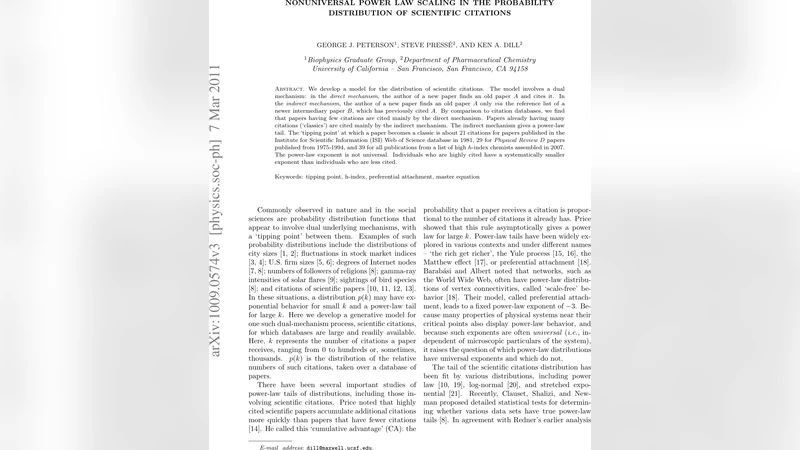
We develop a model for the distribution of scientific citations. The model involves a dual mechanism: in the direct mechanism, the author of a new paper finds an old paper A and cites it. In the indirect mechanism, the author of a new paper finds an old paper A only via the reference list of a newer intermediary paper B, which has previously cited A. By comparison to citation databases, we find that papers having few citations are cited mainly by the direct mechanism. Papers already having many citations (‘classics’) are cited mainly by the indirect mechanism. The indirect mechanism gives a power-law tail. The ’tipping point’ at which a paper becomes a classic is about 21 citations for papers published in the Institute for Scientific Information (ISI) Web of Science database in 1981, 29 for Physical Review D papers published from 1975-1994, and 39 for all publications from a list of high h-index chemists assembled in 2007. The power-law exponent is not universal. Individuals who are highly cited have a systematically smaller exponent than individuals who are less cited.
💡 Research Summary
The paper proposes a stochastic model for the distribution of scientific citations that explicitly incorporates two distinct citation mechanisms: a direct mechanism and an indirect mechanism. In the direct mechanism, a newly written paper discovers an older paper A through a search or personal knowledge and cites it directly. This process is assumed to occur with a constant baseline probability λ, independent of the current citation count of paper A. The indirect mechanism captures the situation where the author of a new paper first encounters a more recent intermediary paper B, reads its reference list, and thereby discovers paper A, which has already been cited by B. In this case the probability of citing A is proportional to its existing citation count k, reflecting a preferential‑attachment effect; mathematically the indirect probability is expressed as (1‑λ)·k/Σk, where Σk is the total number of citations in the system.
Combining the two pathways yields a growth equation for the citation count of any paper: dk/dt = λ + (1‑λ)·k/⟨k⟩, where ⟨k⟩ denotes the average citation count. Solving this equation shows that for small k the dynamics are dominated by the constant λ term, leading to an exponential‑like decay of the probability distribution. When k exceeds a certain threshold k_c, the preferential‑attachment term (1‑λ)·k becomes dominant, and the stationary distribution develops a power‑law tail P(k) ∝ k^‑γ. The exponent γ is directly linked to λ by γ = 1 + λ/(1‑λ), implying that the tail becomes heavier (smaller γ) as the indirect mechanism gains weight (λ decreases). Consequently, the model predicts a non‑universal power‑law exponent that varies with the relative importance of indirect citations.
To validate the model, the authors fit it to three empirical citation datasets: (1) all papers published in 1981 in the Institute for Scientific Information (ISI) Web of Science database, (2) papers from Physical Review D published between 1975 and 1994, and (3) the complete publication records of a set of high‑h‑index chemists compiled in 2007. For each dataset the fitting procedure yields a “tipping point” k_c—approximately 21 citations for the ISI 1981 set, 29 citations for the PRD set, and 39 citations for the chemist set—beyond which the indirect mechanism dominates and the power‑law tail emerges. The fitted λ values differ across datasets, leading to distinct γ values: papers with higher overall citation counts (i.e., “classics”) are associated with smaller λ and thus smaller γ, whereas less‑cited papers exhibit larger λ and steeper tails. Moreover, when the authors examine individual researchers, they find a systematic trend: highly cited scientists have γ values around 2.5, while less cited scientists display γ in the range 3.2–3.5. This demonstrates that the power‑law exponent is not universal but depends on the citation culture of the field, the time period, and even the personal citation network of the author.
The paper’s contributions are threefold. First, it offers a parsimonious yet mechanistically grounded explanation for why citation distributions display both an exponential‑like body and a power‑law tail, by attributing the former to direct citations and the latter to indirect, preferentially attached citations. Second, it introduces two interpretable parameters—λ (the weight of direct citations) and k_c (the classic‑transition point)—that can be empirically estimated for any citation corpus, enabling quantitative comparisons across disciplines, years, or individual scholars. Third, it provides robust empirical evidence that the power‑law exponent is non‑universal, challenging earlier claims of a single universal exponent for all scientific citation networks.
Nevertheless, the model has limitations. It treats indirect citation as a single‑step process, whereas real scholars often follow multi‑step reference chains. It also abstracts away factors such as paper quality, journal prestige, author reputation, and collaborative networks, all of which can influence citation probability. Future work could extend the framework by incorporating multi‑step indirect pathways, time‑varying λ, or additional covariates representing quality and prestige. Such extensions would allow a more nuanced understanding of how scientific influence propagates and evolves over time.
In summary, the study demonstrates that the observed citation distribution can be reproduced by a simple dual‑mechanism model in which low‑cited papers are primarily discovered directly, while highly cited “classic” papers become entrenched through indirect discovery via reference lists. The resulting non‑universal power‑law scaling, together with the empirically identified tipping points, provides a fresh theoretical lens for interpreting the dynamics of scientific impact and for comparing citation behaviors across fields and individual researchers.
Comments & Academic Discussion
Loading comments...
Leave a Comment